Walk through any modern building or production line and you pass hundreds of aluminum extrusions without noticing them: the mullions holding a glass facade, the frame around a machine guard, the finned block cooling a power module. Because the parts are so ordinary, the term gets used loosely. Buyers compare quotations for “extruded aluminum” without knowing what makes one profile stiffer than another, why one quote is double the other, or whether extruded aluminum is a different metal from the sheet already in their warehouse. The confusion is fair, because the word names a manufacturing route rather than a material grade.
An aluminum extrusion is a continuous length of aluminum pushed, while hot and softened, through a shaped steel die so that it leaves the press in the die’s exact cross section. The result is a profile with a constant section along its entire length, made in a single pass instead of being cast, cut, or machined into shape.
Getting from that definition to a specification a supplier can quote against takes an understanding of the tooling, the press cycle, and the alloys that follow it.
What Is an Aluminum Extrusion?
An aluminum extrusion is defined by three properties: a two dimensional cross section, an effectively unlimited length in the third dimension, and a die that costs a fraction of a mould or a set of stamping tools. The section is the design work; everything else is process control.
Because geometry is constrained in only two dimensions, complexity becomes almost free along the length. One profile can carry a cable channel, a mounting flange, a screw boss, and a glazing groove at once, where a machined equivalent would need several operations and would lose most of its material as chips. The trade-off is that the section cannot change along the run, so tapers and closed ends must be added afterwards.
Four elements make up every extrusion line, whatever its press size:
- Billet. A cast alloy log, cut to length and preheated to 400 to 500 degrees Celsius so it flows without melting.
- Die. An H13 tool steel disc machined with the inverse of the profile, then nitrided and preheated to 450 to 500 degrees Celsius. The bearing surfaces inside the aluminum extrusion dies control how fast metal leaves each part of the section, which governs straightness, surface quality, and dimensional consistency.
- Press. A hydraulic ram driving the billet through a heated container, from roughly 100 tonnes for small profiles to 15,000 tonnes for wide architectural sections.
- Handling line. The runout table, puller, quench, stretcher, and saw that catch the profile, cool it, straighten it, and cut it to length.

How Does Aluminum Extrusion Work?
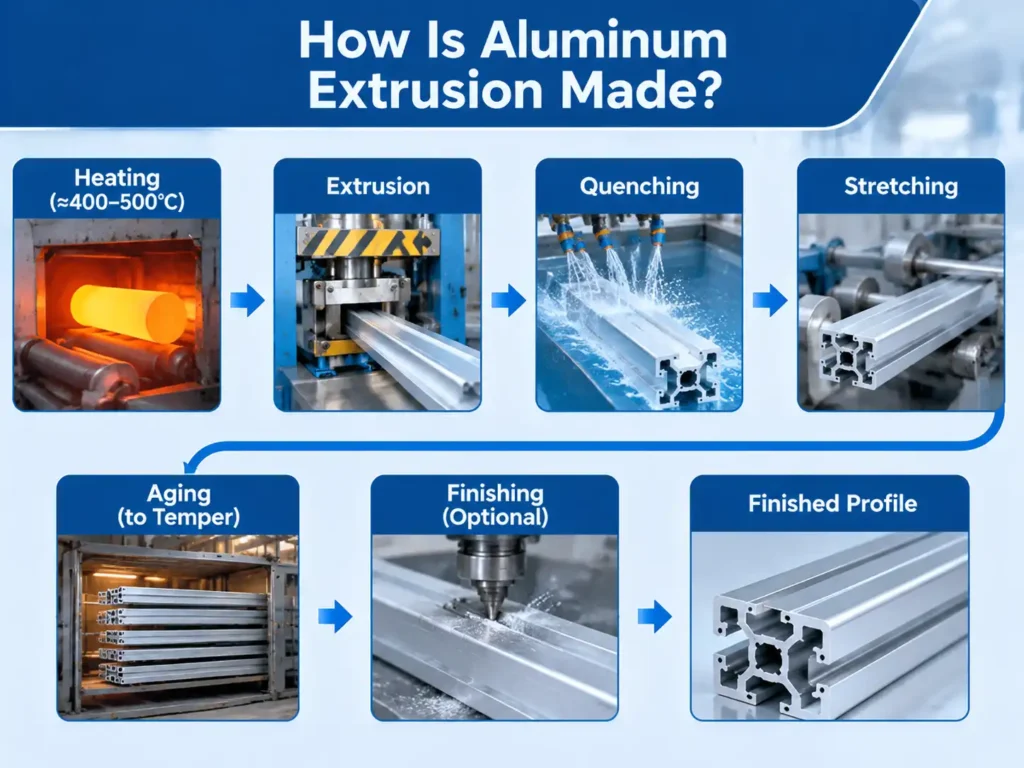
The cycle is short and repeatable: preheat the die, preheat a billet, push the billet through the die with a hydraulic ram, quench and straighten the emerging profile, cut it to length, then age it to the required temper. One billet clears the press in roughly one to three minutes.
From Billet to Finished Profile
- Die preparation. The die is cleaned and preheated to 450 to 500 degrees Celsius, since uneven die temperature produces uneven flow and later twist.
- Billet heating. The billet is cut from a longer log and heated to 400 to 500 degrees Celsius, matched to the alloy and wall thickness.
- Upsetting. The ram compresses the billet to fill the container wall completely, since trapped air becomes a defect in the finished profile.
- Extrusion. Metal flows through the die bearing and emerges at about 500 to 560 degrees Celsius. Ram speed is the main lever on finish: too fast and the surface tears, too slow and the profile runs cold.
- Quenching. A puller guides the profile along the runout table while water or air cools it, leaving the material in the T4 temper.
- Stretching. After shearing and cooling, the profile is stretched by one to three percent to remove quench twist and restore straightness.
- Sawing and ageing. Lengths are sawn to order and aged in an oven, where controlled heating brings the profile to T5 or T6.
Direct Versus Indirect Extrusion
| Feature | Direct extrusion | Indirect extrusion |
| Metal flow | Same direction as the ram | Opposite to the ram |
| Billet friction against container | High | Almost eliminated, the die moves with the billet |
| Ram force | Higher | Roughly 20 to 30 percent lower |
| Surface quality | Good | Better and more uniform |
| Butt scrap remaining | Larger | Smaller |
| Typical use | Most architectural and industrial profiles | Thin walled, tight tolerance, small sections |
The same profile can come from either route with different surface quality and a different scrap allowance, so it is worth asking which method a supplier intends to use when appearance matters. Ram speed, container temperature, and bearing geometry belong to the wider aluminum extrusion process, which is where most quality variation actually starts.
Extruded Aluminum Versus Regular Aluminum: What Is the Difference?
There is no separate metal called extruded aluminum. The aluminum is chemically the same; what differs is the forming route, the alloy, and the temper. A 6063-T5 extrusion and a 6063-T5 rolled sheet are the same alloy in the same condition, with different grain structures and different available shapes.
“Regular aluminum” usually means cast aluminum, rolled sheet and plate, or generic mill finished bar. None of those is a distinct material. Each is a route to a shape.
| Route | How the shape is made | Grain structure | Shape freedom | Tooling cost |
| Casting | Liquid metal poured into a mould | Coarse, randomly oriented | Full three dimensional freedom, ribs in any direction | High, slow to change |
| Extrusion | Solid billet pushed through a die | Elongated along the profile length | Constant section only, but the section can be intricate | Moderate, fast to change |
| Rolling | Metal passed between rolls | Elongated and flattened | Flat products with limited formed features | Very low per kilogram |
An extrusion has a pronounced longitudinal grain, so it bends predictably along its length but is weaker across it, which matters when a frame is loaded in torsion. A casting can carry ribs and bosses in every direction, so applying extrusion tolerances to a cast part is a common specification error. Strength itself is set by chemistry and heat treatment: 6063 in T5 reaches 160 to 175 MPa tensile strength, while the same alloy in T6 reaches roughly 200 to 240 MPa.
Solid, Hollow, and Semi-Hollow Profiles
Profiles fall into three families: solid, with no enclosed void; hollow, with one or more fully enclosed voids; and semi-hollow, with a void closed off by a gap narrower than the void itself. The family decides which die type is needed, and the die type is a significant step in cost and lead time.
The distinction is not cosmetic, because each family needs a different die:
| Category | Geometry rule | Examples | Die type | Relative tooling cost |
| Solid | No enclosed void | Rod, angle, channel, T-slot bar | Flat die | Lowest |
| Semi-hollow | A void whose opening is narrower than the void | C channel with inward lips, some window sections | Flat or semi-hollow die with a bridge | Moderate |
| Hollow | One or more fully enclosed voids | Tube, multi-port tube, thermal break sash | Porthole or bridge die with a mandrel | Highest |
Hollow dies cost more because the mandrel forming the internal void must be supported by a bridge, and the metal has to re-weld cleanly behind it, which is why a hollow section quoted from a plain outline drawing costs noticeably more than a solid section of similar size. The payoff is integration: a frame member can carry a mounting face, cable channel, screw boss, and cover groove in one profile, and that complexity is paid for once in the die rather than per metre.
Alloys and Tempers Used in Aluminum Extrusion
The 6xxx series dominates extrusion because magnesium and silicon produce a heat treatable alloy that flows well through a die, resists corrosion, and takes a uniform anodic finish. Within that family, 6063 covers appearance and moderate structure, 6061 and 6082 carry load bearing work, and 7075 is reserved for high stress niches where its cost and poor weldability are acceptable.
Typical room temperature values for the grades that cover most work:
| Alloy and temper | Tensile strength | Yield strength | Extrudability | Common use |
| 6063-T5 | 160 to 175 MPa | 110 to 130 MPa | Excellent | Window and door sections, trim, LED profiles |
| 6063-T6 | 200 to 240 MPa | 170 to 215 MPa | Excellent | Architectural sections needing more strength |
| 6005-T5 | 260 to 270 MPa | 240 MPa | Good | Ladders, rail car parts, structural tube |
| 6061-T6 | 310 MPa | 276 MPa | Fair | Machine frames, jigs, automotive brackets |
| 6082-T6 | 300 to 310 MPa | 255 to 260 MPa | Fair | Bridges, cranes, heavy structural profiles |
| 7075-T6 | 570 MPa | 505 MPa | Poor | Aerospace and high stress specialities |
Two habits cause most avoidable cost. Defaulting to 6061 or 6082 for a part that carries no real load, when 6063 would run faster and finish better, is one. Defaulting to 7075 for moderate duty work, which brings poor extrudability and a much higher metal price, is the other. Temper follows the same logic: T5 is cooled from the press and artificially aged, the economical choice for most architectural sections, while T6 adds a quench for higher strength at the cost of ductility, process time, and straightness in thin sections.
What Is Aluminum Extrusion Used For?
Aluminum extrusions are used wherever a long, constant section part must be light, stiff, corrosion resistant, and dimensionally repeatable. The largest volumes sit in building and construction, followed by transport, electrical and electronics, and industrial automation.
Demand concentrates in a handful of sectors:
| Sector | Typical components | Why extrusion suits it |
| Building and construction | Window and door frames, curtain wall mullions, handrails, louvers | Long runs, integrated glazing grooves, low tooling cost |
| Transport | Battery trays, roof rails, bumper beams, rail car bodies | Stiffness per kilogram, crash energy absorption, no painting required |
| Electrical and electronics | Heat sinks, LED housings, inverter enclosures, busbar | Conductivity near 200 W/mK with integral fins |
| Industrial automation | Machine frames, safety guarding, conveyor rails, robot mounts | Modular slot systems cut and reconfigured on site |
| Renewable energy | Solar mounting rails, clamp profiles, tracker components | Decades outdoors with minimal maintenance |
| Consumer and medical | Furniture frames, trolley structures, equipment housings | Cleanable surfaces, low unit cost at volume |
The Aluminum Extruders Council estimates that presses across North America produce roughly five billion pounds of extrusions a year, which shows how completely the process has displaced fabricated alternatives. Four properties drive that substitution: aluminum weighs about one third as much as steel, so a well-designed profile can match a steel section’s stiffness at a fraction of the mass; it forms its own oxide layer and survives outdoors without paint; it conducts heat well, making the profile a functional component rather than just a structure; and a die can be cut in weeks rather than the months a casting tool needs. A wider set of sector examples is collected under aluminum extrusion applications.
Why Is Aluminum Extrusion So Expensive?
Extrusion is expensive because the price is not one cost but four stacked together: the metal, usually half to two thirds of the bill; the press time consumed; the die and its amortisation; and the finishing and fabrication applied afterwards. Most of the price movement buyers notice comes from the metal market and from batch size, not from the extrusion step.
The four components break down roughly like this:
| Cost driver | Typical share | What moves it | How to reduce it |
| Metal | 50 to 65 percent | Aluminum index, alloying elements, conversion premium, scrap credit | Standard alloy, defined scrap return, larger volumes |
| Press time | 10 to 20 percent | Section complexity, wall thickness, ram speed | Simplify the section, stay within a common press size |
| Die and amortisation | 5 to 20 percent, higher on small lots | Solid versus hollow, die size, order quantity | Larger lots, an existing die, a standard profile |
| Finishing | 5 to 15 percent | Anodising class, coating system, colour | Mill finish on hidden faces, standard colours |
| Tolerance and inspection | 2 to 8 percent | Standard versus precision class, testing regime | Standard tolerances where function allows |
| Fabrication | Varies widely | CNC operations, punching, bending, tapping | Fewer setups, features formed by the die |
Amortisation explains most surprises. A die costing a few thousand dollars spread across a two tonne order adds a meaningful amount to every kilogram shipped, while the same die spread across twenty tonnes cuts that contribution by an order of magnitude, which is why one profile can be quoted at two very different prices by suppliers quoting different quantities. Wall thickness and tolerance behave the same way: thin walls and tight tolerances slow the press, raise scrap, and shorten die life, so price climbs faster than weight falls. The full arithmetic, including how conversion cost is separated from metal cost, is set out in this guide to aluminum extrusion cost.
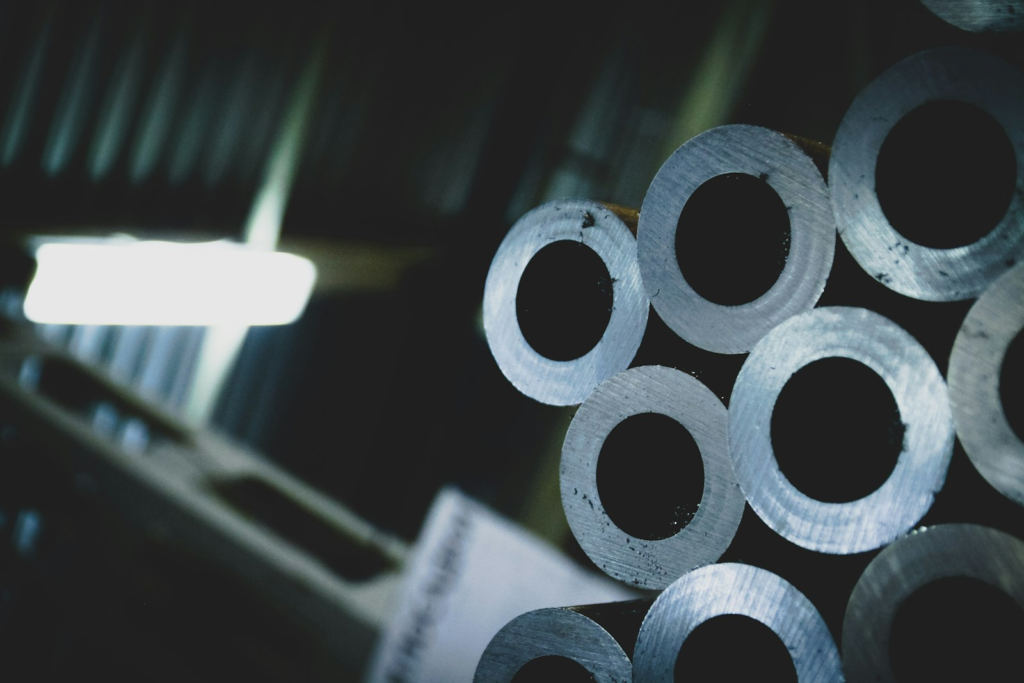
Design, Tolerance, and Finishing Considerations
Most extrusion problems are designed in rather than manufactured in. Uniform wall thickness, generous radii, balanced sections, and realistic tolerances decide whether a profile runs smoothly at a competitive price or fights the die on every billet.
- Keep walls uniform. A section jumping from 4 mm to 1.2 mm in one step forces the die designer to starve one area of flow, producing distortion.
- Respect minimum wall thickness. Roughly 1.0 to 1.5 mm is achievable on small 6xxx profiles, with heavier walls as the circumscribing circle grows.
- Balance the section. Symmetrical mass distribution quenches and stretches more evenly, holding straightness without extra straightening.
- Watch the tongue ratio. Deep projections unsupported on three sides are hard to fill and are the usual cause of a die needing repeated correction.
Dimensional tolerances are governed by standards such as EN 755-9 in Europe and ASTM B221 in North America, and both scale the permitted deviation with nominal dimension and wall thickness. Standard classes suit most frames and housings, while precision classes cost more because they require slower running and tighter die control. Finishing is the last cost decision: anodising builds an integral oxide layer of 10 to 25 micrometres with colour and wear resistance, powder coating adds a 40 to 120 micrometre opaque layer, and liquid or PVDF systems cost more but hold colour on demanding facades.
Sustainability and Recyclability
Aluminum is one of the few structural materials that can be recycled indefinitely without losing properties, and extrusion is unusually circular because process scrap returns directly to the billet supplier and is remelted into new logs of the same alloy.
Recycling aluminum takes roughly 5 percent of the energy needed to produce primary metal from bauxite, according to the International Aluminium Institute, which is why secondary metal carries such a different carbon profile. In North American extrusion, recycled material has accounted for more than half of raw material input, with industry life cycle data putting scrap at around 54 percent of feedstock. Process scrap is also easy to recover, because it arises in a known alloy and condition, so for buyers with carbon reporting obligations the practical levers are recycled content in the billet, the smelter’s energy mix, and a simpler finish.
How to Specify and Source Aluminum Extrusions
A supplier can only quote accurately against a complete specification: a dimensioned cross section with tolerances, the alloy and temper, the finish standard, the order quantity, and the acceptance criteria. Anything missing becomes an assumption in the quotation and a dispute at delivery.
- A dimensioned cross section with wall thicknesses, radii, and the circumscribing circle diameter noted.
- Alloy and temper, with any property that must be verified by test certificate.
- Tolerance class, referencing the applicable standard rather than describing it in words.
- Length and cut tolerance, including whether ends must be square or deburred.
- Finish specification, naming the process, thickness class, colour, and cosmetic faces.
- Quantity and delivery pattern, since die amortisation and press scheduling both depend on it.
Tooling ownership should be agreed in writing before the first order, because a die paid for by the buyer is normally the buyer’s property. A first article inspection should also be built into the schedule, since correcting a die before production is far cheaper than sorting parts afterwards.
FAQ
The questions that arrive after a profile has been specified tend to cluster around three things: what can still be done to the metal after it leaves the press, how large a section a press can physically produce, and how long the tooling survives.
Can aluminum extrusions be bent or curved after extrusion?
Yes. Stretch bending and roll bending both form curves and arches from straight profiles. The limit is the minimum bend radius, which depends on wall thickness, section shape, and temper. Material in the T4 condition bends more easily than fully aged T5 or T6, so some programmes bend first and age afterwards.
What is the largest cross section that can be extruded?
The limit is the press container diameter and available tonnage, since the profile must fit inside the container’s circumscribing circle. Common presses handle circles of roughly 250 to 300 mm, larger presses reach 400 mm and beyond. A hollow section of the same circle needs more force and a more complex die, so its practical maximum is smaller than for a solid profile.
How long does an extrusion die last?
Die life is measured in tonnes rather than time. A well maintained H13 die running a simple 6063 solid section can produce several hundred tonnes before refurbishment, while a hollow die with thin mandrels running a harder alloy may need attention after a small fraction of that. Most dies can be reworked and nitrided more than once.