Industrial buyers rarely struggle to find T-slot aluminum extrusion for sale; they struggle to buy the right one at a defensible price. A guard frame or a test fixture usually begins as an order of a few lengths, and that first order decides whether the project runs on schedule or stalls while somebody re-cuts profiles that will not accept the fasteners already in the store. Because “8020” has become shorthand for a whole family of framing profiles, one search returns hardware listings, regional distributors, and mills quoting numbers that differ by a factor of three.
You can buy 8020 aluminum extrusion from five types of sources: authorized system distributors, industrial catalog distributors, online marketplaces, local metal service centers, and extrusion mills that produce the profiles. For most industrial buyers the practical answer is a local distributor for standard stock lengths and a mill for repeat volume, while marketplaces make sense only for prototypes, repairs, and small orders where convenience outweighs traceability.
The sections below compare those channels on price, lead time, and technical risk, then set out how to verify compatibility before money changes hands.
What Does “8020 Aluminum Extrusion” Actually Mean?
It refers to a modular T-slot framing system built from extruded aluminum profiles, usually in 6105-T5 alloy, with T-shaped channels running along one or more faces so that T-nuts and brackets can be positioned anywhere along the bar. The term describes a category, not a single standardized product, which is why two suppliers can both quote “8020 extrusion” and still ship profiles that will not assemble together.
A T-nut drops into the channel, a bolt passes through a bracket, and the joint locks wherever the designer needs it. Nothing is welded and nothing is drilled in place, so a frame can be extended or reconfigured without scrapping material. The name derives from the 80/20 principle and has since become generic, in the way a category leader’s name often replaces the category itself in procurement language.
A Category Term, Not a Published Standard
No published standard defines this system. Manufacturers converged on a set of conventional sizes instead, and that convention is what lets profiles from different producers work together. It is convenient, and it is also the origin of most procurement failures, because conventional sizing fixes the nominal cross section and the general slot shape, not the details that decide whether a joint is rigid. Slot width, wall thickness, core hole diameter, and T-nut engagement depth can all differ between producers who both call their product a 40 series profile.
The definition and series structure are documented in the reference entry on T-slot structural framing, which confirms both the alloy normally used and the absence of an enforced standard. For a buyer, “same series” is a starting point for compatibility, never a guarantee.
Fractional and Metric Series
Two unit systems coexist, and confusing them is the most common specification error on a first purchase order.
| Series | Nominal cross section | Unit system |
| 10 series | 1 in by 1 in | Fractional |
| 15 series | 1.5 in by 1.5 in | Fractional |
| 25 series | 2.5 in by 2.5 in | Fractional |
| 20 series | 20 mm by 20 mm | Metric |
| 30 series | 30 mm by 30 mm | Metric |
| 40 series | 40 mm by 40 mm | Metric |
| 45 series | 45 mm by 45 mm | Metric |
One inch is 25.4 mm, close enough to 25 mm to look interchangeable on a drawing and far enough apart to bind once a T-nut is tightened, so cross-region teams should fix the unit system in the drawing title block before requesting quotations. Rectangular versions measure twice the base width, from 20 by 40 mm up. A V-slot variant exists for V-groove wheels in linear motion, and it is not interchangeable with T-slot for structural joints.

Where to Buy 8020 Aluminum Extrusion: Five Channels Compared
The five channels that genuinely stock or produce 8020 aluminum extrusion are authorized system distributors, industrial catalog distributors, online marketplaces, local metal service centers, and extrusion mills. Each wins on a different mix of unit price, minimum order, lead time, and technical support, so the right choice depends on whether you are buying one frame or building a product line.
Buyers searching for aluminium extrusion, the British spelling, are looking at the same supply base. Splitting a purchase is often most economical: standard stock from a channel that ships this week, repeat volume on a separate agreement. Existing notes on where to buy extruded aluminum cover the same trade off from another angle.
Authorized Distributors
Distributors hold stock across the full series range, cut to length, and support the accessory catalog that makes the system work. Their advantage is not the profile but the service layer around it: mature networks grade distributors by capability, from project support and on-site demonstration down to design assistance and general technical backup. On a first frame that support often pays for the premium, because one wrong bracket found after delivery costs more than the difference per foot. The trade off is price and regional coverage.
Industrial Catalog Distributors
Catalog distributors publish per inch or per millimeter pricing, allow any cut length, and ship small quantities with no meaningful minimum. They are the fastest route for a repair, a fixture, or a one-off prototype, and their published drawings and CAD files cut design risk. Per foot pricing sits above a distributor’s project pricing, and stock depth on heavy sections is limited.
Online Marketplaces and Retail Listings
Marketplaces are where most small buyers settle the question of where to find aluminum extrusions for sale. Fixed-length multipacks in 20 series and 10 series are cheap, ship fast, and suit jigs, enclosures, and printer frames. The risk profile differs from every other channel: alloy and temper are often unstated, wall thickness falls below the nominal drawing on some listings, slot tolerance is undocumented, and anodized batches vary in color between orders. Fine for a light-duty build, not for an inspected load-bearing frame.
Local Metal Service Centers
A service center carrying aluminum extrusions can cut to size, sell remnants, and let you inspect stock before paying. Collection removes freight from the landed cost, which matters once lengths pass parcel limits. The limitation is range: a general metal stockholder may carry T-slot in a few sizes only, and counter staff may not confirm slot geometry or accessory fit.
Direct From Extrusion Mills
Mills quote on weight rather than length and become the right channel once demand is predictable. The Aluminum Extruders Council, the industry association for the sector, publishes an annual buyer’s guide and a searchable directory of member extruders, a practical starting point for shortlisting mills by region and capability. Going direct adds two costs that stock channels hide: a minimum order in kilograms per shape, and a die charge when the profile is not already in the mill catalog. In exchange, unit cost falls, tolerances are agreed in writing, and the mill certificate travels with the delivery.
| Channel | Unit price | Minimum order | Lead time | Cutting | Compatibility risk |
| Authorized distributor | High | Very low | Days | Accurate | Low |
| Catalog distributor | High | Very low | Days | Accurate | Low |
| Online marketplace | Low | None | Days | Fixed lengths | High |
| Metal service center | Medium | Low to medium | Days | Coarser | Medium |
| Extrusion mill | Lowest | High, by weight | Weeks | Limited | Low, if specified |
What Should You Expect to Pay per Foot?
Expect roughly USD 4 to 8 per foot for 20 mm and 1 inch profiles, USD 11 to 18 per foot for 40 mm and 1.5 inch profiles, and USD 25 to 45 or more for 2.5 inch heavy sections in small quantities. Finish, cut length, order size, and freight move landed cost by 20 to 50 percent either way, so a quote missing those terms cannot be compared with another.
Pricing tracks cross-sectional mass, and the relationship is close to linear once alloy and finish are fixed. Alloy adds a secondary effect: 6063 and 6105 grades used for framing extrude at similar cost, while harder alloys or tighter temper requirements shrink the list of mills willing to quote. Finish is the third lever, from mill finish through clear anodizing to color anodizing or powder coating.
Price Benchmarks by Series
| Profile | Per foot, mill finish | Per foot, anodized |
| 20 series, 20 by 20 mm | 4.00 to 6.50 | 5.50 to 8.50 |
| 10 series, 1 by 1 in | 5.50 to 8.00 | 7.00 to 10.00 |
| 40 series, 40 by 40 mm | 11.00 to 17.00 | 13.00 to 20.00 |
| 15 series, 1.5 by 1.5 in | 12.00 to 18.00 | 14.00 to 21.00 |
| 25 series, 2.5 by 2.5 in | 25.00 to 45.00 | 28.00 and above |
Ranges rather than single figures are the honest answer, because extruded aluminum is a commodity and quotes trail the metal price by weeks. A fuller breakdown of the drivers sits in this guide to aluminum extrusion cost, including how quantity bands shift the number.
The Costs That Are Not on the Price Tag
Material is frequently less than half of the invoice.
| Cost item | Typical magnitude | Comment |
| Fasteners, brackets, T-nuts | 30 to 100 percent of material | Underestimated on first projects |
| Cutting charge | Per cut or per length | Adds up fast on many short parts |
| Drilling, tapping, milling | Per hole or operation | Cheap at the mill, costly after delivery |
| Anodizing, powder coating | 10 to 50 percent premium | Coating build-up tightens slots |
| Freight | LTL class plus length surcharge | Charged by dimension, not weight |
| Packaging | Crating or strapping | Prevents bending and edge damage |
Where Can You Buy Aluminum Extrusion Cheaply Without Cutting Corners?
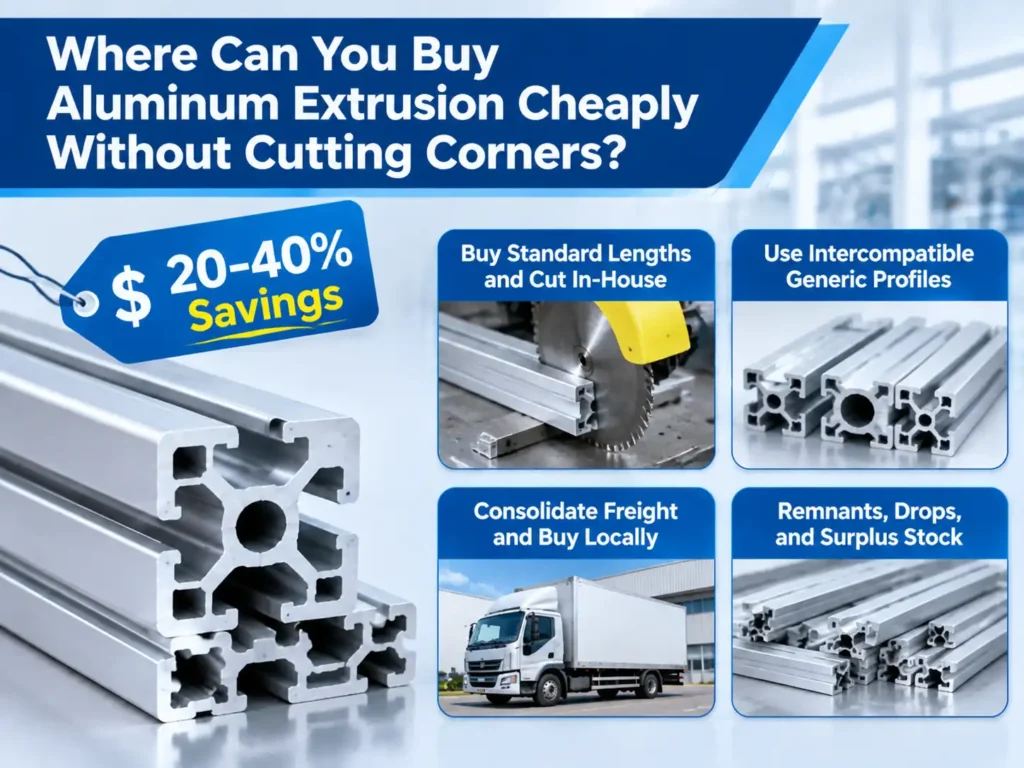
The reliable way to buy 8020 aluminum extrusion cheaply is to attack cutting, freight, and intermediation rather than to buy thinner profiles. Standard stock lengths cut in house, intercompatible generic profiles, consolidated freight or local collection, and surplus stock typically cut landed cost by 20 to 40 percent without touching the alloy or the wall thickness.
Downgrading the section is a false economy: a lighter wall deflects further, needs more supports, and eats the saving in brackets and assembly time. The four tactics below keep the mechanical properties intact.
Buy Standard Lengths and Cut In-House
Suppliers charge per cut, and ten cut charges can exceed the material cost of one standard length. Ordering full 8 foot, 10 foot, or 3 meter lengths and cutting on a chop saw with a non-ferrous blade moves cost into your own labor, where it is usually cheaper and always faster. The exception is a profile needing a machined end, where factory cutting and deburring earn their price.
Use Intercompatible Generic Profiles
Profiles in the same series from different producers are generally interchangeable at the joint, provided slot width and T-nut engagement match. Generic profiles cost less than system-branded equivalents because you are not funding the accessory ecosystem. Check slot width with a caliper against the T-nut drawing, and get the wall thickness tolerance in writing before committing to a whole frame.
Consolidate Freight and Buy Locally
Carriers apply length surcharges once a piece passes about 8 feet, so splitting an order into two shipments can cost more than the material saved. One delivery, a supplier within driving distance, or collection in person removes that line entirely. On larger projects, asking for a delivered price instead of an ex works price closes the gap between quotes that look different but are not.
Remnants, Drops, and Surplus Stock
Service centers sell offcuts and project surplus at a discount, and mills dispose of overruns. These suit brackets, jigs, guarding posts, and prototypes where length tolerance is loose, though straightness and finish batch need checking since remnants are the ends of longer runs. More tactics, including how to spot a low quote built on a substituted wall thickness, are in this guide on how to buy aluminum extrusion cheaply.
How to Verify Compatibility Before You Place an Order
Verify three things before ordering: slot width and T-nut geometry, profile tolerance and straightness, and alloy and temper on the mill certificate. Those three mismatches account for most re-orders and field failures reported by buyers moving between suppliers.
Ask for the items below with the quotation, not after it. A supplier who cannot produce a dimensioned drawing is telling you something about the process control behind the product.
| Check | What to request | Accept criteria |
| Slot width | Drawing with tolerance | Nut seats without rocking |
| Wall thickness | Nominal plus tolerance band | Within load assumptions |
| Straightness | Twist and bow per length | Meets frame squareness |
| Core hole | Diameter and tap size | Takes the intended fastener |
| Alloy and temper | Mill certificate per heat | 6063-T5 or 6105-T5 as specified |
| Finish | Thickness and color reference | Slot clearance preserved |
When Stock Profiles Are Not Enough
Stock extrusion stops being the economical choice when a design needs a non-standard slot position, an integrated mounting feature, a specific wall thickness, or a section nobody stocks. At that point a custom die wins once annual volume passes roughly 1,000 to 2,000 feet, because tooling cost is amortized across the run.
Die Cost, MOQ, and Lead Time
Tooling for a solid shape costs less than for a hollow one, and both are modest against tooling for most other processes. A workable assumption is a few thousand dollars for a hollow profile on a mid-sized press, with two to three weeks of tooling lead time before the first billet runs. Minimums are usually set in kilograms per shape, which is why the break-even matters more than the headline die price: divide die cost by the per foot saving against a stock profile to find the volume where custom wins, and the answer is often lower than buyers expect once machining and assembly time enter the comparison.
A tooling supplier evaluating custom aluminum extrusion dies needs the full specification before quoting, since die design, bearing length, and support tooling all follow from the section geometry. Bring a dimensioned drawing with tolerances, alloy and temper, finish, cut lengths, secondary machining, monthly and annual volume, and packaging and delivery terms. Disclosing annual volume early is not a negotiating weakness; it is what lets the die and run length be designed around your cost target instead of a single trial order.
What to Include in a Request for Quotation
A complete request for quotation lists the series and cross section, exact lengths and quantities, alloy and temper, tolerance class, cutting and machining requirements, surface finish, packaging, delivery terms, and destination. Missing one of these turns a firm price into a range that cannot be compared with a competing quote.
- Series and nominal cross section, with a drawing or the supplier’s part reference.
- Exact cut lengths, quantities of each, and whether short lengths are acceptable.
- Alloy and temper, stated explicitly rather than left to the supplier’s default.
- Tolerance class, particularly slot width and straightness.
- Cutting, deburring, drilling, tapping, and counterboring, with hole positions.
- Surface finish and color reference.
- Packaging, including bundle protection for long lengths.
- Delivery terms and destination, so freight is quoted on one basis.
- Required date, and whether partial shipments are acceptable.
Frequently Asked Questions
These three cover what buyers ask after the quotation stage: stock lengths, finishing after purchase, and shipping of long bundles.
What lengths does 8020 aluminum extrusion come in?
Commonly 8, 10, and 12 feet in fractional series and 2 or 3 meters in metric, with some suppliers offering 6 meter lengths. Most distributors cut to order for a per-cut charge, but pieces longer than about 8 feet move as freight rather than parcel, which changes both cost and lead time.
Can 8020 aluminum extrusion be anodized or powder coated after purchase?
Yes, but coating adds thickness everywhere, including inside the slot. A build-up of 60 to 100 micrometers per face can stop a T-nut seating, so masking or post-coating reaming may be needed. If finish matters to the assembly, order it from the mill and specify slot clearance after coating.
How is 8020 aluminum extrusion shipped, and can long lengths be delivered?
Short lengths ship as parcel or in reinforced cartons. Longer bundles move as less-than-truckload freight, priced partly on length with a surcharge above 8 feet. Crating or strapping is worth requesting, since one bent profile usually spoils the bundle for a precision frame. Local collection avoids the surcharge and the handling risk.