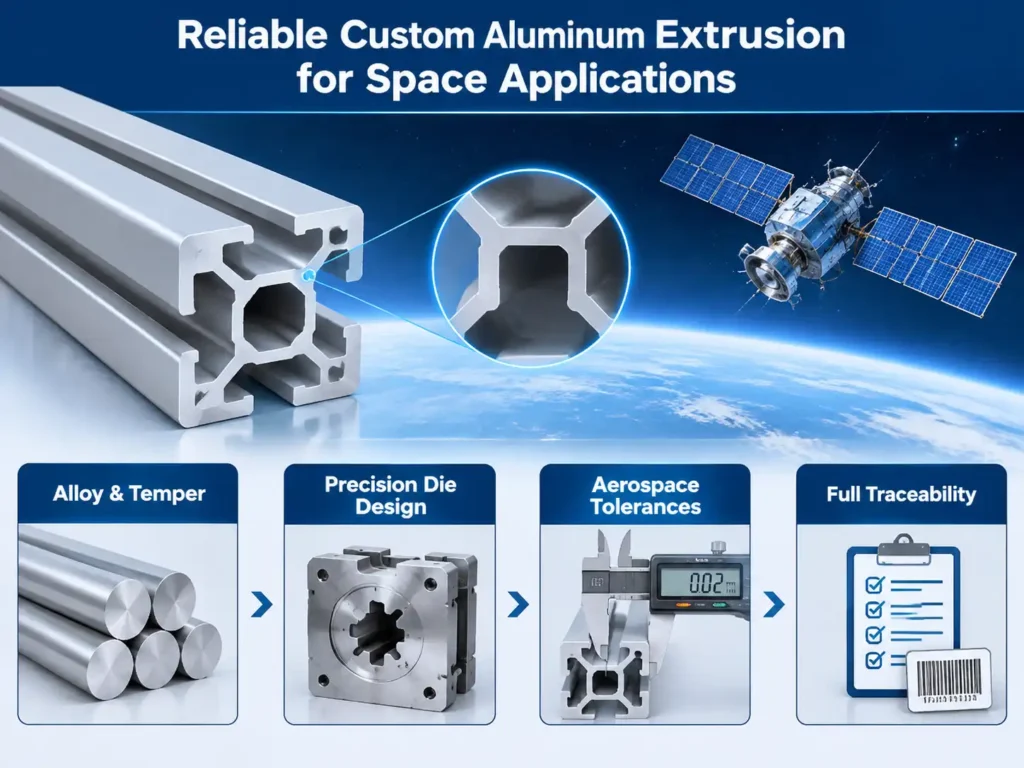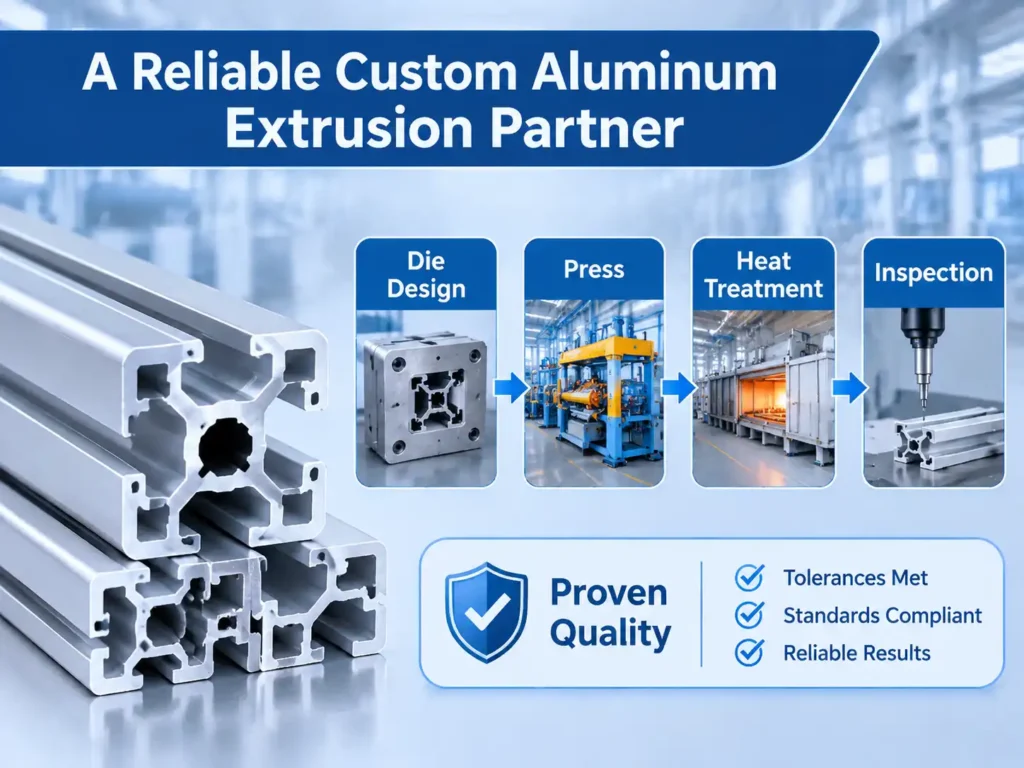
Aluminum extrusion sits behind a large share of the metal parts in daily life, from window mullions and heat sinks to machine frames and battery housings. Buyers often specify a profile long before they understand what happens between the drawing and the delivered length of metal. That gap creates predictable problems: tolerances get requested that no die can hold, alloys get chosen on price alone, and delivery dates get promised against a process nobody in the room has seen.
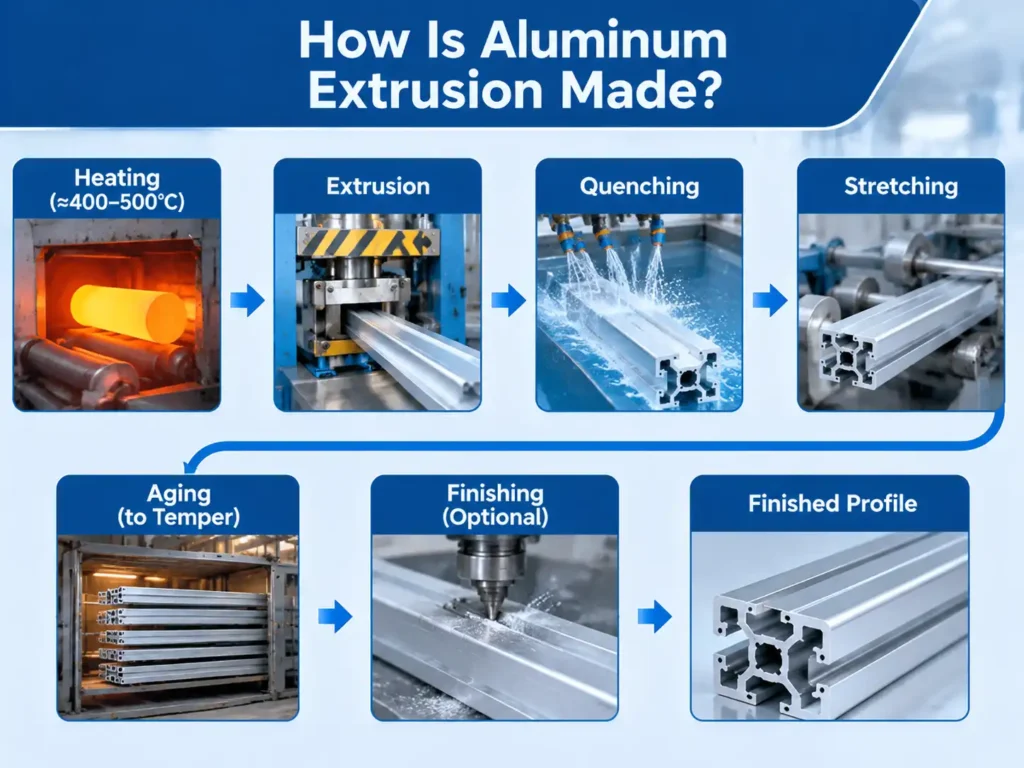
Aluminum extrusion is made by heating a cylindrical alloy billet to roughly 400 to 500 degrees Celsius, loading it into a hydraulic press, and forcing it through a hardened steel die whose opening matches the required cross-section. The metal that emerges is quenched, stretched, cut to length, aged to a temper, and then finished or machined. The die determines what shape is possible; the billet determines how strong the result can be.
What follows is that sequence in order, beginning with what the process actually produces.
What Is Aluminum Extrusion and What Does It Produce?
Aluminum extrusion is a forming process that pushes softened aluminum through a shaped orifice to create a long part with a constant cross-section. No liquid metal is poured, and the profile keeps the same geometry along its entire length. The output is called a profile or an extrusion, and it is later cut, machined, finished, and assembled.
The usual comparison is squeezing toothpaste from a tube. The opening sets the shape, the pressure sets the rate, and what comes out is a continuous length with a fixed section. Replace the tube with a hydraulic press and the toothpaste with a preheated billet, and the principle barely changes.
The commercial value lies in that constant section. A screw channel, a stiffening rib, a gasket groove, or a snap fit that replaces a bracket can all be formed in the same pass as the outer shape, and each feature built into the profile removes a machining or assembly step downstream. The profile is only as good as the tool that shapes it, which is why aluminum extrusion dies sit at the center of the process rather than at its edge.
Solid, Hollow, and Semi-Hollow Profiles
Every extrusion belongs to one of three families, and the family decides the die, the cost, and the achievable tolerance.
| Profile family | Cross-section | Die type | Typical products |
| Solid | No enclosed void | Flat die | Angles, channels, rods, T-sections, trim |
| Semi-hollow | A void partly enclosed by a narrow gap | Semi-hollow die with a rigid tongue | C-channels, slot rails, hinge profiles |
| Hollow | One or more fully enclosed voids | Porthole or bridge die with a mandrel | Tubes, boxes, window frames, heat sinks |
Hollow sections cost most, because the die must hold a mandrel in the middle of the metal flow while the streams around it rejoin cleanly before they exit. Semi-hollow shapes sit in an awkward middle ground where a thin steel tongue resists the full extrusion pressure.
What Material Is Aluminum Extrusion Made Of?
Extruded aluminum is made from aluminum alloy billets, most often from the 6xxx series, which combines aluminum with magnesium and silicon. The common grades are 6063 for architectural and general profiles, 6060 where anodizing consistency matters, 6061 where strength and machining are priorities, and 6082 for structural members. Pure aluminum is rarely extruded structurally because it lacks the strength that precipitation hardening delivers.
The billet is a solid cylinder, usually 100 to 300 millimeters in diameter, cut from a longer cast log. It is not simply melted aluminum: the alloy is degassed, filtered, cast semi-continuously, then homogenized for several hours so magnesium and silicon distribute evenly and form a fine strengthening phase instead of coarse bands that would streak the finished surface. The outer skin is scalped away before the press because it carries oxide and segregation from casting.
Why 6xxx Alloys Dominate Extrusion
The 6xxx group is the most widely extruded alloy family because it is the easiest to push through complex, thin-walled dies at speed while still responding to heat treatment afterward.
| Alloy | Relative extrudability | Strength after aging | Surface and finishing | Common use |
| 6063 | Excellent | Moderate at T5 or T6 | Very good anodizing response | Window frames, heat sinks, trim, machine guards |
| 6060 | Excellent | Slightly below 6063 | Best anodizing uniformity | Precision architectural profiles |
| 6061 | Good | High at T6 | Good, harder to polish | Structural brackets, frames under load |
| 6082 | Moderate | High at T6 | Fair | Bridges, rail, heavy structural members |
| 7075 | Poor | Very high | Poor anodizing response | Aerospace, rarely extruded as complex profiles |
Higher alloy content raises achievable strength and lowers extrudability at the same time. A designer who needs a 0.8 millimeter wall in a complex hollow section is effectively choosing 6xxx whether or not that was the intention, because harder alloys will not fill the die at that thickness without tearing.
From Liquid Metal to Billet
Alloying elements are added to molten aluminum near 720 to 750 degrees Celsius, the melt is degassed and filtered, and the metal is cast into a log through a water-cooled mold. The log is homogenized, cooled, scalped, and sawn to the length the press container accepts. Each billet carries a heat number that traces the finished profile back to its chemical analysis.
How the Extrusion Die Is Designed and Made
An extrusion die is a disc of hot-work tool steel, normally H13, machined with an opening that matches the profile cross-section. It is roughed on a CNC lathe, cut on a machining center, finished on wire EDM, polished by hand in the flow areas, and nitrided to resist wear. A simple solid die is ready in a few weeks; a complex hollow die takes longer and costs several times as much.
Die design is where most of the process knowledge actually lives. The die must survive enormous pressure at high temperature while holding dimensions to fractions of a millimeter, cycle after cycle. Thickness is a compromise, since a thicker die adds friction that demands a larger press and accelerates wear, so makers concentrate on flow geometry rather than on the exit shape alone.
Flat Dies and Porthole Dies
A flat die carries a single aperture and handles solid and semi-hollow sections. It is comparatively simple, cheap to make, and easy to correct during trial runs.
A porthole or bridge die handles hollow sections. The billet splits into streams that pass around the bridge legs, then recombine in a welding chamber just before the bearing. The metal that rejoins forms a longitudinal weld seam whose quality depends on pressure, temperature, and residence time. A well controlled seam reaches a large fraction of parent metal strength; a poor one becomes the weakest path in the profile and the first place a fatigue crack starts. Producing reliable hollow extrusion dies means controlling chamber volume and port geometry as carefully as the final aperture.
Bearing Length and Metal Flow Balance
The bearing, or die land, is the short parallel section at the exit where the profile takes its final dimensions. It behaves like a throttle: metal moving through a longer bearing meets more friction and slows down. Makers exploit this deliberately, giving thick sections shorter bearings so they flow faster and thin sections longer bearings so they do not outrun the rest.
When the balance is wrong, one side exits faster than the other and the result is twist, bow, wave, or a wall that drifts thin. Correcting it afterward is expensive, which is why modern die design relies on flow simulation before steel is cut.
Design Limits: Tongue Ratio, Wall Thickness, Symmetry
Three geometric rules govern what a die can realistically produce, and the Aluminum Extruders Council publishes them as guidance rather than as absolute limits. Tongue ratio describes how far a void extends behind a narrow opening, and a deep pocket behind a thin gap puts a slender steel tongue under full extrusion load. Walls should stay as uniform as function allows, since thick to thin transitions distort and very thin walls are costlier to extrude. Symmetry keeps flow balanced, and generous corner radii protect the die.
Step-by-Step: How Aluminum Extrusion Is Made
Production follows a fixed sequence: billet preheat, die preheat, loading and upsetting, extrusion, quenching on the runout table, shearing, cooling, stretching, and cutting to order length. Every stage has a controlled temperature or speed, and drifting outside those windows shows up later as surface defects, dimensional drift, or properties that fail specification.
- Billet preheating. The billet reaches 400 to 500 degrees Celsius. It becomes plastic but never melts. Many presses apply a gradient so the leading end runs hotter and offsets the heat generated by deformation.
- Die preheating. The die set and container are held at 450 to 500 degrees Celsius for two to six hours. A cold die shocks the steel and chills the first metal through it.
- Loading and upsetting. The ram upsets the billet against the die face, purging surface oxide and preventing backflow.
- Extrusion. Press capacity runs from a few hundred tons on small lines to well over 10,000 tons for wide profiles, and architectural 6063 exits at roughly 10 to 30 meters per minute.
- Quenching. Water spray, mist, or forced air cools the profile at once, setting the metallurgy and stopping the still-soft section from sagging.
- Shearing. A hot saw separates the run at table length, usually 8 to 21 meters.
- Cooling. Sections equalize to room temperature on a cooling bed.
- Stretching. Each profile is pulled to 0.2 to 1.0 percent permanent elongation, removing twist and bow and relieving residual stress.
- Cutting. A finish saw cuts to ordered length before aging or finishing.
| Parameter | Typical range | What it controls |
| Billet temperature | 400 to 520 degrees Celsius | Fluidity and surface quality |
| Die temperature | 450 to 500 degrees Celsius | Flow uniformity and die life |
| Container temperature | 380 to 450 degrees Celsius | Friction and heat loss |
| Exit temperature | 500 to 560 degrees Celsius | Solution treatment and seam integrity |
| Exit speed, 6063 | 10 to 30 meters per minute | Surface finish and throughput |
| Stretch ratio | 0.2 to 1.0 percent | Straightness and residual stress |
Because this happens hot and fast, extrusion tolerances are inherently looser than machining tolerances, which is where most cost disagreements begin. The drawing should name a tolerance class rather than a wish.
Direct vs Indirect Extrusion
There are two ways to arrange the push, and the difference shows up in friction and energy.
| Feature | Direct extrusion | Indirect extrusion |
| Billet movement | Billet moves, die is stationary | Die moves through a stationary billet |
| Container friction | High, metal slides against the wall | Low, no relative motion |
| Force required | Higher for the same section | Roughly 20 to 30 percent lower |
| Typical use | Most architectural and industrial profiles | High-strength alloys and specialty sections |
Direct extrusion accounts for the overwhelming majority of tonnage because tooling is simpler and billets feed continuously. Indirect extrusion reduces friction and gives a more uniform structure, but added mechanical complexity limits where it pays.
Heat Treatment and Temper: From T4 to T6
After extrusion, heat-treatable alloys are aged to reach their specified temper. The profile leaves the press solution-treated but unstable, and controlled aging precipitates the strengthening phase that gives the alloy its final properties. T5 covers profiles air cooled on the runout table and then aged; T6 requires a faster quench before aging and delivers higher strength at the cost of more distortion risk.
The effect is large. Untreated 6061 in T4 has a tensile strength near 241 MPa, and the same alloy at T6 reaches roughly 310 MPa, close to a 30 percent gain with no change in geometry. A drawing that names 6061 without a temper is an incomplete specification.
| Temper | Cooling after press | Aging | Strength | Typical use |
| T4 | Air or spray, natural aging | None, or natural | Moderate | Parts bent or formed after extrusion |
| T5 | Air quench on runout table | Artificial, 175 to 185 degrees Celsius for 6 to 8 hours | Good | Architectural profiles, heat sinks, industrial |
| T6 | Water or mist quench | Artificial, same window | Highest for the alloy | Structural and load-bearing parts |
T5 is the practical default for architectural work because air quenching keeps distortion low. T6 buys strength and gives up straightness, so it belongs on parts where the load actually requires it.
Finishing and Fabrication After Extrusion
Extruded profiles are finished to protect the surface and fabricated to reach final dimensions. Anodizing grows a controlled oxide layer, powder coating applies a cured polymer film, and cutting, drilling, milling, and punching bring the profile to an assembly-ready state. Sequence matters, because finishing comes after fabrication: machining a coated surface exposes bare metal and creates a corrosion site.
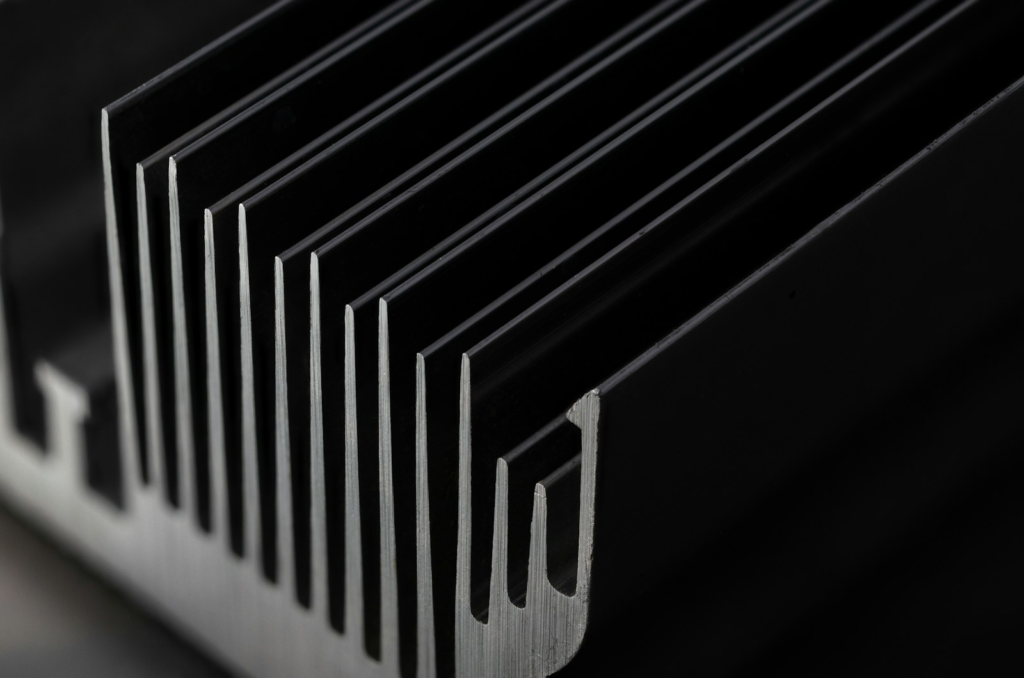
Anodizing builds a film of 10 to 25 micrometers whose porous structure accepts dye before sealing. Powder coating applies 60 to 120 micrometers of polymer cured in an oven, giving better outdoor color retention but hiding the metallic surface. Fabrication comes after: a heat sink may leave the press with straight fins and later have them cross-cut into a pin array for airflow. Designing those operations into the profile, where the die allows it, is almost always cheaper.
Why Is Extruded Aluminum So Expensive?
Extruded aluminum is expensive because four costs stack on top of each other: the metal, the die and tooling, the press time consumed per kilogram, and any finishing or machining added afterward. No single item dominates universally. On a small first order the die can be the largest line on the quote; on a large repeat order the metal price and conversion charge set the floor.
Understanding aluminum extrusion pricing starts with separating one-time costs from per-unit costs, because the two move in opposite directions as volume grows. Confusing them is the most common reason buyers misjudge a quote.
Tooling and Die Cost
A die is a one-time investment amortized across the run. Large hollow dies with multiple cavities cost many times more than simple solid dies because they need more steel, more machining hours, and more trial iterations. On a small order, die cost can exceed the value of the metal.
Metal Input Cost
Billet is priced against an exchange reference plus a conversion and alloying premium, so the metal component tracks the market rather than the extruder’s costs.
Press Time and Yield Loss
A press earns money only while running, so time is billed. Thin walls force slower speeds, new dies consume trial material, and butt ends and runout scrap reduce yield.
Tolerances, Finishing, and Secondary Operations
The last group is the one buyers control most directly, because it comes from the drawing rather than from the market.
| Cost driver | What pushes it up | How buyers reduce it |
| Die complexity | Hollow sections, multiple cavities, very thin walls | Use an existing standard profile where function allows |
| Alloy grade | Higher alloy content, heat-treatable tempers | Match the alloy to the real load, not a worst case |
| Order quantity | Small batches spread die cost over few kilograms | Combine profiles or commit to a blanket order |
| Tolerance class | Precision class, straightness and twist limits | Specify tight tolerance only on functional faces |
| Surface finish | Colored anodizing, multilayer coating, textures | Finish only visible faces, or accept mill finish |
| Secondary machining | Drilling, milling, and tapping after extrusion | Design features into the profile where the die allows |
FAQ
How is extrusion different from die casting, and when should each be used?
Extrusion produces a constant cross-section along one axis, so it suits long prismatic parts with no undercuts perpendicular to the length. Die casting fills a closed mold and handles geometry that changes along all three axes in a single shot. Extrusion wins when the profile repeats and volume justifies a die; casting wins when the shape does not repeat. Many products combine both, using an extruded body with cast end caps.
How long does it take to go from a drawing to the first production profiles?
It depends almost entirely on whether the die exists. A stocked standard profile ships in days. A new die for a simple solid section needs a few weeks for design, machining, and trial, while a complex hollow die with several cavities takes considerably longer. First article approval adds further time after the trial succeeds.
Can extruded profiles be welded or machined after delivery?
Both are routine, with caveats. 6061 and 6082 weld well, while 6063 is weldable but loses strength in the heat affected zone unless the assembly is re-aged. Machining is straightforward, though thin walls deflect under cutting force. Welding a T6 profile always reduces strength locally, so critical joints keep the weld away from the highest stress.