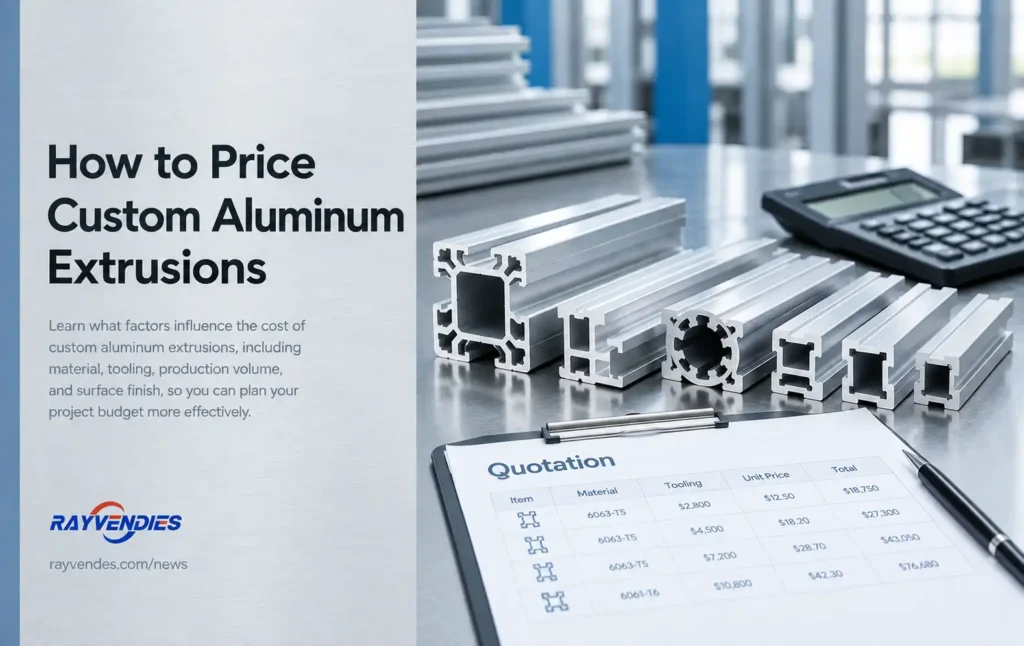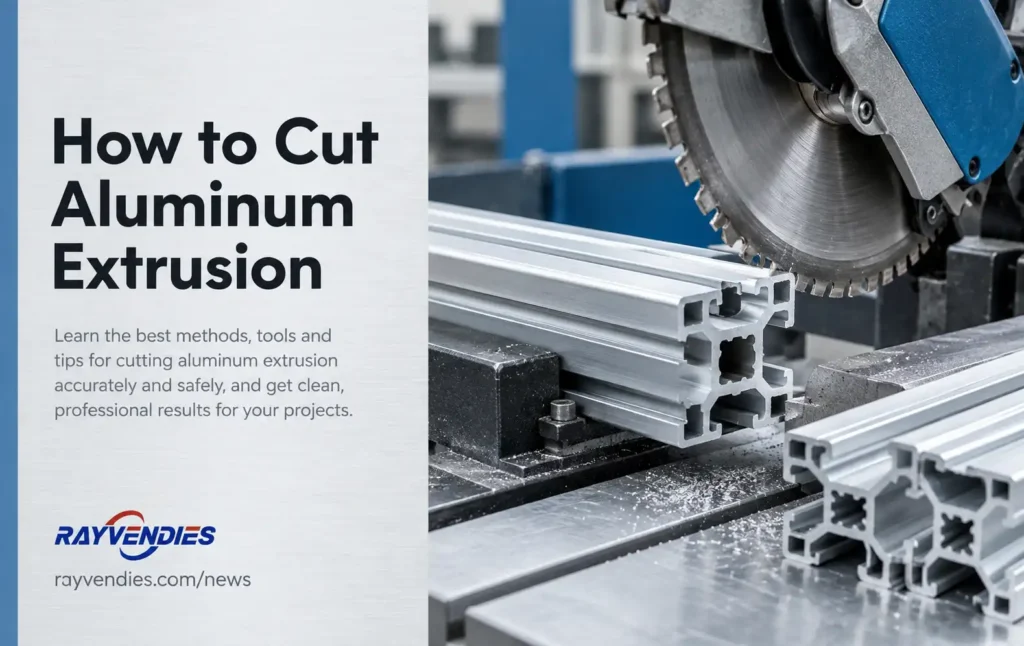
Aluminum extrusion turns a heated aluminum billet into a continuous profile with a fixed cross section, and that profile shows up everywhere from window frames to electric-vehicle battery trays. Buyers usually approach a project with a single number in mind, but the real expense is built from several moving parts that are worth understanding before requesting a quote. If you are new to the manufacturing method, our guide on what extruded aluminum is explains the fundamentals in plain terms.
A simple custom aluminum extrusion in a common alloy typically costs about 2 to 2.5 per foot in volume production, while the raw metal alone trades near 1.50 to 3.50 per kilogram, and a custom die runs 400 to 2,000 or more as a one-time charge, so the final price is shaped by alloy, profile complexity, surface finish, and order volume rather than a single sticker price.
The sections below break down each cost driver so you can budget accurately and negotiate from a position of knowledge.
What is the aluminum extrusion process?
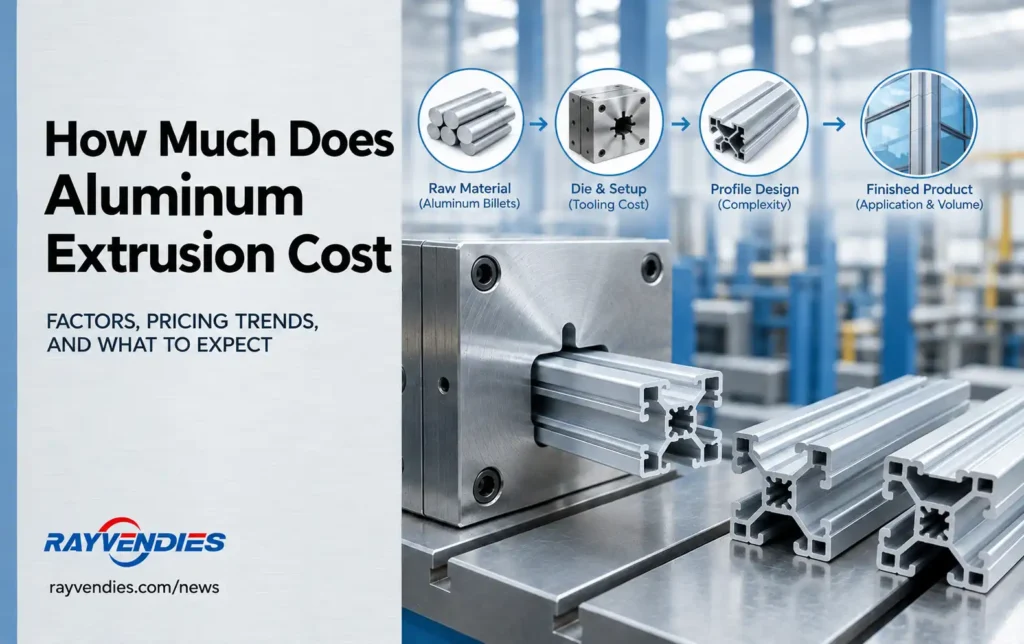
Aluminum extrusion is a manufacturing method that forces a heated aluminum billet through a steel die to produce a long profile with a consistent cross section, and the speed, scrap rate, and tooling involved in that process directly set your unit cost.
The process starts with a cylindrical billet cut to length and heated until the alloy becomes soft enough to flow. A ram pushes the billet against the die, and the metal squeezes through the shaped opening to form the profile. After exiting the press, the extrusion is cooled, straightened, and cut to length, then often aged, machined, or finished depending on the specification. Two press styles dominate the industry: direct extrusion, where the billet moves toward a stationary die, and indirect extrusion, where the die moves toward the billet to reduce friction. Both produce the same family of shapes, but they suit different sizes and alloys.
How the extrusion process works
Heating is the first controlled variable. Aluminum for extrusion is typically brought to roughly 400 to 500 degrees Celsius so it flows without cracking. The die itself is the heart of the operation: a single solid die can form a simple bar or angle, while a hollow profile needs a mandrel and a “bridge” or “porthole” die that re-welds the metal around the void. The press tonnage, measured in the force rating of the machine, determines the maximum circumscribed circle diameter the die can hold and the wall thickness it can hold reliably.
Why the process shapes your cost
Process efficiency is where savings or waste are born. A symmetrical profile with uniform walls extrudes quickly and produces little scrap, which lowers the cost per foot. A thin-walled or highly asymmetric section runs slower, rejects more material, and may need tighter inspection, all of which add cost. The same press that runs a simple angle in seconds may need to creep through a complex heat-sink section to avoid tearing, and that slower cycle is reflected in your quote.
What is aluminum extrusion used for?
Aluminum extrusions are used wherever a light, strong, corrosion-resistant shape with a fixed cross section adds value, which places them across construction, transportation, electronics cooling, and renewable energy.
The material’s strength-to-weight ratio and natural corrosion resistance make it a default choice in buildings, vehicles, and equipment. Because a profile can be tailored to a precise function, engineers replace welded assemblies and machined parts with a single extruded section that needs far less secondary work.
Construction and architecture
Curtain walls, window and door frames, railings, and structural trim are the most visible uses. Architectural profiles favor alloys with good surface finish and easy anodizing, and they are often supplied in long lengths that are cut and assembled on site. The predictable geometry also supports standardized systems such as framing for partitions and enclosures.
Automotive and transportation
Vehicle makers use extrusions for crash structures, battery enclosures, roof rails, and lightweight bumper beams. The ability to tune wall thickness and add internal cavities lets designers hit stiffness targets while trimming mass, which matters directly for fuel economy and electric driving range.
Electronics and heat management
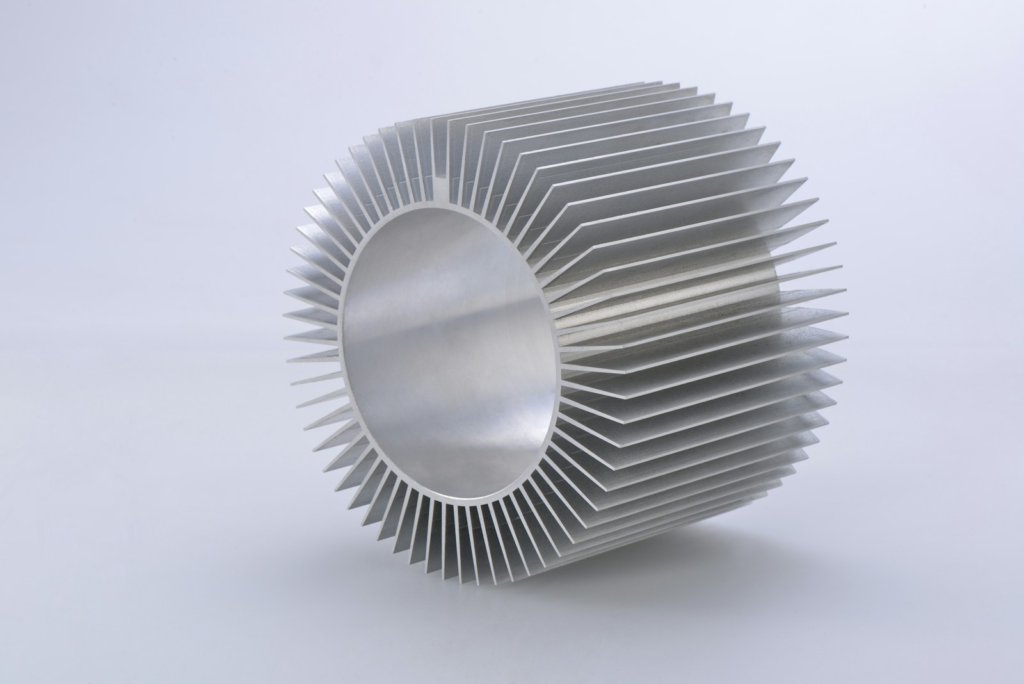
Electronics rely on extrusions as passive heat sinks. Fins and thermal channels are built into the profile so heat moves away from processors and power components without separate cooling parts. This is one of the fastest-growing application areas as power electronics shrink and heat densities rise.
Renewable energy and solar
Solar panel frames, mounting rails, and inverter housings are commonly extruded because the parts must survive outdoor exposure for decades while staying light enough to install quickly. You can explore the range of aluminum extrusion applications to see how profiles are matched to each industry.
How much does aluminum extrusion cost per foot?
For simple profiles in common alloys ordered in volume, aluminum extrusion typically costs about 2 to 2.5 per foot, while complex custom sections with tight tolerances or special finishes can run 8 to 20 per foot or more, because price per foot tracks the weight of metal in each length and the difficulty of making it.
Price per foot is not a fixed rate. It is driven by how much aluminum sits in a given length and how hard that length is to produce. A slender trim piece carries little metal and extrudes fast, so it lands at the low end. A heavy structural section or a thin-walled hollow shape carries more metal and runs slower, pushing the price up even in the same alloy.
| Profile type | Typical price per foot, volume production | What moves the number? |
|---|---|---|
| Simple solid shape, common alloy (for example, 6063) | 2 to 5 | Low die risk, fast extrusion, minimal scrap |
| Standard hollow or semi-hollow section | 4 to 9 | Mandrel tooling, slower press speed |
| Complex custom profile, tight tolerance | 8 to 20 or more | Dedicated die, higher scrap, added inspection |
| With anodizing or powder coating | Add 0.50 to 3.00 per square foot of surface. | Finish type, film thickness, color |
When you compare quotes, check whether the number is per foot, per kilogram, or per piece, because suppliers quote all three. Per-foot pricing is most useful for standard lengths, while per-kilogram pricing reflects the metal and conversion cost more transparently. A useful rule of thumb from industry cost guides is that the metal itself is the largest single component, so a heavier section costs more per foot almost automatically.
What are the main cost components of aluminum extrusion?
Aluminum extrusion cost is built from five components working together: a one-time die and tooling charge, the raw aluminum material, surface finishing and secondary operations, the economies of production volume, and logistics, including freight and duties.
Treating these as separate line items is the clearest way to read any quote. A supplier may fold them together, but asking for a breakdown lets you see where your money goes and where there is room to optimize.
Die and tooling costs
A custom profile needs a die made specifically for your shape, and that is a one-time expense. Tooling for a standard architectural or industrial die typically runs from 400 to 1,000, while profiles that require larger presses in the 2,000 to 4,000 ton class can push tooling to $2,000 or beyond, with very large or hollow dies reaching higher still. The circumscribed circle diameter, the symmetry of the section, and the number of internal voids all raise die cost. Many suppliers amortize the tooling into the piece price over a volume commitment, and some refund the die charge if you reach a stipulated tonnage within one to two years, so the tooling line is rarely the end of the story.
Raw aluminum material
The base metal is usually the biggest single cost, commonly estimated at 60 to 75 percent of the total per-unit price for a straightforward profile. Its price is set on global commodity exchanges rather than by the extruder, and it has swung widely in recent years, from roughly 1,500 to 3,500 per metric ton, and, by early 2026, market data placed the benchmark near $3,300 per ton. The London Metal Exchange publishes the aluminum settlement price that most contracts reference, which is why the same profile can cost more in one quarter than the next. Alloy choice also matters: a common grade such as 6063 costs less and extrudes easily, while a higher-strength grade such as 6061 typically carries a 10 to 20 percent premium because it is harder to push through the die.
Surface finishing and secondary operations
Right off the press, aluminum has a clean “mill finish” at no extra charge. Any treatment after that adds cost. Anodizing and powder coating typically add about 1,200 to 1,400 per metric ton depending on the profile; a chemical film such as alodine is cheaper at roughly 800 per ton, and specialty looks such as wood-grain or PVDF coatings cost substantially more. Secondary machining is the other variable: simple drilling may add $200 to $300 per ton, while CNC work, bending, or welding can add 15 to 40 percent over the base extrusion price. Ordering from a supplier that handles extrusion, fabrication, and finishing under one roof usually lowers the total compared with coordinating several vendors.
Production volume and logistics
Fixed costs such as die making and press setup spread across more units as volume rises, so a 10,000-piece run is far cheaper per piece than a 100-piece run using the same die. Logistics then closes the equation. Shipping a 40-foot container from Asia to North America has ranged from about 8,000 to 20,000 in recent years, and import duties or anti-dumping measures can add a meaningful percentage on top, so the delivered price in your market may differ sharply from the ex-works price at the plant.
Aluminum extrusion profiles and how they affect price
Standard extruded profiles such as T-slot framing, rails, and angles are cheaper because they use shared tooling and run in high volume, while custom profiles cost more up front because they require a dedicated die but give you exact geometry, alloy, and tolerance control.
The choice between buying a catalog shape and commissioning a custom die is one of the first and most consequential budget decisions.
Standard profiles and catalogs
Standard shapes are produced from dies that already exist, which removes the tooling charge entirely. T-slot profiles, for example, form the backbone of modular framing systems used for machine guards, workbenches, and enclosures, and they are assembled with matching T-slot nuts, brackets, and connectors rather than welding. Linear rail profiles and structural channels serve similar off-the-shelf roles. Because these shapes are made in bulk, their price often lands near the lower end of the per-kilogram range, and lead times are short because no tooling wait is involved. The trade-off is geometric freedom: you adapt your design to the catalog, not the other way around.
Custom profiles and tooling trade-offs
A custom profile lets you consolidate several parts into one section, hit a unique tolerance, or place a feature exactly where the application needs it. The cost is the one-time die plus usually a higher per-kilogram rate until volume builds. For many projects the math favors custom anyway: replacing a welded assembly with a single extrusion can cut labor and inventory even after paying for tooling, and the die is reused on every reorder. The practical path is to check whether a standard shape meets the need first, then move to custom only where the geometry earns its due.
How to reduce aluminum extrusion costs
You can lower aluminum extrusion cost most reliably by simplifying the section, choosing a common alloy, ordering enough volume to amortize tooling, consolidating parts, specifying finish only where it is functional, and working with a vertically integrated supplier.
None of these require compromising performance. They are design and sourcing choices that remove avoidable expense.
- Simplify the geometry. Uniform wall thickness, symmetry, and radii instead of sharp corners Let the press run faster with less scrap, which directly cuts cost.
- Choose a common alloy. A grade such as 6063-T5 is the low-cost baseline for most jobs; reserve higher-strength grades for where the mechanics demand them.
- Plan for volume. Economies of scale become clear once a run passes several tons, because fixed tooling and setup spread across more metal.
- Consolidate parts. Combining two or three components into one profile removes assembly labor and inventory even after the die cost.
- Specify finish only where needed. Mill finish is free; reserve anodizing or coating for surfaces where corrosion resistance or appearance earns the spend.
- Use one integrated partner. A supplier that extrudes, machines, and finishes in one facility reduces logistics overhead and hand-off risk compared with managing several vendors.
FAQ
Is extruded aluminum cheaper than steel or CNC machining?
It depends on the comparison point. Extrusion die tooling is a fraction of the tooling needed for die casting or injection molding, and at volume the per-foot cost can fall to a few cents, which beats machining a similar shape from solid stock. Against raw steel, the metal cost is higher, but aluminum’s lower weight, corrosion resistance, and reduced finishing often close the gap over the product lifecycle. For a one-off part, machining may still be cheaper because it needs no die.
Do I pay the die cost again on every reorder?
No. The die is a one-time charge for your specific shape. On reorders of the same profile you typically pay only for material and production. Many suppliers amortize the tooling into early orders and refund it once you reach a volume threshold within one to two years, and they usually replace a worn die at no charge while you keep ordering.
What is the typical minimum order and lead time?
Minimum order quantities commonly start around 500 to 1,000 kilograms, or several hundred to a few thousand linear feet for custom profiles, though some suppliers accept prototypes at much lower weights. Lead time usually runs one to three weeks for die making, two to six weeks for first samples, and three to eight weeks for full production, with complex or large dies on the longer end.