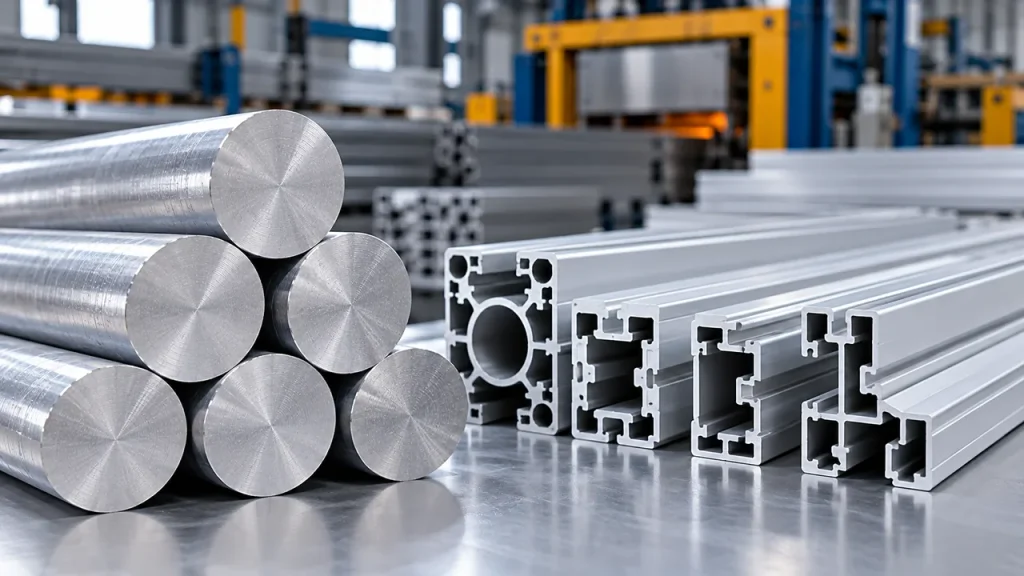
An extrusion line can run the same alloy, press and billet supplier and still deliver two different profiles a week apart. The difference is rarely the machine; it is how the process window and the tool interact, and the two are easier to control once separated.
The aluminum extrusion process delivers quality through four parameters, billet temperature, die temperature, ram speed and extrusion ratio, plus the exit temperature they produce and the flow resistance built into the die. When the two agree, the profile leaves at an even speed and holds its shape; when they disagree, the result is tearing, die lines, twist or wall thickness that drifts.
The sections below separate parameters from tooling, then trace a defect to whichever of the two caused it.
How Does the Aluminum Extrusion Process Work?
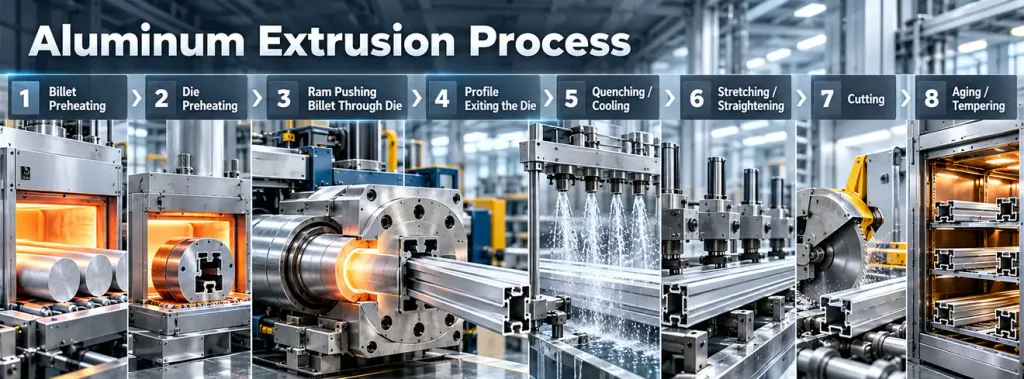
A heated billet is pushed through a steel die that gives it its cross-section, and the profile that emerges is quenched, stretched, cut and aged. Most of what decides whether it is good or scrap is settled inside the die, though quenching, stretching and ageing can add a defect the die did not cause, or hide one it did.
The sequence is short: billet preheated, die preheated, ram advances, metal flows through the aperture, quenches, stretches, cuts, ages to temper. Those steps sit under What Is Aluminum Extrusion; what follows stays inside the press.
What Parameters Affect the Aluminum Extrusion Process?
Four parameters set the window: billet temperature, die temperature, ram speed and extrusion ratio, with exit temperature as the result they all feed. Each can be pushed, but every push is paid for elsewhere in the same run, so the window behaves as a set of trade-offs rather than a list of settings.
Billet and Die Temperature
Billet temperature sets flow stress, and flow stress sets the pressure the press must deliver. Too cold and the metal resists, pressure climbs and the die carries loads it was not designed for; the surface damage that follows traces to that overload rather than to temperature alone. Too hot, or too hot for the speed being run, and hot shortness tears the surface, metal adheres to the bearing, grain coarsens and the finish turns dull once anodized. Die preheat is the other half of the same number: a cold die draws heat out of the metal when it most needs to be fluid, and the first meters show hesitation and die lines.
Ram Speed and Extrusion Pressure
Ram speed is the parameter most often raised to lift output, and the one that most often turns a stable run unstable. It adds deformation heat faster than the container and die can remove it, so exit temperature climbs and tearing starts well before the press reaches its tonnage limit. The ceiling is rarely force; it is the temperature at which the surface stops surviving.
Extrusion Ratio and Metal Flow
Extrusion ratio is container area divided by profile cross-section, and it sets both the pressure required and the heat generated. It is a planning condition, not a running adjustment: once container and section are chosen the ratio is fixed, and the press team controls only the speed and temperature at which it is run. A thin wall drawn from a large container can demand pressure near the press limit while pushing exit temperature up, so section and press are chosen together.
Exit Temperature and Cooling Conditions
Exit temperature is a readout rather than a setting: it is what billet heat, deformation heat and speed add up to. It governs surface quality, how far the profile moves after the die, and whether the quench holds the temper, which is verified against the mechanical property requirements of ASTM B221. Uneven cooling, one flange thin and the other thick, bends a profile already clear of the die, which is why a bend is not automatically a die problem.
| Setting | Set too low | Set too high | What it costs |
| Billet temperature | Flow stress and pressure climb | Metal sticks to the bearing | Die load and finish |
| Die preheat | Heat leaves the metal on entry | Die loses hardness sooner | Hesitation, die life |
| Ram speed | Output per hour falls | Exit temperature runs away | Tearing and scrap |
| Exit temperature | Quench misses the temper | Coarse grain, dull finish | Properties and appearance |
How Does the Extrusion Die Control Metal Flow?
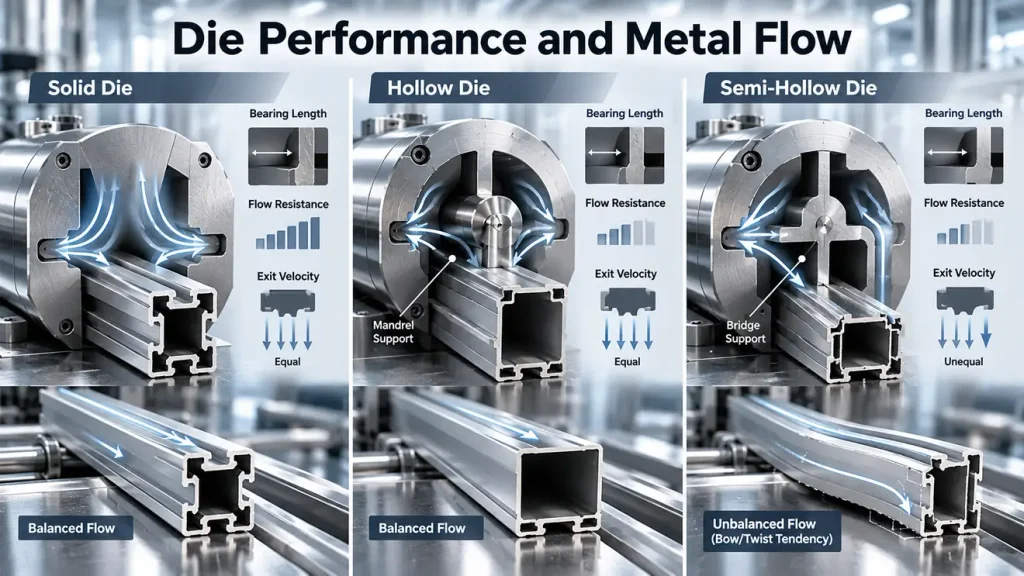
In the aluminum extrusion process the die does not simply shape the metal; it decides how fast each part of the section leaves. Bearing length is the brake on each zone, the portholes and welding chamber decide where metal arrives, and the support behind the face decides how far it deflects. Distribute that evenly and the profile runs straight; leave it uneven and nothing downstream recovers it.
Die Bearings and Flow Resistance
Bearing is the land the metal rubs against as it exits. A longer land adds friction and slows that zone, a shorter one lets metal through, so bearing is set zone by zone, thin and thick walls getting different lengths. A published assessment of metal flow balance in multi-output porthole extrusion models a two-cavity tool for thin-walled AA6060 and predicts wall thickness variation of up to 14 percent where the mandrel deflects. That figure belongs to the simulated configuration, not to production at large; the mechanism transfers, and it says part of the error is built into the tool before the press contributes.
Metal Flow in Solid and Hollow Dies
A solid die has one problem, which is resistance: balance the bearing and the section follows. Solid aluminum extrusion dies also give a die shop the most direct access to that adjustment, with one face to work on and no internal geometry to reach.
Hollow dies carry two problems instead of one, because metal is split by bridges, drawn around a mandrel and welded back before it reaches the bearing. Chamber volume sets the pressure available for that weld and bridge layout fixes where the seam lands, so hollow aluminum extrusion dies are judged on weld quality as much as on dimensions.
An outward-opening slot needs a tongue of steel standing inside the metal, and semi-hollow aluminum extrusion dies carry that tongue as their most heavily loaded feature. At the thin-wall extreme, a published die design study of a heatsink profile shows bearing deliberately shortened at fin tips so the fins do not lag behind the base.
Die Support, Wear, and Thermal Stability
Behind the face sits a stack of backer, bolster and support ring whose job is to stop the die sagging; on wide flat sections the span between supports decides whether the face stays flat or dishes. Over a production life bearing wears, the nitrided layer is consumed, and dimensions creep until a batch fails. The support stack behind aluminum extrusion dies is a quality component, not an accessory.
Common Aluminum Extrusion Problems and Their Causes
Almost every defect in the aluminum extrusion process has at least two plausible causes, one in the process and one in the tool, and the same symptom can come from either. The useful question is not what the defect is called but what to check first, and whether the answer is a setting, a worn land, or a tool that was never balanced.
Surface Cracks and Tearing
Tearing shows as a rough edge or a crocodile-skin pattern, usually on a thin flange or a corner where metal moves fastest. Treat it as temperature first: exit temperature too high, or speed too high for the section. It becomes a die problem when bearing there has been drawn too short or friction has been raised by pick-up.
Die Lines and Aluminum Pick-Up
Longitudinal lines repeating at the same position on every meter are die lines, and they come from a damaged, worn or under-polished bearing, or from aluminum adhering to the land and dragging. Pick-up accelerates once it starts, because adhered metal raises friction, friction raises temperature, and heat encourages more adhesion.
Twisting, Bending, and Uneven Metal Flow
Twist and bow are the signature of unequal exit velocity: one zone leaves faster, the difference accumulates along the length, and the profile spirals or curves. Cooling and the stretcher produce the same look, so where the error appears decides it; a profile straight off the press and bent after quenching was not a flow problem.
Dimensional Drift Across a Run
Wall thickness that starts inside tolerance and drifts out over a run points to thermal or wear movement, not a die that was wrong from the first meter. Comparing the first and last cut of the same billet separates the two, and the categories that govern the limit sit under aluminum extrusion tolerances.
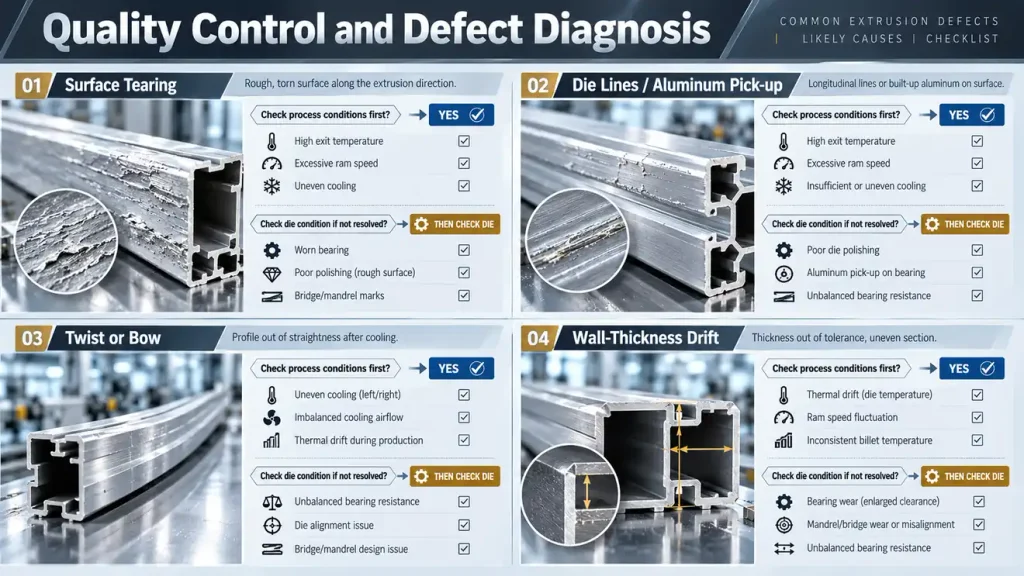
How to Tell Whether a Defect Comes from the Die or the Process
Work in a fixed order: record the symptom precisely, verify the parameters and the machine, examine the tool, and only then run a trial that isolates one variable. Process causes are cheap to test and die corrections are not, so the expensive branch should be the last one entered rather than the first.
The Elimination Order
- Record before adjusting: where on the section, along the length, which billet, which shift. The same position on every piece is a tool signature; movement with time is a process signature.
- Check the run record: billet and die temperature, ram speed, exit temperature, and whether the press held them or hunted. A parameter that drifts explains drift in the product.
- Check the line: puller tension, runout table alignment, quench uniformity, dummy block condition. A bend that survives a straight die and a stable press starts after the die.
- Inspect the tool: bearing length against the drawing, polish, pick-up, cracks at bridge roots, mandrel straightness. If evidence still points to flow balance, run one trial changing a single zone.
The Checklist That Settles the Question
| Symptom | Check that settles it | What the result means | Die work likely? |
| Twist or bow in one direction | Watch the exit before measuring | A leading zone means flow, a late bend means cooling | Only if a zone leads |
| Tearing on a thin flange | Drop billet temperature at the same speed | Tearing that persists means the land is over-drawn | Yes, add resistance |
| Die lines at one position | Compare against the die drawing | A position matching a land means wear | Polish or re-nitride |
| Wall thickness drifting in a run | Weigh first and last cut of one billet | Drift within one billet means thermal movement | Possibly, bearing wear |
| Weld seam opening after anodizing | Etch samples from both billet ends | A seam worse at the start means chamber pressure | Rarely, bridges are fixed |
A Worked Example: A Hollow Profile That Bows After the Trial
A two-cavity hollow section leaves its first trial bowing consistently to one side. Puller tension comes first, since it can mask or create a bow, but it cannot explain a consistent direction. The exit is then watched rather than measured, because the faster side shows as a longer, hotter leg. If one cavity consistently leads, the cause is in the tool: unequal bearing between cavities, a chamber filling unevenly, or a mandrel deflecting toward the thin side. Where uneven exit velocity is confirmed, the die specialist may reduce bearing resistance in the slower-flowing regions or increase resistance in the faster-flowing regions, whichever side has material to give, and the correction is verified through a controlled trial that changes nothing else. This sequence is illustrative, not a record of a specific production run.
How to Improve Extrusion Efficiency Without Sacrificing Quality
Efficiency in the aluminum extrusion process comes from holding a stable window rather than running at the highest speed the press accepts, because every excursion above the window returns as scrap, rework or a die correction.
Speed Stability, Scrap, and Die Records
The gain that survives is the one that removes variation: repeatable billet preheat, a die heated to the same temperature each time, a ram profile that does not overshoot. Most scrap comes from the first and last meters of a billet, so it falls first. A die record logging meters run, bearing corrections and nitriding cycles turns a vague reputation into a number planning can use.
When Should You Optimize or Replace an Aluminum Extrusion Die?
Bearing corrections, polishing, pocket relief and support changes can usually be made to an existing die. Aperture geometry, tongue structure and cavity layout cannot, and a defect traced to those three needs a new tool rather than another trial.
The dividing line is whether the correction changes friction or changes the shape of the hole: friction can be rebalanced in the tool, the hole cannot. Where the answer is a new tool, OEM ODM extrusion die services begin from four inputs, the cross-section drawing, the alloy and temper, the press and container specification, and a photograph of the defect with its position on the section. With those, a supplier can say whether the existing tool can be rebalanced or a new aperture is cheaper.
| Condition | Action | What it costs |
| Twist traced to uneven velocity | Rebalance bearing resistance, then re-trial | A die correction and a repeat trial |
| Wall thickness drifting over die life | Recut bearing or replace an insert | A partial rebuild |
| Crack at a bridge root | Replace the die | Full tooling cost and lead time |
| Section that cannot be balanced | Redesign the aperture | New die plus a trial cycle |
Frequently Asked Questions
The three questions below come up once parameters and tooling have been separated, and each has an operational answer rather than a definition.
What extrusion speed should a die be rated for?
There is no single rating, because the limit is set by section, alloy and press together. A die is quoted against a speed range that keeps exit temperature inside the window for that profile, and a heavier press or a colder billet shifts that range.
Why does the same die perform differently on a different press?
Container diameter, ram control, quench distance and puller behavior all change the boundary conditions the die was balanced against. A die corrected on one press shows a different exit temperature and pull elsewhere, and bearing that was right may now be slightly wrong.
How often should a die be re-nitrided?
At the point where bearing wear or pick-up starts appearing earlier than the record predicts, not on a fixed calendar. Whether another cycle helps depends on what is left of the nitrided layer, how much bearing was lost to polishing and wear, how the earlier cycles were run, and what the tool has been through, so a die with a thin layer or a history of chipping may need a rebuild instead.