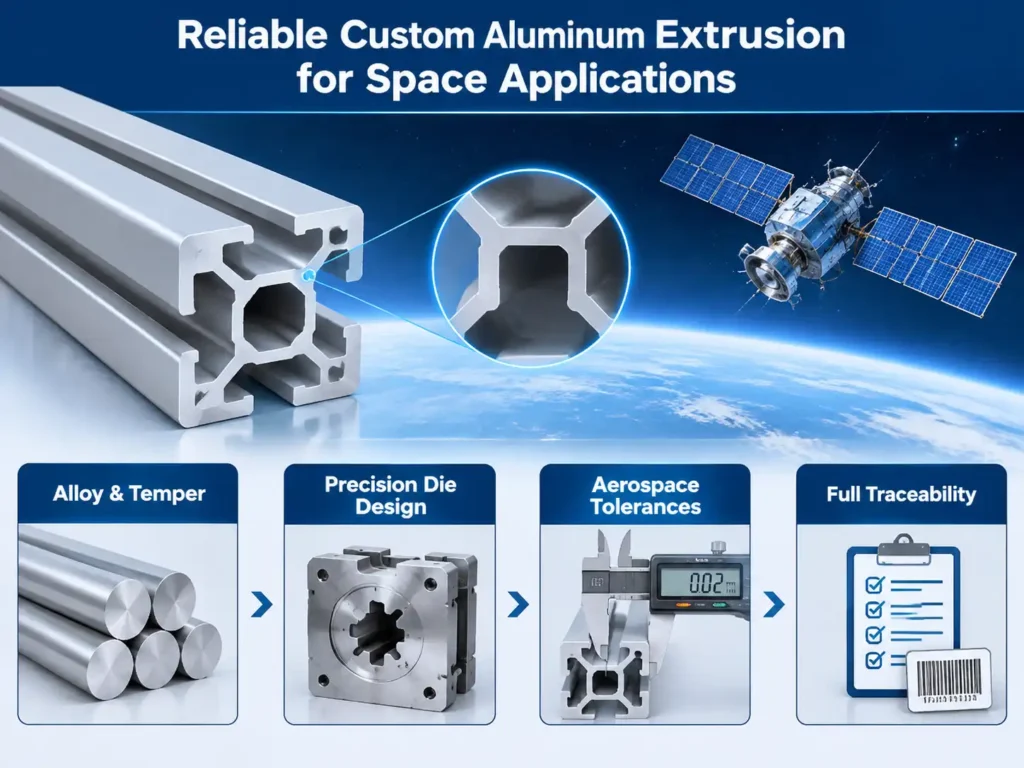
Industrial buyers rarely fail to find someone willing to quote an aluminum extrusion. The problem appears later, when the bundle arrives and the wall thickness has drifted, the straightness sits outside the drawing, or the die is worn out after two runs. That gap between a competitive quotation and a repeatable process is where sourcing programmes lose margin.
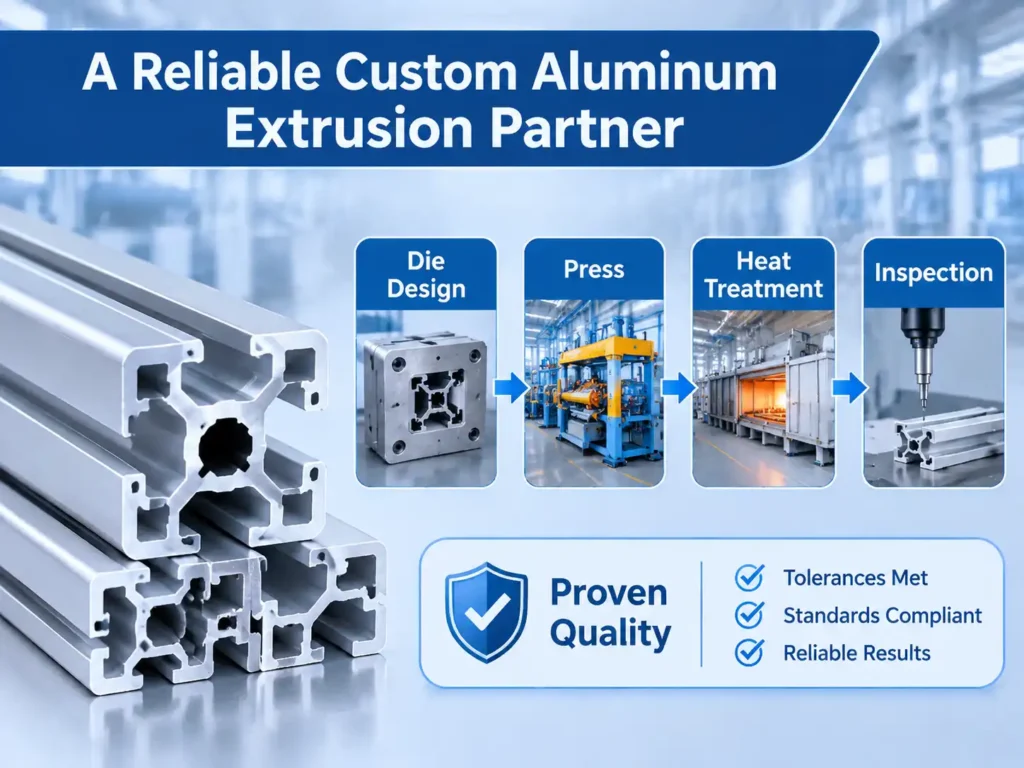
A reliable custom aluminum extrusion partner controls the die, the press, the heat treatment and the inspection records under a single quality system, and can prove the resulting tolerances against a published standard for your alloy, temper and geometry. Capability fit matters far more than company size, catalogue length or rank in an industry list, because the plant that runs your profile decides the outcome.
The sections below set out what such a partner delivers, how to verify the claims before committing to tooling, and what the numbers behind a quotation should look like.
What Does a Reliable Custom Aluminum Extrusion Partner Deliver?
The partner delivers one accountable route from billet to finished component: die design and manufacture, extrusion on a press that suits the profile envelope, controlled quenching and aging, straightening, machining and finishing, and inspection with traceability back to the billet lot.
That route removes the handover points where responsibility for a defect becomes negotiable. When four vendors touch a profile and the anodized face shows die lines, the extruder blames the die shop and the finisher blames handling. With one owner, the same defect has one corrective action.
From billet to finished component
Each stage leaves a record a buyer can audit.
- Billet selection and homogenizing, with alloy and heat number recorded against the order.
- Heating to the working range, typically 450 to 500 degrees Celsius for 6xxx grades.
- Extrusion through a preheated die, at a rate that keeps exit temperature inside the metallurgical window.
- Quenching behind the die to lock the temper, then stretching, cutting and aging to the ordered temper.
| Delivery stage | Documentation to expect |
| Die approval | Die drawing, correction log, sample measurement report |
| Extrusion | Billet certificate, heat number, press identification, run parameters |
| Heat treatment | Temper designation, aging cycle record, hardness results |
| Mechanical testing | Tensile and yield results against EN 755 or ASTM B221 limits |
| Final inspection | Coating or anodic thickness, dimensional report, first article inspection |
Tooling sits at the centre of that chain and explains most defects that surface three steps later. Buyers who treat die capability as an engineering question look for a custom aluminum extrusion dies manufacturer rather than a trader that subcontracts the die, because a single owner of both die and press removes the argument about which one caused the bow.
Which Capabilities Should You Verify Before Sending an RFQ?
Verify four things: that a specific press can physically produce your profile, that the plant holds the tolerances you need rather than the ones in its catalogue, that your alloy and temper are routine on that line, and that finishing and inspection are in-house or under direct contractual control.
A group may list presses from 600 to 5,000 tonnes, but only one may be scheduled for your region and only one die shop may be qualified for your alloy. Capability is a combination, not a number: tonnage, container diameter, maximum circumscribing circle, weight per metre and extrusion ratio. A large circumscribing circle consumes more billet per metre and needs a bigger die block, moving both tooling price and scrap rate.
A plant that runs 6063 all week will quote 7075 confidently and deliver late, so ask which alloys are routine rather than offered. For finishing, confirm whether anodizing and coating are in-house, because outsourcing removes schedule control and the ability to trace a surface defect to its source. Typical ranges are 5 to 25 microns for Type II anodizing, 25 to 100 for hard anodizing, and 60 to 120 for powder coating.
Tolerances and standards
Two standards dominate purchasing. EN 755 covers extruded bars, rods, tubes and profiles for Europe and defines dimensional and form tolerances by alloy group and size; ASTM B221 and B221M serve North America. A quotation that says standard tolerance without naming a class is not a specification. Wall thickness, straightness per metre, twist and flatness of wide faces are the four buyers most often underestimate. The Aluminum Extruders Council publishes the industry tables used to compare a standard class against a precision class (AEC aluminum extrusion tolerances).
| Capability | Question to ask |
| Press and envelope | Which press will run my profile, and what is its maximum circumscribing circle? |
| Alloy and temper | Is this grade routine on that press, or does it need a trial? |
| Tolerances | Which standard and class are quoted, and which dimensions are critical? |
| Die ownership | Who owns the die, where is it stored, and what is the correction policy? |
| Finishing | Are anodizing and coating in-house, and what thickness is certified? |
| Traceability | Can a bundle be linked to a heat number and a test certificate? |
How Is a Custom Profile Developed From Drawing to First Article?
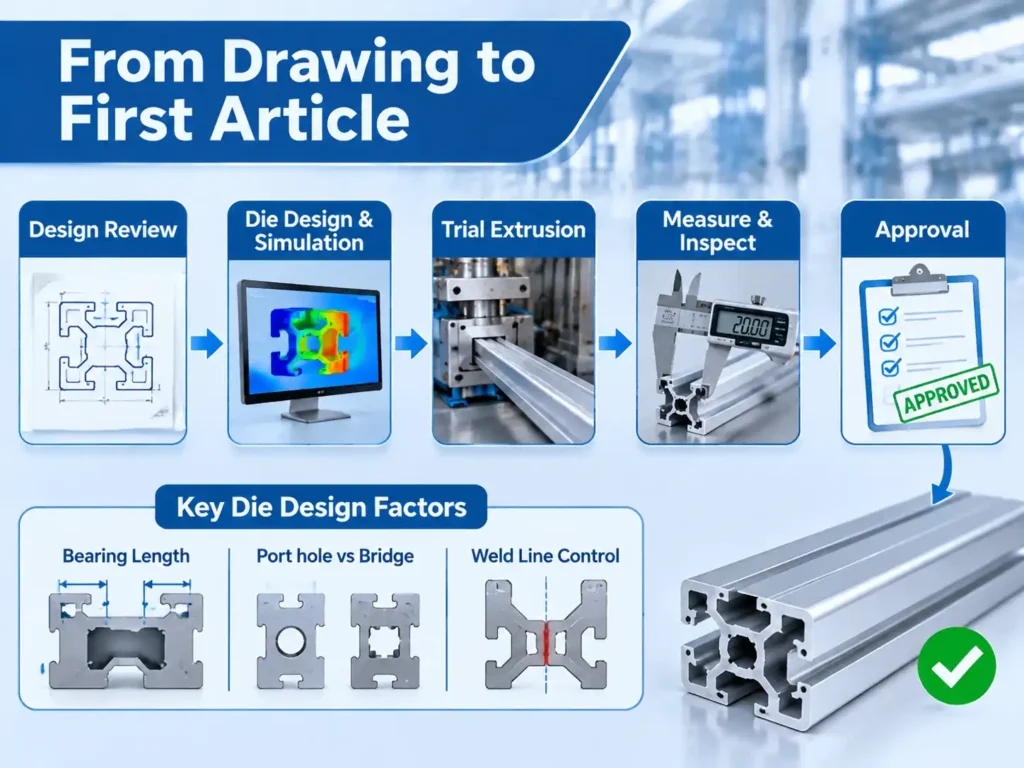
The route runs from a manufacturability review, through die design and flow simulation, to a trial extrusion, sample measurement and a written first article approval before any production quantity is released. Skipping the written approval is the most common cause of a dispute nobody can settle later.
A disciplined programme treats the first article as a contract. The approval records measured values, the gauge used, and which dimensions are conditional, meaning they will be achieved by machining rather than by extrusion. Industry bodies document the process variables behind those limits (AEC aluminum extrusion basics).
Die design decisions that determine yield
The programme has seven stages: requirement review, design for extrusion feedback, die design and simulation, die manufacture and nitriding, trial extrusion with sectioning, correction cycles, then first article approval.
The die, not the press, sets the ceiling on surface quality. Bearing length controls how much back pressure each face sees, and unbalanced bearing is the usual cause of a section that bows in one direction only. For hollows, the choice between porthole and bridge design fixes where weld lines form, and those lines must stay clear of visible faces and peak stress zones. Because die behaviour explains so much of what a buyer eventually measures, experienced managers examine how hot extrusion dies are designed, nitrided and maintained before discussing price.
What Is the Strongest Aluminum Extrusion for Industrial Loads?
On paper, 7075-T6 is the strongest extruded aluminum in common supply, with typical yield strength near 500 MPa, roughly double that of 6061-T6. In industrial practice the strongest sensible choice is usually 6082-T6 or 6061-T6, because 7075 costs far more per kilogram, extrudes slowly, welds poorly and is prone to stress corrosion cracking unless supplied overaged.
Strength is a property of alloy and temper together, not of the extrusion process: the same profile in 6063-T5 and 7075-T6 differs threefold in yield strength while looking identical on the loading dock.
| Alloy and temper | Typical yield strength and fit |
| 6063-T6 | 170 to 215 MPa, architectural sections, heat sinks, anodized visible parts |
| 6061-T6 | 240 to 276 MPa, machine frames, brackets, general industrial fabrication |
| 6082-T6 | 260 to 310 MPa, heavy structural members, transport, large sections |
| 2024-T4 | 275 to 325 MPa, fatigue-critical parts, needs corrosion protection |
| 7075-T6 | 430 to 505 MPa, high-load aerospace and tooling, poor weldability |
Strength without over-specifying
Design against yield rather than tensile strength, because a member that has yielded has failed even without fracture. Then note that deflection usually governs industrial frames: the elastic modulus of all common aluminum alloys sits between 69 and 71 GPa, so moving from 6061 to 7075 barely changes stiffness. Section geometry returns far more deflection control per dollar than alloy substitution. Finally, check joining, since 7075 and 2024 lose strength in the heat affected zone when welded and need protection against galvanic attack when fastened to steel.
How Much Does a Custom Aluminum Extrusion Cost?
A custom aluminum extrusion typically costs 2.50 to 6.00 US dollars per kilogram for extruded material, plus a one-time die charge of roughly 800 to 5,000 dollars, plus finishing and machining. A mid-volume industrial order usually lands between 3.50 and 6.00 dollars per kilogram delivered once tooling, scrap, freight and inspection are counted.
Regional spreads change business cases: about 2.50 to 3.50 dollars per kilogram from Chinese extruders, 2.00 to 3.00 from Indian suppliers, 3.50 to 5.00 and above in North America, and 3 to 5 euros in Europe, before finishing. Comparing those figures without the die charge, scrap allowance and inspection scope produces a ranking that reverses as volume changes.
| Cost element | Typical range |
| Solid single-cavity die | 800 to 2,000 USD per die |
| Hollow or semi-hollow die | 1,500 to 5,000 USD per die |
| Complex multi-cavity die | 5,000 to 12,000 USD per die |
| 6063 extrusion, mill finish | 2.50 to 3.80 USD per kilogram |
| 6061 extrusion, mill finish | 4.00 to 6.00 USD per kilogram |
| Anodizing or powder coating | 0.10 to 0.50 USD per kilogram added |
| Machining and assembly | Often 15 to 40 percent on top of base extrusion |
Two variables deserve their own line in the quotation. Material yield, the share of charged billet that becomes saleable profile, commonly falls between 75 and 95 percent. Secondary operations can equal the base extrusion cost on a feature-heavy part, which is why consolidating features into the profile is the most reliable saving a designer can make.
Die amortization math
Tooling is fixed, so its effect per unit depends on volume. A 3,000 dollar die over 1,000 kilograms adds 3.00 dollars per kilogram; over 10,000 kilograms it adds 0.30. Below roughly 600 kilograms the tooling premium can exceed the material saving that justified the custom section. Hollow sections carry the largest premium, because each chamber adds a mandrel and bridge assembly to the custom hollow aluminum extrusion dies and flow balance is hard to correct after cutting.

Where Is the Best Place to Buy Extruded Aluminum?
For standard sections in small quantities, a stock distributor is cheapest and fastest. For a proprietary profile with a tolerance-critical interface or a cosmetic face, the best place to buy is a custom extruder that owns its die shop and quotes a complete production route, normally in the region where the assembly is built.
The channel follows from three variables: whether the geometry already exists, how tight the tolerance is against standard classes, and how much downstream work the buyer wants to own.
| Sourcing channel | When it fits |
| Stock distributor | Standard sections, prototypes, urgent repair, volumes under one tonne |
| Regional custom extruder | Tight delivery, engineering dialogue, domestic standards, moderate volume |
| Offshore extruder with in-house tooling | Cost-driven programmes, drawing-based specification, high annual volume |
| Plant with machining and finishing | Assemblies where one party must own final tolerance and surface |
What global rankings do and do not tell you
Lists of the largest extrusion companies are editorial shortlists built from published capability statements and market presence. They answer who operates at scale, and nothing about whether a given plant can run a 180 mm wide heat sink in 6082-T6 to a precision class on a press with capacity this quarter. A group that supplies automotive crash structures may route a small industrial order to a plant that has never extruded your alloy, so treat a ranking as a contact list and convert it into a plant-level enquiry carrying a drawing, an alloy, a tolerance class, a volume and a delivery window.
How Should You Run the Supplier Qualification?
Run qualification in four stages: document review, sample measurement, process audit and a paid trial run. Reject any supplier that will not show the die shop, the press log or the inspection records for the trial batch, because a partner who cannot evidence a process cannot control it.
Each document answers a question that a sample alone cannot: whether the process behind the part is controlled.
- Check the quality certificate for scope and site, not just the logo.
- Request material test certificates for a comparable batch, in EN 10204 3.1 form where the programme requires it.
- Review a dimensional report and note the gauge used for each critical dimension.
- Ask for the die drawing, correction history and expected die life on a similar section.
- Confirm the press proposed for your profile, then place a paid trial order and measure the parts.
Red flags in quotes and samples
Tooling is not separated from the part price, so the die can never be amortized or disputed. The alloy is described only as aluminum, with no temper. The minimum order sits far below what the die can be amortized over, which usually means a shared or re-cut die. Samples are hand-selected while the quotation stays silent on production surface quality. Tolerance is called standard with no class and no standard number. Traceability stops at the packing list. The tooling stack is undefined, including the aluminum extrusion die holder and backer sized to the press, which suggests press tooling will be billed after the order is placed.
Frequently Asked Questions
Most remaining questions from industrial buyers concern timing, input format and documentation rather than capability, and those three decide whether a programme starts on schedule and survives an audit.
How long does a new die and first sample take?
A single-cavity solid die usually takes two to four weeks to build, a hollow die three to six, and a complex multi-chamber die longer, before any correction cycle. Trial extrusion, sectioning and measurement add one to two weeks. A realistic first article window is four to eight weeks from drawing approval, and expediting typically adds 25 to 50 percent to the die cost only.
Can a supplier work from a physical sample instead of a drawing?
It can, but the sample must be sectioned, measured and converted into a controlled drawing, and the alloy and temper established by testing rather than assumed. A sample proves geometry at one moment, not material condition, and an existing die is unlikely to match it exactly. Expect a new die and a tolerance review regardless of how complete the sample looks.
What documents should accompany an industrial shipment?
At minimum a material test certificate with heat numbers, a dimensional report against the approved drawing, coating thickness records and a packing list keyed to bundle numbers. Programmes with regulatory exposure should add first article inspection reports, declarations for restricted substances where applicable, and a certificate of conformity naming the standard and tolerance class.