Aluminum extrusion is one of the few structural materials you can order by the meter, by the kilogram, or by the drawing, and that flexibility is what makes sourcing it confusing. The same 20 by 20 profile can cost three times as much from one channel as another, arrive as a 6 m mill length or a pre-cut piece, and carry either a mill certificate or no paperwork. Most sourcing problems are channel mismatches.
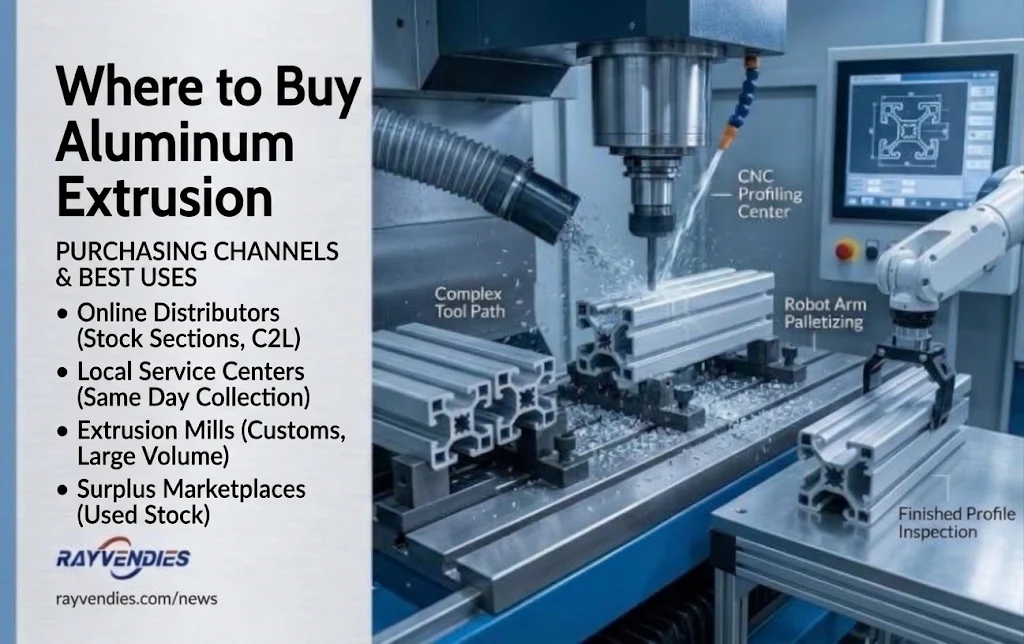
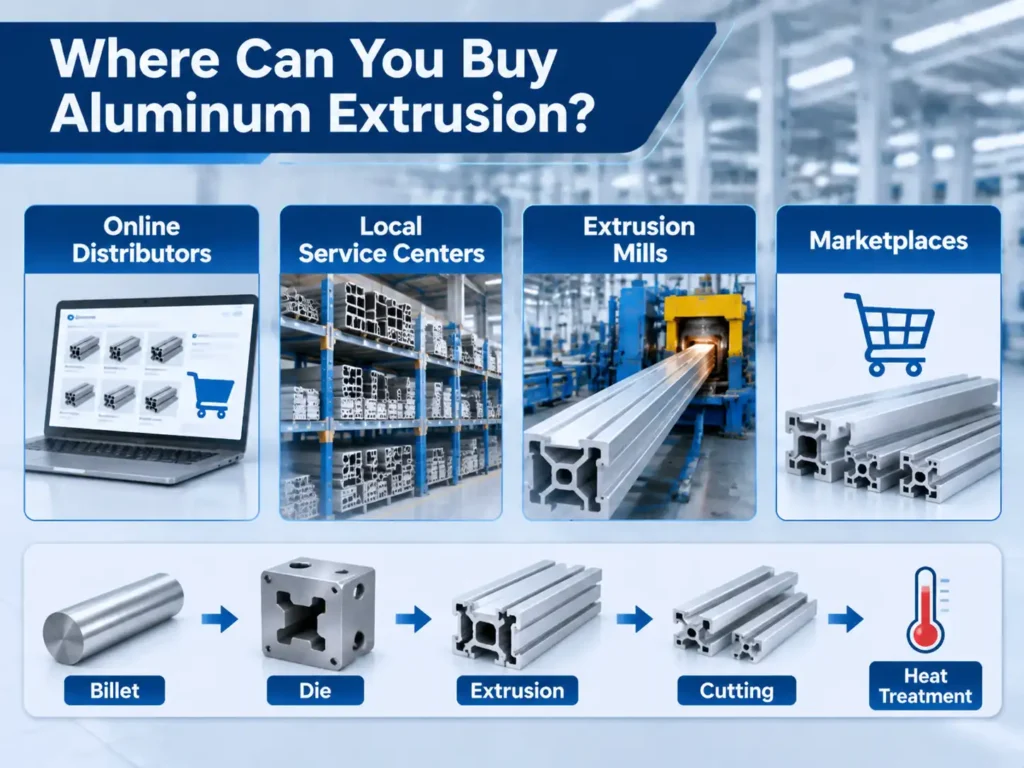
You can buy aluminum extrusion in four places: online distributors that stock standard sections and cut to length, local service centers where you collect the same day, extrusion mills that produce a section to your drawing, and marketplaces selling surplus and used stock. Which one is right depends on three variables: whether the section already exists, how much you need, and how fast you need it. Under a few hundred kilograms, a distributor or local yard usually wins on landed cost. Above that, or when no catalog section fits, the extruder wins.
The sections below compare those channels, then work through real price bands, the costs that hide in freight, and how to check a supplier before you pay.
Where Can You Buy Aluminum Extrusion?
Distributors, yards, mills, and marketplaces each solve a different problem. Distributors and yards resell sections that already exist in small quantities with short lead times. Mills manufacture new sections and need tooling plus volume. Marketplaces sell whatever happens to be available, so alloy, temper, and batch consistency are unpredictable by definition.
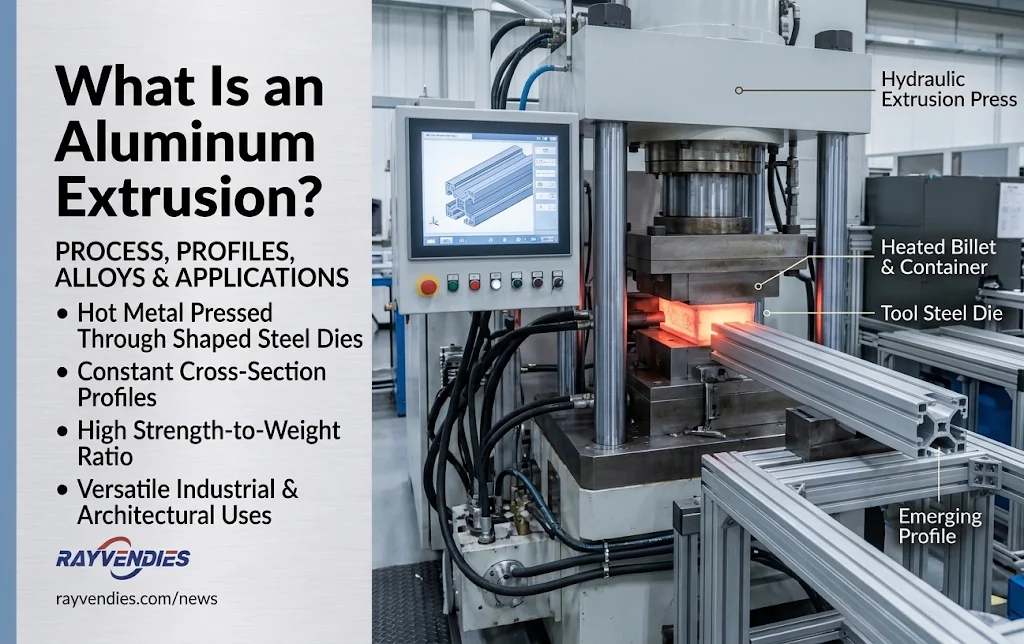
The material comes from a simple process: a heated billet is pushed through a shaped die, and the emerging profile is cooled, straightened, cut, and heat treated. That is why one die can produce thousands of identical meters at low unit cost, and why the economics flip so sharply between stock and custom. A stock section carries no tooling burden because the die was amortized years ago; a new section carries all of it. The aluminum extrusion process explains where each supplier’s cost actually sits.
Online metal distributors and stock catalogs
Catalogs are organized by section family rather than alloy: slotted framing, angle, channel, tube, bar, heat sink. Listings show stock status, published tolerance, mass per meter, and a price that includes cut-to-length service. If you are still choosing between a tube, an angle, and a slotted profile, review the common aluminum extrusion shapes first, because the family determines which dies exist and which accessories fit. Expect the highest per-unit price and cut tolerance of plus or minus 1 mm.
Local metal service centers and supply yards
A yard removes the two things that ruin small orders: freight and uncertainty. You can inspect before paying, cut while you wait, and carry it out, which eliminates the length surcharge entirely. Yards also sell remnants at a fraction of catalog price, often adequate for brackets and spacers. Selection is narrow, but for a repair or a single missing piece this is the fastest route to material in hand.
Extrusion mills and custom extruders
A mill is the only channel that can produce a cross section which does not exist yet, and the cheapest per kilogram at volume, because you buy conversion rather than resale margin. The commitment is real: die design, die cutting, a trial run, first article approval, and a minimum quantity tied to press size. This channel is approached too early more often than any other.
Marketplaces, resellers, and secondary stock
Surplus lots, discontinued lines, and framing stripped from decommissioned equipment land here at 30 to 60 percent below catalog. Alloy and temper are often unmarked, batches are mixed, anodize lots do not match, and slot geometry varies enough that hardware can bind. There is no certificate and no recourse, so buy here only when certification and cosmetic consistency do not matter.
Channel comparison
| Channel | Order size | Cut to length | Custom section | Lead time |
| Online distributor | 1 to 200 kg | Yes, catalog increments | No | 1 to 5 days |
| Local service center | 1 kg to 1 t | Yes, on site | No | Same day |
| Extrusion mill | 300 kg and up | Yes, to drawing | Yes, new die | 3 to 8 weeks |
| Marketplace reseller | Any | Rarely | No | 2 to 10 days |
How Much Does Aluminum Extrusion Cost?
Standard 6063-T5 slotted profiles typically land between 2 and 6 US dollars per meter in modest quantities. The 40 mm series and heavy-wall sections reach 8 to 12 dollars per meter, while 40 by 80 and larger sections exceed 20 dollars. Custom and architectural profiles are quoted per kilogram instead, commonly 3 to 6 dollars at tonnage volume, with tooling charged separately.
These are working ranges, not quotations. Aluminum is a traded commodity, so every quote is anchored to a reference price on a specific date. The London Metal Exchange aluminum price is the benchmark most mills index against, which is why an accepted quote can be re-priced a month later. For the full line item breakdown, see this guide to aluminum extrusion cost.
What the price is actually made of
- Metal cost: the reference aluminum price plus a billet premium covering alloying, casting, and homogenizing.
- Conversion cost: press time, die wear, energy, labor, and yield loss, all higher for complex hollow sections.
- Surface treatment: mill finish as baseline, anodizing priced per square meter plus a batch minimum, powder coating as a separate pretreatment and cure step.
- Tolerance and secondary work: straightness, precision cut lengths, drilling, tapping, and deburring priced as extras.
- Packaging and freight, which on long lengths can rival the material cost.
Indicative price bands
| Profile type | Condition | Typical range | Driver |
| 20 by 20 slotted, 1.5 mm wall | Clear anodized | USD 2 to 5 per m | Volume, cut tolerance |
| 40 by 40 slotted | Clear anodized | USD 6 to 12 per m | Mass per meter |
| 40 by 80 or 80 by 80 | Clear anodized | USD 12 to 25 per m | Mass, straightness |
| Architectural, per kg | Mill finish | USD 3 to 4.5 at 1 t and up | Alloy, die complexity |
| Custom, new die, per kg | Anodized | USD 4 to 7 plus tooling | Section complexity, MOQ |
| Surplus stock | Mixed | 30 to 60 percent below catalog | Availability, consistency |
Why two quotes for the same profile differ
Identical drawings do not produce identical prices. The usual causes are wall thickness, where 1.5 mm and 2.0 mm look the same in a sketch but differ by a third in material, cut loss billed between cuts, anodize thickness class, tolerance class, delivery terms, and price basis date. Ask every supplier to quote the same cut list and finish standard, and to state the index date.
How to Find Cheap Aluminum Extrusions Without Buying Scrap
Cheap extrusion comes from reducing what you buy, not from negotiating the unit rate. Order to a nested cut list, standardize on one section and one finish, accept mill finish where it will be hidden, and buy full stock lengths only when you can absorb the drop. Discounts of 20 to 40 percent are normal at volume. Prices far below market mean thinner walls, a substituted alloy, or no traceability.
Buy to a cut list, not to stock lengths
Stock lengths are convenient for the supplier and expensive for you, because the drop is your material and your freight. A nested cut list that groups similar lengths across the project routinely recovers 8 to 15 percent of material and pays for the cutting charge several times over. Compare the discarded drop at the per-meter rate, plus freight and storage on the extra length, against the cutting fee you were avoiding.
Standardize the section, alloy, and finish
Every added variable creates a setup, a minimum charge, or a separate lead time. One section size, one alloy and temper, and one finish turns four small orders into one that qualifies for a better break. Where the surface is hidden inside a frame or painted later, mill finish removes both a cost step and the batch-to-batch color variation anodized lots can show.
Where the hidden costs sit
- Length surcharges billed on the packaged dimension rather than the cut length.
- Minimum cutting charges applied per order, which double when an order is split.
- Second cuts, end machining, and deburring quoted after the price was agreed.
- Packaging specifications that add a crate or a pallet to the invoice.
- Small-batch premiums that reset on every reorder.
When cheap becomes expensive
Low-cost extrusion fails in predictable ways. Wall thickness under nominal reduces stiffness only after the frame is loaded. Slot width outside the fastener tolerance makes T-nuts spin or bind, the most common assembly fault in modular framing. Substituted temper changes machinability, and missing certification removes any route to a claim. None of this is visible at delivery; it surfaces during assembly, with replacement lead time measured in weeks. Compare landed cost of an accepted assembly against the cost of rework.
When Buying Direct From the Extruder Makes Sense
Direct extrusion makes sense when the section exists in no catalog, when annual volume justifies the tooling, or when the profile can absorb features that would otherwise be machined on as separate operations. It rarely makes sense for a first prototype, a repair, or a single frame, because the tooling cost has to be carried by the parts you actually buy.
Tooling, dies, and minimum order quantities
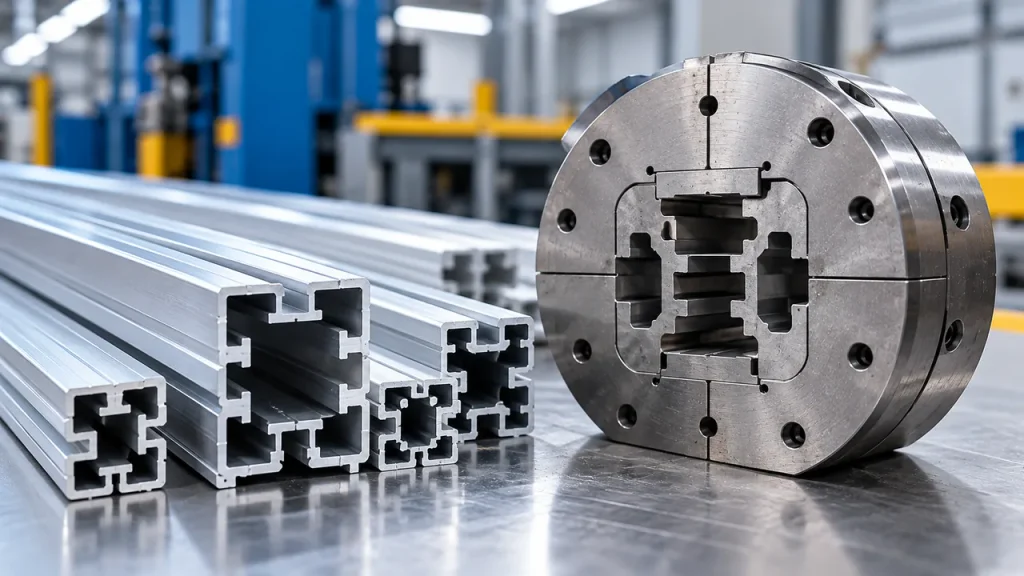
Die cost scales with section complexity rather than order size. A multi-void hollow, a wide flat section, or one with tight wall uniformity needs a more complex die, slower press speed, and more trial iterations before the first saleable meter. Three commercial points matter before you approve tooling: who owns the die, since ownership decides whether the profile can move to another press later, how many correction cycles the trial includes before extra charges apply, and how maintenance is handled. Die construction by profile family is covered under custom aluminum extrusion dies.
The hybrid route
Most successful programs do not start with a new die. They start with a standard section plus machining while the interfaces are still moving, then move to a dedicated profile once geometry and demand stabilize. The transition point is visible: the same machining repeats on every unit, the part count stops changing, and forecast volume can absorb tooling within a few production runs.
What to send with an RFQ
- 2D drawing and 3D model, stating which governs if they conflict.
- Alloy and temper, with permitted alternatives named.
- Critical dimensions and fit tolerances, plus straightness and twist limits.
- Finish type, color, texture, and any masked areas.
- Cut lengths, quantities, and annual forecast.
- Secondary operations: drilling, tapping, machining, bending.
- Packaging, delivery location, and commercial terms.
How to Vet a Supplier Before You Pay
Vet on evidence rather than presentation. Ask for the mill certificate with the heat or lot number, ask which standard the tolerances are held to, ask for a first article report on the die or batch that will supply you, and ask in writing what happens when a batch fails inspection. A supplier who cannot answer those four questions is a supply risk at any price.
Documentation and traceability
Traceability is what turns an assurance into an enforceable claim. Expect a certificate tied to a specific heat number, a stated dimensional standard, and an inspection record that travels with the shipment. The Aluminum Extruders Council publishes design and purchasing guidance that helps frame these questions in the vocabulary suppliers already use. For a first shortlist, this checklist on how to choose an aluminum extrusion manufacturer covers capability and commercial fit.
Tolerance and inspection reality
Ask how each critical characteristic is measured, not only what tolerance is promised. Wall thickness taken with a micrometer at the cut end differs from an ultrasonic check along the length. Straightness on a surface plate is not a visual check across a bundle. Suppliers who can describe the method, frequency, and record are the ones whose numbers mean something.
Red flags
- A quote that will not separate tooling, material, conversion, finish, and freight.
- Tolerance questions answered with adjectives rather than numbers and standards.
- A sample visibly better finished than the production lot that follows.
- Alloy substitution disclosed only after the order is placed.
- No stated policy for damaged freight, short counts, or nonconforming material.
The Logistics Cost Most Buyers Forget
Freight is where long-length extrusion becomes expensive. Carriers apply length surcharges once a piece passes roughly 2.4 m, the surcharge climbs in steps beyond that, and packaging adds to the measured length, so a nominally short cut can still bill as oversize. Designing the cut list around the carrier threshold often saves more than the price negotiation.
Length surcharges
Parcel networks and less-than-truckload carriers handle length differently, but both escalate. Parcel services add a charge past a set length and a much larger tier near the maximum handling length. LTL carriers apply their own tiers in linear feet, and the jump between tiers is not gradual. Two further charges catch buyers who ship to the wrong address: residential and limited-access fees, and a liftgate charge when neither end has a dock.
How to design around freight
- Cut under the threshold and join pieces with connectors or splice plates.
- Collect from a local yard, which removes freight and allows inspection before payment.
- Consolidate the project into one shipment instead of releasing it in three.
- Ship to a commercial address with a dock and a forklift.
- Palletize and band bundles so they are handled once rather than piece by piece.
FAQ
Can you mix profiles from different suppliers in one frame?
Physically yes, but check slot geometry first. Nominal size is not a standard: two 20 by 20 profiles from different producers can differ by several tenths of a millimeter in slot width, and hardware sized for one will bind in the other. Measure the slot, test-fit a T-nut and a corner bracket from each supplier, and keep one supplier for any frame whose joints carry load.
Can a small buyer order directly from an extrusion mill?
Often yes, but the order is priced around the press rather than around your project. Mills quote by weight with a minimum tied to the smallest die and press they run economically, so a small requirement is either refused or quoted at a rate that makes a distributor look cheap. The practical route is stock sections through a distributor, approaching a mill only when a custom section is necessary and the volume credible.
Should you cut and drill extrusion yourself or have the supplier do it?
It depends on the tolerance the joint needs and the number of pieces. A saw with a carbide blade and a decent square handles framing cuts on small profiles and keeps the cut list flexible. Once you need repeated lengths within a tight tolerance, square ends, or a hole pattern that must align across a frame, supplier machining costs less than the scrap from hand work.