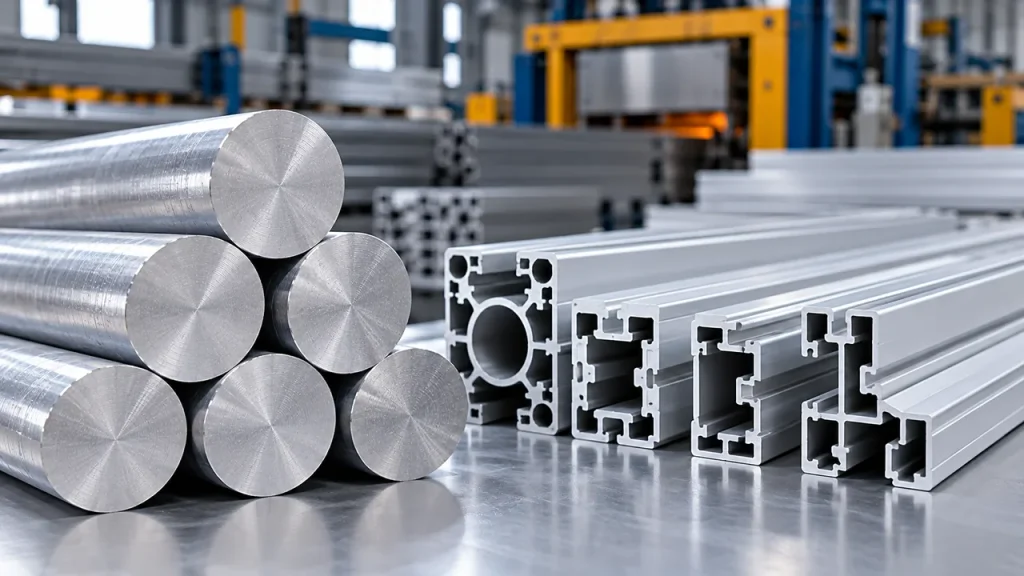
Aluminum extrusion shapes come in far more variety than most buyers expect on a first inquiry. A profile that looks like a simple angle on a drawing can hide draft angles, wall thickness variation, internal ribs, and thermal break chambers, and each of those details changes what the part can do in service. Buyers who treat the cross-section as a generic label usually discover the cost problem later, when the quotation arrives or when the first article does not fit the assembly. Getting the shape, family, alloy, temper, and finishing right at the specification stage is what separates a workable profile from an expensive one.
Aluminum extrusion shapes are the finished cross-sections produced when a heated aluminum billet is forced through a hardened steel die, and the standard families cover almost every general fabrication need: flat bar, round and square bar, angle, channel, tee, Z-section, I-beam, round tube, square and rectangular tube, and modular T-slot framing. Beyond those standards, custom aluminum extrusions can add grooves, chambers, ribs, fastening features, and decorative surfaces so that one piece replaces several machined parts. The shape family decides the die complexity, the wall thickness decides whether the section stays solid, hollow, or semi-hollow, and the alloy and temper decide how much load and heat the profile can actually carry.
The sections below walk through the shape families, their applications, how the shapes are produced, how extrusions get joined in a real assembly, and what actually drives the price.
| Shape family | Typical section | Common use | Classification |
|---|---|---|---|
| Flat bar | Solid rectangle | Bracing, trim, joining plates, machined parts | Solid |
| Round bar / rod | Solid circle | Pins, shafts, spacers, welding filler stock | Solid |
| Square bar | Solid square | Standoffs, frames, general stock | Solid |
| Angle | L-shape, equal or unequal legs | Corner reinforcement, edging, brackets | Solid or hollow |
| Channel (U / C) | Parallel flanges with an open back | Panel guidance, edge protection, framing rails | Solid or semi-hollow |
| Tee | T-shape | Joins and reinforcement, panel connection | Solid |
| Z-section | Offset flanges | Frame bracing, tracking, light structures | Solid or semi-hollow |
| I-beam / H-beam | I or H cross-section | Higher-load structural members | Solid |
| Round tube | Circular, enclosed void | Handles, rails, furniture, guards | Hollow |
| Square / rectangular tube | Box section, enclosed voids | Equipment frames, partitions, architectural framing | Hollow |
| T-slot profile | Slot on each face | Machine frames, workstations, modular automation | Hollow or semi-hollow |
What aluminum extrusion shapes are
Aluminum extrusion shapes are the length of profile that comes out of the press, defined by one cross-section repeated along the length. That is the whole reason the process exists: a single die opening can produce meters of material with the same geometry every time, which is far cheaper than forming each part individually.
The reason aluminum works so well for this is a combination of properties that rarely line up in other metals. Aluminum is light, ductile, and highly formable, so it fills complex die cavities without tearing or cracking. It conducts heat well, takes surface finishes cleanly, and is recyclable without meaningful loss of properties. Strength is not the headline feature, but strength-to-weight is, which is why aluminum competes with steel in applications where moving weight matters more than absolute hardness.
The cross-section is what buyers should focus on when they say “aluminum extruded shape.” Two profiles can share a name and behave completely differently.
Solid, hollow, and semi-hollow shapes
Solid extrusions have no enclosed voids. Flat bar, round rod, square bar, angle, tee, and Z-section fall here. They are the simplest to design, carry the lowest tooling cost, and extrude predictably. For a non-structural bracket, a spacer, or a trim detail, a solid section is usually the economical answer.
Hollow extrusions contain one or more fully enclosed voids. Round, square, and rectangular tubes belong here, along with multi-chambered window and door systems that use internal dividers and thermal break bridges. The die carries internal mandrels held in place by bridges; the metal flows around the bridge and re-welds behind it as it exits. Hollow sections remove material from the center, which drops weight while keeping most of the stiffness, and they can also carry cables, fluids, or fasteners inside the cavity.
Semi-hollow extrusions sit in between. The void is large relative to the opening that lets metal into it. Deep channels, C-shapes with a narrow mouth, and undercut features are typical. Semi-hollow designs save weight and add function, but they ask more of the die because the metal has to squeeze through a narrow gap before filling a wide cavity. A high tongue ratio, meaning the depth of the void against the width of the gap, makes the die more fragile and shortens its life.
The classification matters commercially. Solid is the cheapest. Hollow needs more die engineering and closer process control. Semi-hollow sits between the two and is often priced closer to hollow.
Common aluminum extrusion shapes
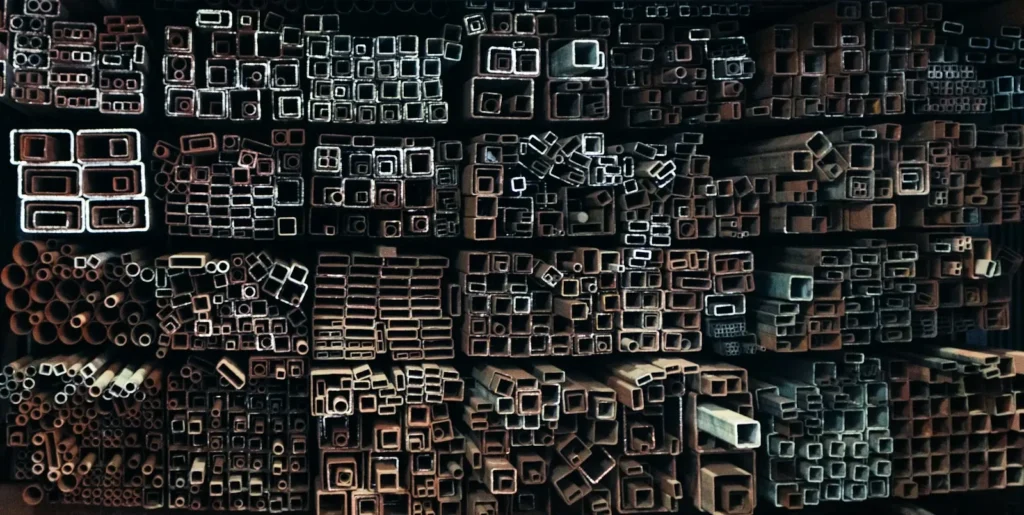
The standard aluminum extrusion shape families are angle, channel, tee, Z-section, flat and round bar, round tube, square and rectangular tube, and beam sections. These are produced from dies that the extruder or a distributor already owns, so there is no custom tooling charge for the buyer and often a shorter lead time. Their weakness is that the geometry may not match the assembly exactly, which can mean extra brackets, extra machining, or more material than the design needs.
The table at the top of this article lists the families with their normal uses. A few points deserve emphasis because they come up repeatedly in specification work.
Angles and channels are the most broadly useful sections in general fabrication. Equal-leg angles and U-channels join easily, take welding well, and are easy to cut and drill. They also come in equal and unequal leg versions and in a wide range of wall thicknesses, so one family usually covers framing, edging, guarding, and support work.
Tubes cover the round and rectangular hollow needs. When specifying a tube, buyers should state whether the requirement is outside dimension or outside dimension plus wall thickness and whether the profile needs to be seamless, welded, or open-seam. A round tube is generally specified by outside diameter and wall thickness; a pipe may follow different sizing conventions, so the two should not be treated as interchangeable on a drawing.
T-slot profiles are a different proposition. The slot on each face accepts nuts and compatible connectors, which makes assembly fast and adjustable without drilling or welding. That modularity is why T-slot framing is so widely used for machine frames, workstations, guards, and automation structures. It is worth noting that a slot profile that is dimensionally close to a standard slotted extrusion is not automatically compatible; slot geometry and connector systems differ between manufacturers.
Alloy choice also determines how readily a shape can be extruded. The 6xxx series is the most common extrusion class because its magnesium-silicon chemistry balances strength, corrosion resistance, and formability, while 5xxx resists corrosion in marine use and 7xxx reaches higher strength at the cost of more difficult metal flow. The Aluminum Association publishes the alloy designation and properties framework that explains why some alloys suit standard shapes more readily than others.
Standard versus custom profiles
A standard profile is one produced from an existing die, so the buyer pays no tooling cost; a custom profile is produced from a new die built for one design, which adds a one-time tooling charge and lead time before the first article.
Custom shapes earn their place when several parts can be merged into one extrusion, when a fastening point or groove needs to be built into the section, or when eliminating machining and material waste pays back the die cost over the order quantity. A design that consolidates four machined components into a single profile can be cheaper overall than the standard version even though the per-kilogram price is higher.
The honest test is straightforward. Start from the intended function rather than the profile name, because decorative edging and structural load bearing call for different tolerance and finish priorities. If a standard section performs the job without excessive secondary machining or material waste, use it. If it does not, the tooling cost needs to be weighed against the savings the custom geometry delivers.
What aluminum extrusion shapes are used for
Aluminum extrusions are used wherever a light, stiff, corrosion-resistant, repeatable section is needed, which covers architectural framing, industrial equipment, machine bases, heat management, vehicles, solar mounting, furniture, and display systems. The same shape family frequently serves several of these at once, which is why the cross-section rather than the end use drives most of the specification decisions.
- Building and construction: window and door frames, curtain wall framing, mullions, scaffolding, ladders, and structural trims
- Industrial equipment: machine guards, conveyor frames, workbenches, enclosures, and hydraulic and pneumatic support structures
- Automation and modular systems: T-slot frames, linear motion supports, workstations, and production line guarding
- Heat management: heat sinks, cold plates, radiator frames, and enclosures for power electronics, where the extrusion carries both structural and thermal duty
- Automotive and transportation: battery tray and enclosure components, roof rails, trim, and structural brackets
- Renewable energy: solar frame and mounting components, where stiffness and corrosion resistance both matter
- Furniture and interior: frames, handles, edging, display rails, and shopfitting
- Consumer products: cooking utensils, equipment housings, and heat-dissipating parts
Each application puts a different emphasis on the specification. Architectural work leans on finish quality and anodizing appearance. Heat sinks care about fin geometry and thermal contact. Structural members care about alloy temper and section moment, not about surface.
How aluminum extrusion shapes are made
The aluminum extrusion process heats a billet to a temperature where the alloy softens, then forces it through a steel die whose opening is the negative of the desired shape; the profile cools, is straightened, cut to length, and finished.
- Billet preparation. A cast aluminum billet is cut to length and, in direct extrusion, preheated. Alloy choice happens here, and it decides extrudability.
- Heating. The billet reaches the working temperature for its series. Temperature control here drives surface quality and structural consistency.
- Extrusion. A ram or hydraulic press pushes the softened metal through the die. In direct extrusion the billet is stationary; in indirect extrusion the container moves relative to the billet, which generally improves surface finish and metal flow at higher complexity.
- Cooling and quenching. The profile leaves the die hot and is quenched or air cooled, then allowed to reach temper.
- Straightening and correction. Runout and cooling distortion are corrected by stretching, press straightening, or roll correction.
- Cutting. Profiles are cut to specified lengths, saw cut, or cut-to-length as required.
- Finishing. Optional operations include deburring, machining, punching, bending, anodizing, powder coating, brushing, and assembly.
The die is the constraint that runs through every one of these steps. Design choices that are easy on paper are hard to extrude: extreme wall thickness variation cools unevenly and distorts, very thin walls fill inconsistently, sharp internal corners impede flow and concentrate stress, deep narrow channels challenge both fill and die strength, and high asymmetry can twist during cooling if cooling and die design are not managed.
Hollow sections make this harder, because the internal mandrel and bridges must survive repeated cycles while the metal re-welds behind them. Semi-hollow sections are harder still because of the tongue. Design for manufacturability, with the extruder reviewing the drawing early, prevents most of these problems. For solid and hollow geometry specifically, custom solid aluminum extrusion dies and custom hollow aluminum extrusion dies are where the geometry decisions actually get resolved before a billet is ever heated.
Joining methods for aluminum extrusions
Aluminum extrusions are joined by mechanical fastening, welding, adhesive bonding, or integrated modular connectors, and the right choice depends mainly on load, permanence, appearance, and whether the assembly must come apart again.
| Joining method | Permanence | Tooling required | Load capacity | Reusable |
|---|---|---|---|---|
| Bolted / screwed fastening | Semi-permanent | Low | Medium to high | Yes |
| Riveting or clinching | Permanent | Low to medium | Medium | No |
| T-slot connectors | Modular | None beyond fasteners | Medium | Yes |
| Angle brackets and corner connectors | Modular | None beyond fasteners | Medium | Yes |
| Snap-fit and interlocking joints | Modular | None | Low to medium | Limited |
| Threaded inserts | Semi-permanent | Low | Medium to high | Yes |
| TIG welding | Permanent | High | High | No |
| MIG welding | Permanent | High | High | No |
| Friction stir welding | Permanent | Specialized | Very high | No |
| Adhesive bonding | Semi-permanent | Low | Medium | Limited |
Mechanical fastening
Fasteners are the default because they need little equipment and keep assemblies serviceable. The details decide whether the joint lasts. Stainless steel or aluminum fasteners should be specified in wet or outdoor environments, since a steel fastener in contact with aluminum creates a galvanic couple that corrodes the aluminum preferentially. Threaded inserts work well where repeated assembly cycles occur. Blind rivets are useful when only one side is accessible. T-nuts and drop-in fasteners suit slotted profiles and allow adjustability. Hole size and fastener torque should be specified rather than left to the installer, because aluminum strips easily, and over-torquing leaves no margin.
Welding
TIG gives the cleanest, most controllable joint and suits thin sections; MIG is faster and handles thicker material at higher volume; friction stir welding joins without melting the metal, producing consistent high-strength joints with little distortion. All three carry a caution that belongs in the specification, not just the workshop: the heat-affected zone of a heat-treatable alloy loses strength compared with the parent material. On common 6xxx structural temper, a welded joint can sit near annealed strength until a post-weld aging treatment is specified. Welded areas also need surface preparation to remove the oxide layer before welding.
Adhesive bonding
Structural adhesives give a clean appearance without fastener holes or weld distortion, and modern formulations reach useful strength when surface preparation is right. Epoxy is stiff and strong but unforgiving of gaps and stress concentration. Methacrylate tolerates less-than-ideal preparation. Polyurethane is flexible and handles thermal movement and vibration well. In all three cases, abrading, degreasing, and priming the surface does more for long-term durability than the adhesive brand does.
One more design point belongs here rather than in the workshop notes. Aluminum’s coefficient of thermal expansion is roughly twice that of steel, so a long run of profiles moves measurably between seasonal extremes. Every assembly needs expansion accommodation at at least one point, usually a slotted hole or oversized clearance, with flexible sealant at panel perimeters. Rigidly locking every fastener transfers that movement into the weakest joint in the assembly.
How much aluminum extrusion costs
Aluminum extrusion price is not a per-kilogram number; it is a per-kilogram number plus tooling amortized across the order, plus the finishing and machining the drawing implies, so the total cost of a shape depends on how much complexity is designed into it and how many pieces are ordered.
The following factors move cost more than any other:
| Cost driver | Effect on price |
|---|---|
| Alloy and temper | Higher-strength alloys and tempers cost more per kilogram. |
| Section complexity | Multi-void, thermal break, or undercut sections need more die engineering. |
| Wall thickness variation | Drastic thick-to-thin transitions increase distortion risk and scrap. |
| Minimum wall limits | Thin walls require precision and can carry a premium. |
| Order quantity | Tooling amortizes across volume; low quantities carry the full die cost. |
| Tooling | Custom die is a one-time charge, then amortized per piece. |
| Surface finish | Anodizing, powder coating, brushing, or a painted finish add per-meter or per-piece cost. |
| Cut length and tolerance | Tighter length tolerance and precision cutting add cost. |
| Secondary machining | CNC work, punching, and bending are separate line items. |
The way to work out an actual number is to send a drawing rather than a shape name. Provide the cross-section with dimensions and wall thicknesses, alloy and temper, cut length and length tolerance, dimensional tolerance, surface finish, machining requirements, packing method, and quantity. Ask specifically whether an existing standard section would do the job, since that answer alone can remove the tooling line entirely.
Buyers who want to see the cost case internally should build it from their own numbers rather than assume a payback period. Total installed investment divided by annual labor, reject, and capacity savings gives the payback period, and it only becomes meaningful with the buyer’s own data: shifts, annual running hours, labor cost, how many positions can be eliminated, current and target reject rates, annual volume, and spare capacity. Quote requests answered with a project-specific calculation return with the quotation are more useful than any headline figure.
What to confirm before you order
Before ordering aluminum extrusion shapes, confirm the full specification rather than the shape alone, because alloy, temper, wall thickness, tolerance, finish, and quantity all change the price and the performance of the delivered part.
- Cross-section drawing with all dimensions and wall thicknesses marked
- Critical dimensions identified, rather than applying the tightest tolerance to the whole profile
- Alloy and temper, checked against the service conditions, including heat and load
- Outside dimensions, internal cavity dimensions, and corner geometry for hollow sections where another part must fit inside
- Dimensional tolerance and cut length tolerance
- Surface finish, including any color or appearance requirement
- Machining requirements, holes, and deburring
- Packaging method and piece count per bundle
- Order quantity and required lead time
Two final habits pay for themselves. Send a marked-up drawing rather than a verbal description, and ask for a first article or sample before releasing the full quantity. Samples confirm surface appearance, straightness, dimensions, machining, and assembly fit while the change is still cheap to make. If the profile is a repeat of a common standard section, ordering a short piece first is often enough to confirm the fit without a full sample run.

FAQ
Can I get a standard aluminum shape with a feature that no standard shape has?
Yes, and this is a normal request rather than an unusual one. Standard dies cover a lot of general geometry, but integrated grooves, cable channels, fastening bosses, thermal break chambers, or mounting features usually mean a custom die. The practical route is to send the drawing and ask for two options: the closest standard section with a secondary machining or bracket step and a custom profile that integrates the feature. Compare the two on total delivered cost rather than on piece price.
How do I know whether I need a solid, hollow, or semi-hollow section?
Start with what the profile has to carry and what it has to hide. A structural member benefits from a hollow section because removing the core material keeps stiffness while reducing weight. A component that must carry a fastener, a seal, or a press fit usually works better solid. A section that needs weight reduction but does not need full enclosure, such as a deep channel used as a rail, often lands in the semi-hollow range. Where a part must slide inside another, the internal dimensions and corner geometry become critical and must be confirmed with a sample.
Aluminum extruded shapes are described by different dimension systems across suppliers—does that matter?
It can. Aluminum sections have long been produced in both imperial and metric sizing, and two suppliers quoting “the same” square tube can mean different outside dimensions and wall thicknesses. Order in whichever system your drawings and tolerances use, then state that system explicitly on the order. A useful check is to ask each supplier for the outside dimension, wall thickness, and weight per meter and compare those three values rather than comparing nominal sizes. The Aluminum Association publishes extrudability and alloy selection guidance that is useful background when alloy and temper drive the shape choice, since not every alloy extrudes the same way.