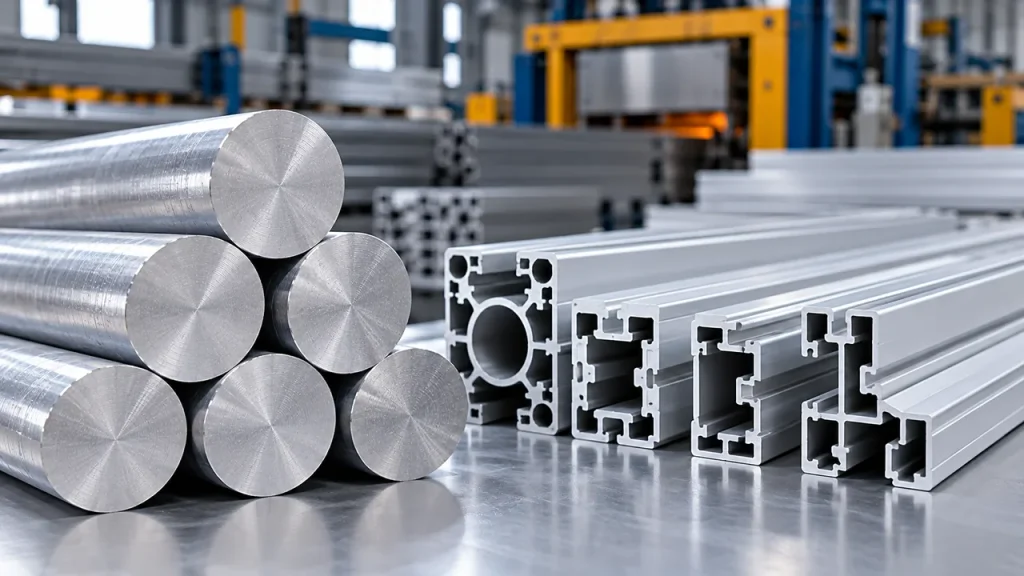
A drawing, a target price, and a shortlist of names are how most extrusion projects begin. Then the quotes arrive, and they cannot be compared: one supplier prices the profile alone, another bundles tooling, and a third leaves finishing out of scope. Six months later the gap shows up as a die nobody can modify quickly or a tolerance that drifts at volume.
The global aluminum extrusion market was estimated at USD 101.12 billion in 2026 (360iResearch, base year 2025), so capacity is not the constraint—telling a capable plant apart from a sales office is. Tooling is the fastest tell: a custom aluminum extrusion dies manufacturer with its own die workshop can correct a profile in days, while an intermediary forwards the problem to somebody else’s schedule.
Four checks decide most of it before price enters the conversation. The manufacturer’s press range has to cover your profile’s circumscribing circle, its alloy and temper capability has to match your specification, die design and correction have to happen in-house, and tolerance and inspection data have to ship with the order. Price then picks a winner from the suppliers that pass all four.
The sections below run through those checks in order, from capability to cost.

What is aluminum extrusion used for?
Extruded aluminum is used wherever a constant cross-section can replace assembly, welding, or machining: window and curtain-wall framing, electric vehicle battery trays, solar module frames, heat sinks, machine frames, and conveyor systems.
The reason is structural rather than cosmetic. A die pushes heated metal into a shape that already contains the stiffening ribs, screw ports, cable channels, and thermal fins the finished part needs. You buy one part instead of five, and the assembly steps disappear with it.
| End use | Typical profiles | What it demands |
|---|---|---|
| Building and construction | Window frames, curtain wall mullions | Finish consistency, long lengths, straightness |
| Automotive and transport | Battery trays, crash rails, roof rails | Alloy and temper control, dimensional reports |
| Solar and renewable energy | Module frames, mounting rails | Mill-finish cost control, repeatability |
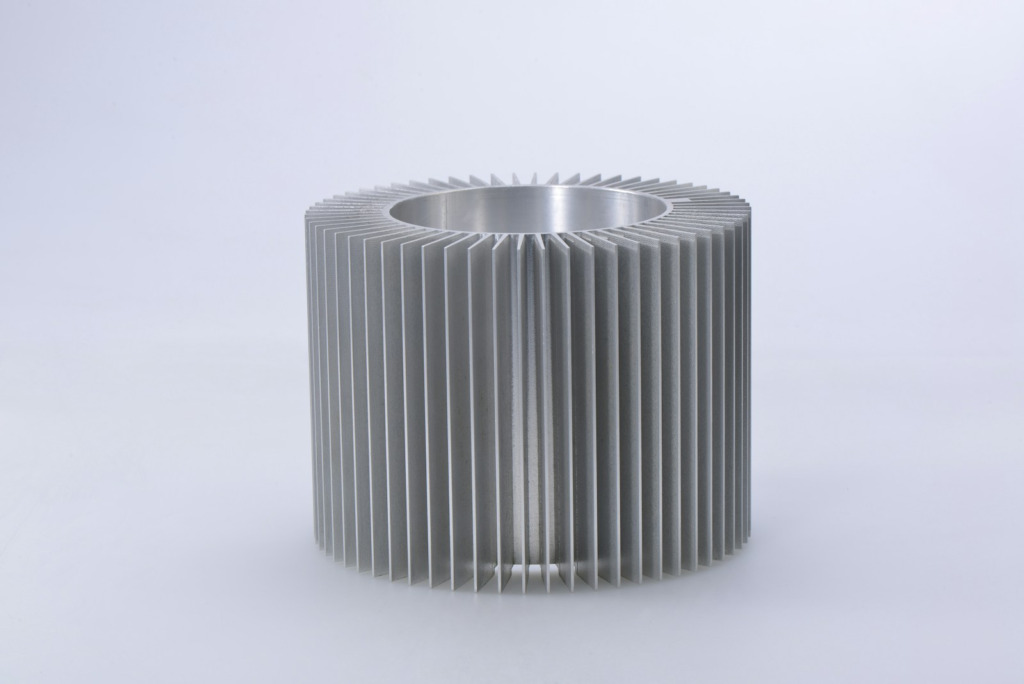
| Electronics and power | Heat sinks, housings, enclosures | Fin geometry held at speed, machining |
| Industrial machinery | T-slot framing, guarding, conveyor rails | Standard dies in stock, short repeat lead times |
Die design follows the end use, not the other way around. A solar frame die runs long and holds straightness. A heat sink die has to hold thin fin geometry while metal moves through it at speed. Reviewing aluminum extrusion die applications before you send drawings tells you whether a supplier has already solved problems shaped like yours.
Press capacity, circle size, and die capability
A manufacturer can only quote profiles that fit inside the circumscribing circle of its largest press, and the tonnage available sets how complex the section can be. The circumscribing circle is the smallest circle that encloses the whole profile design, measured across its widest points, including projections.
Most capability sheets publish both figures. Most buyers read only one. A plant with a single 1,600-ton press will quote a wide architectural mullion anyway, then quietly subcontract it.
| Press class | Tonnage range | Typical work | Practical limit |
|---|---|---|---|
| Small | 600 to 1,800 t | Thin sections, trim, tubes, small heat sinks | Narrow envelope, wall control is harder. |
| Medium | 2,000 to 3,500 t | Industrial profiles, moderate hollows, framing | Good balance of envelope and cost |
| Large | 5,000 t and above | Wide architectural and structural sections, multi-void profiles | Higher setup and billet cost, fewer slots |
Ask which press would run your profile and why. A supplier that names a machine and a reason knows its equipment. One that answers with a range is quoting from a brochure.
In-house die design versus outsourced tooling
The work is where delivery dates are won or lost. When a profile comes out twisted or a wall runs thin, the fix is a die correction. Plants with an in-house die workshop measure the section, adjust the bearing, and re-run, often inside the week. Plants that outsource tooling wait in another company’s queue, and every correction resets that clock.
Three questions separate the two cases:
- Who designs the die, and can I see cross-sections from comparable jobs?
- What is the expected die life, and what is the maintenance cadence?
- When a dimension drifts at volume, who corrects it, and how long does that take?
Treat tooling as infrastructure rather than a purchase. If a supplier cannot explain how the die will be developed, corrected, maintained, and reproduced, the project has no manufacturing visibility yet.
Alloys and tempers for extruded profiles
The best grade for extrusion is almost always a 6xxx alloy, because the magnesium and silicon in that series balance strength against extrudability. Which grade, and at what temper, depends on whether strength or surface quality governs the part.
What is the best grade of aluminum for extrusion?
| Alloy | Strength | Extrudability and finish | Typical use |
|---|---|---|---|
| 6063 | Moderate | Excellent. Thin walls extrude cleanly, taking bright anodizing | Architectural frames, trim, enclosures, heat sinks |
| 6061 | Higher | Harder to extrude, duller finish, machines well | Structural frames, automotive, load-bearing profiles |
| 6082 | High | Moderate. The European structural equivalent to 6061 | Structural sections, machining stock |
| 6005A | Higher than 6063 | Moderate, performs well in transport sections | Vehicle structures, rail and bus profiles |
Pick 6063 when the visible surface and fine profile detail matter. Pick 6061 or 6082 when the part carries a load and will be machined afterward. The Aluminum Association registers alloy designations and their chemical composition limits in its Teal Sheets, which are the reference to check when a supplier offers a 6063 equivalent without naming the standard it follows.
Temper and material traceability
Temper is not a finish. It is the thermal and mechanical treatment that sets mechanical properties, and it belongs in the inquiry as much as the alloy does. Alloy 6063 in T5 is cooled from the press and artificially aged. Alloy 6061 in T6 is solution heat treated and then artificially aged to peak strength. T6511 adds controlled stretching that relieves stress, which matters on parts machined to tight flatness.
A quote that names an alloy without a temper is not comparable to one that gives the full designation. On any structural part, ask for the mill test report and the lot number tying the profile back to its billet.

Tolerances, finishes, and fabrication capability
Tolerance control is where a general extruder and an engineered-component supplier divide. Anyone can hit nominal size on a simple section. Holding wall thickness, twist, and straightness at volume needs to be demonstrated rather than asserted.
Published standards exist so that within tolerance means something specific. ANSI H35.2 covers aluminum mill products, while EN 755-9 and EN 12020-2 cover extruded profiles in the European system. Ask which standard governs the quote, which tolerance class the drawing calls for, and how the supplier measures critical characteristics.
Secondary operations and finishing
The extrusion is usually a starting shape, not a finished part. Downstream steps include:
- Cutting to length and precision sawing
- CNC machining, drilling, tapping, and punching
- Deburring, bending, welding, and assembly
- Anodizing, powder coating, and other architectural finishes
Every step kept in-house removes a handoff, and handoffs are where handling damage and schedule slippage live.
What drives aluminum extrusion price?
Extrusion price is a structure, not a number. Two quotes can differ by a wide margin and both be honest, because they are pricing different scopes.
How much does a custom aluminum extrusion cost?
| Cost item | What sets it | How to compare |
|---|---|---|
| Material | Alloy, temper, and profile weight per meter | Same alloy and weight per meter, or nothing is comparable. |
| Tooling | The complexity, number of voids, corrections, replacement | Tooling charged once, amortized, or shared |
| Extrusion | Press time, minimum order, scrap allowance | Same minimum order basis |
| Machining | Cutting, CNC time, hole and slot count | Per piece or per operation, stated |
| Finishing | Anodizing class, coating thickness, color | Same specification and thickness |
| Inspection and documents | Report level, traceability requirements | Named documents, not certificates on request |
| Packaging and logistics | Export protection, freight, duties | Landed cost, not ex-works price |
The honest answer is that a custom extrusion costs what its profile weight per meter, die, annual volume, and processing scope add up to. A supplier quoting a firm figure without asking those questions is guessing.
Why the cheapest kilogram price can be the most expensive order
Picture two quoted options for the same finished part: one uses a general-purpose section, the other a slightly heavier profile designed around the machining that follows. The first shows a lower cost per kilogram, but if it then needs three extra machining operations to reach the same geometry while the second arrives closer to finished form, the cheaper material quote can lose on total cost.
That is an illustration of the mechanism, not a price comparison, because no standard ratio exists between extrusion and machining cost. The cheapest kilogram is not automatically the cheapest part.
Tooling ownership, minimum order, and lead time
Tooling, minimum order quantity, and lead time are the three items most often left vague in a first quote, and all three reappear as cost later.
Who owns the die, and how is it maintained?
Ask who owns the die once it is paid for, whether it can be transferred to another extruder, and what condition it will be in after five years. A die has a service life, and when it reaches that limit, someone pays for the replacement, so the contract should say who. Ask too how the die is stored between runs, because a die left unprotected will not perform the same way next time.
MOQ, trial runs, and lead time planning
Minimum order logic depends on the die. If the die exists, minimums are usually low, and the real constraint is press scheduling. If the die is new, the supplier recovers tooling cost, so minimums rise or tooling is invoiced separately. Some manufacturers accept pilot runs; some share tooling costs against projected volumes.
Lead time should be quoted by stage, not as one number. Tooling, first extrusion, surface finishing, inspection, and packing each carry their own duration, and the total is what lands on your dock.
Quality systems, certifications, and documentation
Certifications show that a supplier has documented systems. They are a starting filter rather than proof that your part will be right, which is why the documents travelling with the order matter as much as the certificate on the wall.
| Credential | What it covers | When it matters |
|---|---|---|
| ISO 9001 | Quality management system | Baseline for any industrial supplier |
| IATF 16949 | Automotive quality management and defect prevention | Automotive and transport programs |
| AS9100 | Aerospace quality management, safety, and conformity | Aerospace and defense work |
| EN 10204 3.1 | Material certificate with independent inspection | Any part where alloy and temper are verified |
| EN 755-9 and EN 12020-2 | Profile dimensional tolerances | Consistency across repeat orders |
Name the documents you expect in the purchase order itself: the material certificate with alloy and temper, a dimensional inspection report, the surface finish specification, and lot traceability back to the billet.
Questions to ask before placing an order
- Which press would run my profile, and what is the maximum circumscribing circle you can handle?
- Can you show die cross-sections from comparable jobs?
- What tooling lead time and die life should I expect?
- Are dies designed and corrected in-house?
- What tolerances can you hold reliably on this profile, and to which standard?
- Which secondary operations and finishes are done on site?
- What are your minimum order requirements, and do you offer trial runs?
- What documents ship with each batch?
- How do you handle a drawing revision after tooling is complete?
- Can you provide references from customers with similar applications?
Which of these the supplier asks you is a signal in itself. One that wants the application, load case, and annual volume before quoting is doing engineering. One that quotes from the drawing alone is doing sales.
Red flags and green lights
Warning signs are usually about vagueness rather than price: generic equipment descriptions, reluctance to share inspection documents, an unusually low quotation with no explanation of what was left out, and pressure to commit before you have seen comparable work. Stronger suppliers ask technical questions before quoting, explain their limits alongside their capabilities, and itemize costs.
FAQ
What should I prepare before requesting a quote?
Send the alloy and temper designation, a drawing or CAD file of the cross-section with critical dimensions and tolerances, finished cut lengths, the surface finish specification, initial and annual quantities, and the standard your incoming inspection follows. Quotes built on a complete pack come back comparable.
Who owns the extrusion die, and can it move to another extruder?
It depends on the contract, and it is worth settling early. Common arrangements include the buyer paying for tooling and owning it, the supplier retaining ownership and amortizing the cost into the piece price, and shared funding against projected volumes. Ownership on paper does not guarantee transferability in practice.
How do I verify claimed tolerances without visiting the plant?
Ask for a dimensional inspection report from a recent comparable profile, then request a sample or pilot run and have the critical characteristics measured independently. A supplier that produces measurement data quickly is showing you its process, which is more useful than a facility tour.