Specifying a frame for a machine, a guard, or a test rig comes down to one decision: the profile system. T-slot aluminum extrusion became the default answer because a structure can be assembled and taken apart with hand tools, without welding, and without losing the option of adding a bracket later. The difficulty is that the market treats it as a commodity. Buyers compare series numbers and price per metre, while the details that decide whether a frame stays square rarely come up.
T-slot aluminum extrusion profiles are aluminum sections, normally extruded from 6063-T6 alloy, that carry one or more longitudinal T-shaped slots on their outer faces. Each slot captures a nut or bolt head that can be placed anywhere along the length, turning the profile into a reusable structural element instead of a fixed weldment. Four variables separate one profile from another: series designation, slot width, wall thickness, and alloy temper. Load tables, accessory compatibility, and price all follow from those four.
The sections below work through the cross-section, the tooling that produces it, the series system, and the specification details that keep a purchase order from becoming a dispute.
What Are Aluminum T-Slot Extrusion Profiles?
A T-slot aluminum extrusion profile is a length of extruded aluminum whose cross-section combines a structural body with one or more undercut channels. The undercut does the work: the slot opening is narrower than the cavity behind it, so a nut with a wide head slides in from the end and clamps anywhere along the run, pulling against two internal shoulders rather than against the outer face.
That single feature replaces drilling, tapping, and welding as the primary means of joining. A frame can be built, loaded, then modified by loosening four bolts, which is why the system spread from factory automation into laboratory fixtures, machine guarding, and any structure expected to change during its service life.
Anatomy of the Cross-Section
Five features govern behaviour in service:
- Slot mouth. The gap at the surface, which decides which fastener family fits and is the first dimension to drift as a die wears.
- Slot throat. The neck between mouth and cavity, which carries clamping load in shear.
- Bearing shoulders. The flat internal faces a nut presses against. Their width and flatness set how much torque a joint takes before the aluminum deforms.
- Core void. The enclosed centre, which makes the profile hollow rather than solid.
- Wall thickness. The material between void and slot cavity, where the light and heavy wall classes are expressed.
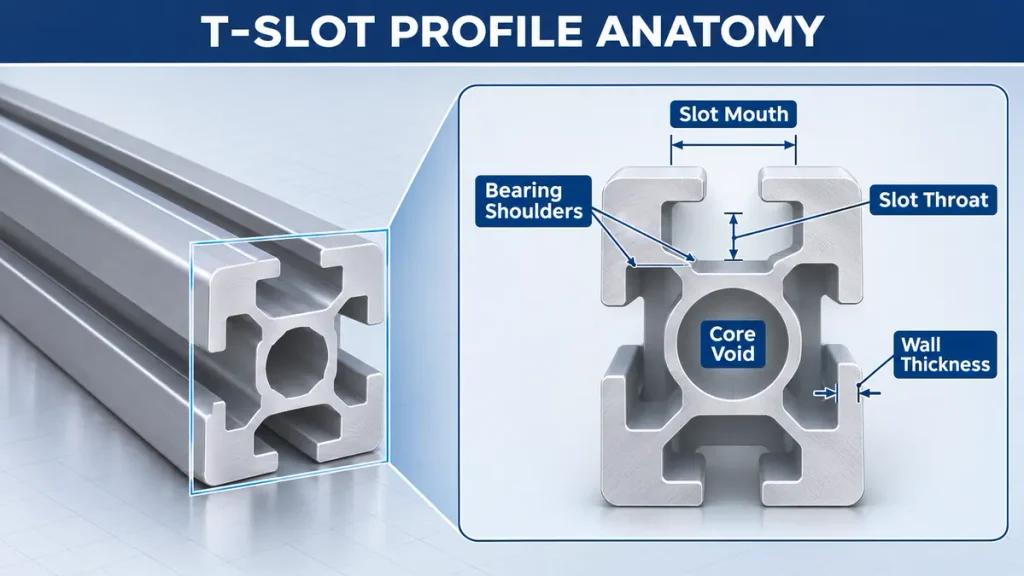
Every feature is formed in one pass and fixed by the aluminum extrusion dies, not by downstream machining. A profile that measures correctly on the outside can still have a slot throat too wide to hold a nut under load.
Why 6063-T6 Dominates
The 6xxx family balances extrudability against strength. 6063 pushes through complex hollow dies at high speed, finishes cleanly, and responds well to ageing and anodizing. Acceptance requirements for these tempers are defined in ASTM B221, the standard specification for extruded aluminum profiles.
| Alloy and temper | Tensile strength | Yield strength | Extrudability | Typical role |
| 6063-T6 | 240 MPa | 215 MPa | Excellent | General framing, guards |
| 6063-T5 | 190 MPa | 150 MPa | Excellent | Light frames |
| 6005A-T5 | 270 MPa | 225 MPa | Good | Medium duty structures |
| 6061-T6 | 310 MPa | 275 MPa | Moderate | Heavy load members |
| 6082-T6 | 310 MPa | 260 MPa | Moderate | High load frames |
Where a frame carries a machine tool or a mezzanine load, 6061-T6 is often substituted at the same nominal section. The penalty is a narrower extrusion window and a higher unit price, not a change in slot geometry.
Where the Profiles Are Used
Guards are rebuilt when a line is rearranged, benches are cut to height, and cleanroom frames benefit from an anodized surface that wipes down cleanly.
How the Die Shapes the Slot
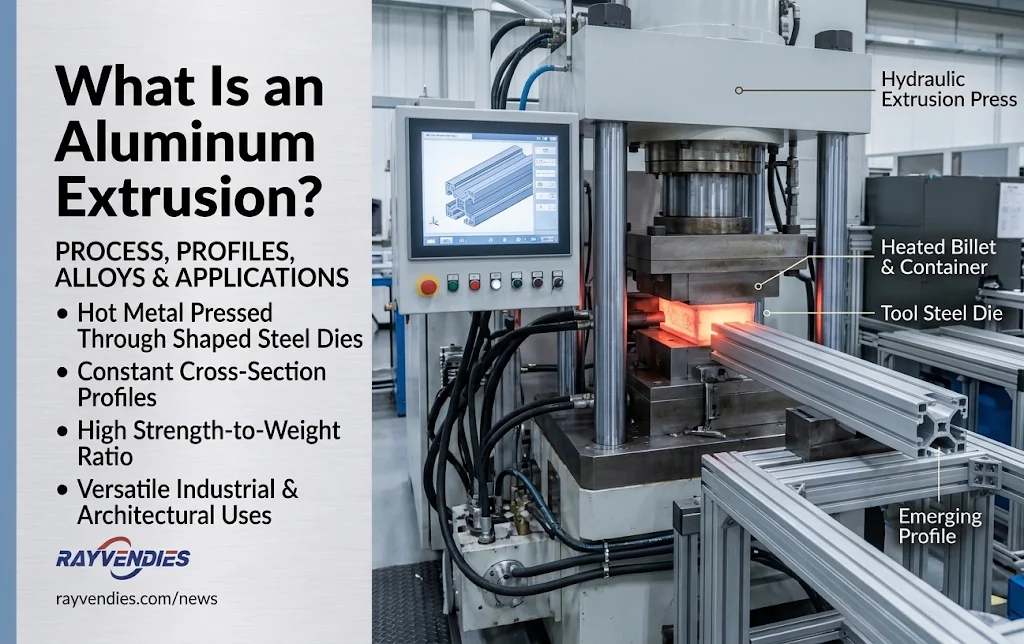
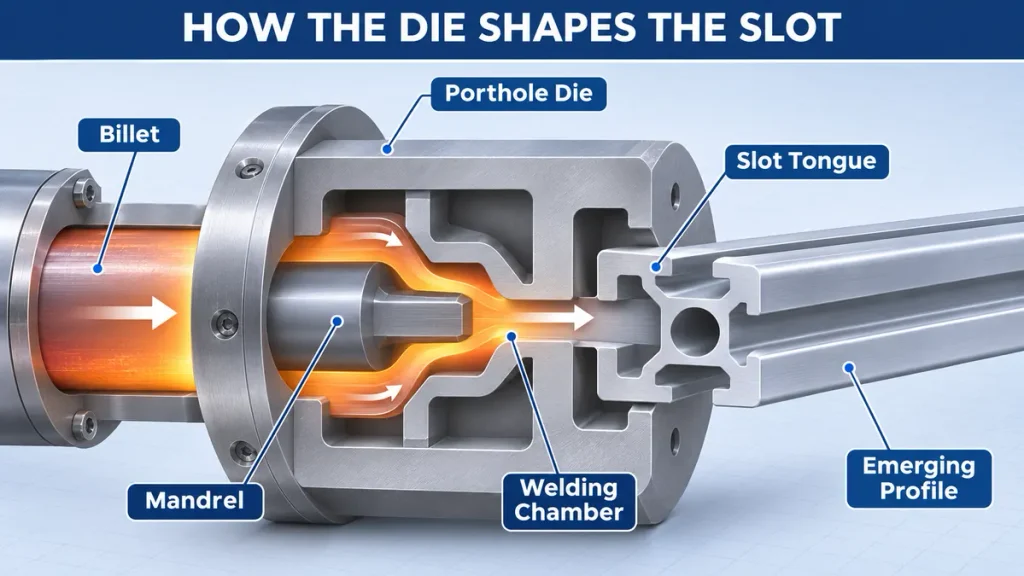
A T-slot cross-section is created in one continuous operation: a heated billet is pushed through a die whose opening matches the section, and the metal emerges with the slot, the void, and the wall thickness already in place. The die therefore sets slot geometry, wall uniformity, and surface finish before the profile is cooled, straightened, cut, or anodized.
Most buyers never see this stage, and it explains most of the variation between suppliers. Two profiles can both be labelled 4040 and still differ in throat width, shoulder flatness, and corner radius, because each came from a different die.
Hollow Dies for Enclosed Cores
A T-slot section encloses a central void, so it cannot run on a flat die. The billet must be split into streams around a mandrel and recombined before it leaves the die. This is the domain of hollow aluminum extrusion dies, typically porthole or bridge designs with a welding chamber where the streams rejoin under pressure.
Two consequences follow. The longitudinal seam must weld completely, or the profile splits during stretching. And the tongue forming the slot mouth is a thin feature surrounded by flowing metal, so it wears or fractures first. A profile with four open slots puts four such tongues in one die, which is why slot control is a tooling question rather than a finishing question.
Wall Thickness and the Bearing Surface
Wall thickness is usually quoted as a nominal figure with about ten percent tolerance, but the number that matters at the joint is local. If the shoulder behind the slot is thinner than nominal, a nut at recommended torque deforms it, the joint relaxes, and the frame loses squareness under vibration. Heavy series profiles solve this by thickening the shoulder rather than enlarging the section, which is why a heavy 4040 weighs more than a light one at the same footprint.
Tooling for Structural Framing
Framing that carries equipment rather than panels moves into a different tooling class, grouped with architectural structural aluminum profile molds where the emphasis is thicker walls, tighter corner radii, and straightness over six metre lengths. Higher extrusion pressure is required, and die steel and nitriding are chosen for a longer run rather than the fastest cycle.
Why Slot Geometry Drifts
Slot mouth width is not constant across a campaign. The slot tongue erodes, widening the mouth by hundredths of a millimetre per run. Unbalanced bearing length slows metal locally, deflecting the tongue and shifting the slot off centre. For repeat orders, measure mouth and shoulder width on a sample from each lot.
Standard Series and Slot Widths
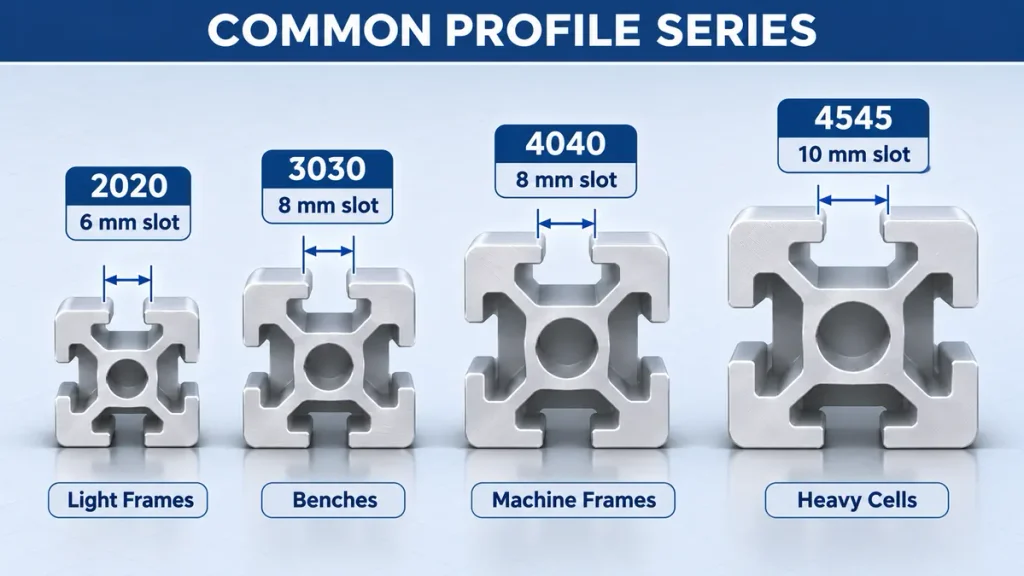
Series designations describe the nominal outside dimension; slot width describes the fastener family. The two travel together: a 2020 normally carries a 6 mm slot and takes M5 hardware, a 4040 an 8 mm slot and M8, a 4545 a 10 mm slot. Fractional systems follow the same logic in inches and are never dimensionally compatible with metric profiles.
| Series | Nominal section | Slot width | Fastener | Typical use |
| 1515 fractional | 1.5 in | 0.30 in | 5/16-18 | Light carts, small enclosures |
| 2020 | 20 x 20 mm | 6 mm | M5 | Desktop equipment, light guards |
| 3030 | 30 x 30 mm | 8 mm | M6 | Medium frames, benches |
| 4040 | 40 x 40 mm | 8 mm | M8 | Machine frames, automation |
| 4545 | 45 x 45 mm | 10 mm | M8 to M10 | Heavy frames, robot cells |
| 8080 | 80 x 80 mm | 8 or 16 mm | M8 to M12 | Gantries, base structures |
Metric and Fractional Systems
The metric range runs 20, 25, 30, 40, 45, and 60 mm and above, with rectangular variants such as 20 x 40 and 45 x 90 for beams needing a stronger axis. The fractional range uses 1 inch and 1.5 inch modules with imperial hardware. The two look similar enough to be confused and are never interchangeable: slot width, nut head width, and thread all differ. Even within one system, slot dimensions vary between manufacturers, so a mixed purchase should be sample fitted first.
The 2020 size is the entry point for most new builds. Its 2020 aluminum extrusion dimensions suit bench equipment and its accessory range is the widest relative to its size, but its moment of inertia is low and it should not be stretched across long unsupported spans.
Choosing a Series
Four factors decide the series: load, unsupported span, accessory range at the chosen slot width, and budget. The common error is sizing for load and ignoring span. Going up one series is usually cheaper than bracing a smaller profile, but gusseting a 3030 can cost less than moving the frame to 4040. Both are legitimate; the mistake is choosing neither.
Load Capacity, Span and Stiffness
Load capacity is not a single number on a datasheet. It is the load a given profile carries at a given span with given end conditions before deflection, not failure, becomes unacceptable. Published tables report values for defined spans and supports, and using them outside those conditions gives optimistic results.
Stiffness, not strength, governs most framing decisions. Aluminum frames rarely break; they sag, and a sagging frame misaligns the machine mounted on it. The scale effect is large:
| Profile | Mass | Ix | Iy | Zx |
| 2020 | 0.48 kg/m | 0.68 cm4 | 0.68 cm4 | 0.68 cm3 |
| 4040 light | 1.35 kg/m | 7.8 cm4 | 7.8 cm4 | 3.9 cm3 |
| 4040 heavy | 1.85 kg/m | 11.5 cm4 | 11.5 cm4 | 5.7 cm3 |
Doubling the section dimension raises the second moment of area by more than an order of magnitude, which is why a 4040 frame behaves so differently from a 2020 frame of identical layout.
How Much Weight Can It Hold?
It depends on span and support, and any figure quoted without those conditions is marketing. A short, well supported 4040 member carries several hundred kilograms in compression; the same profile spanning two metres as an unsupported beam deflects visibly under a fraction of that load. Take the load table for the exact profile, find the span closest to the application, then apply a safety margin. For critical structures, a beam calculation using the tabulated Ix and the alloy modulus of 68.9 GPa confirms the table.
Why Span Dominates Deflection
Deflection scales with the cube of span under a point load, so doubling the span multiplies it by eight. That relationship explains why a mid span support beats upgrading the profile.
Assembly and Connection Methods
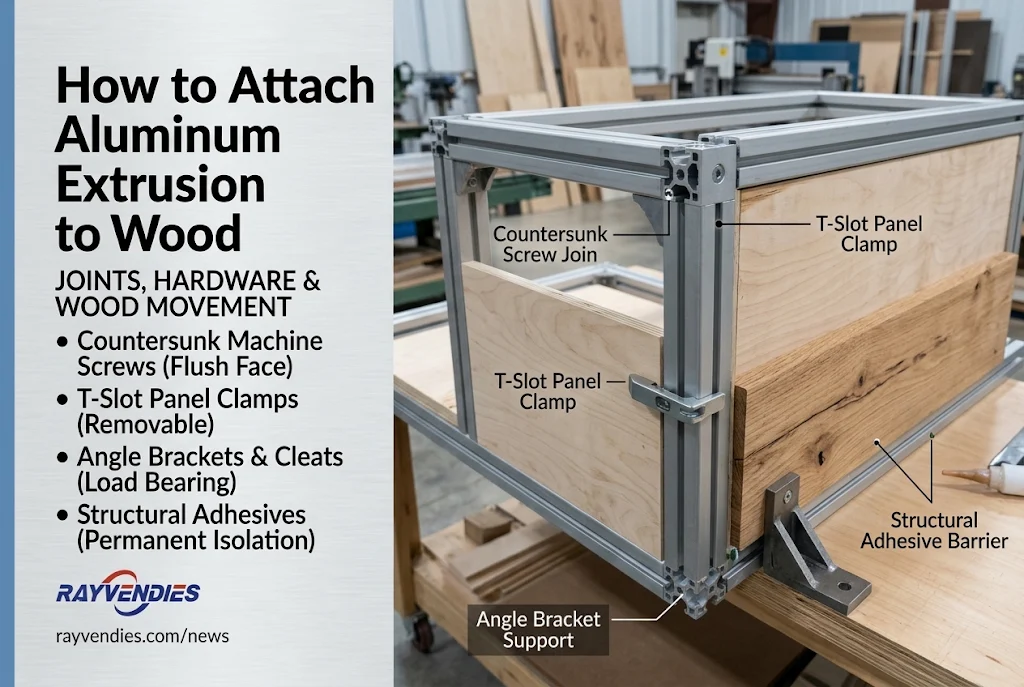
T-slot frames are assembled with fasteners that clamp into the slot rather than through the face of the profile. The connector sets joint stiffness, the machining required, and whether the connection can be adjusted later without dismantling the frame.
T-Nuts and Bolts
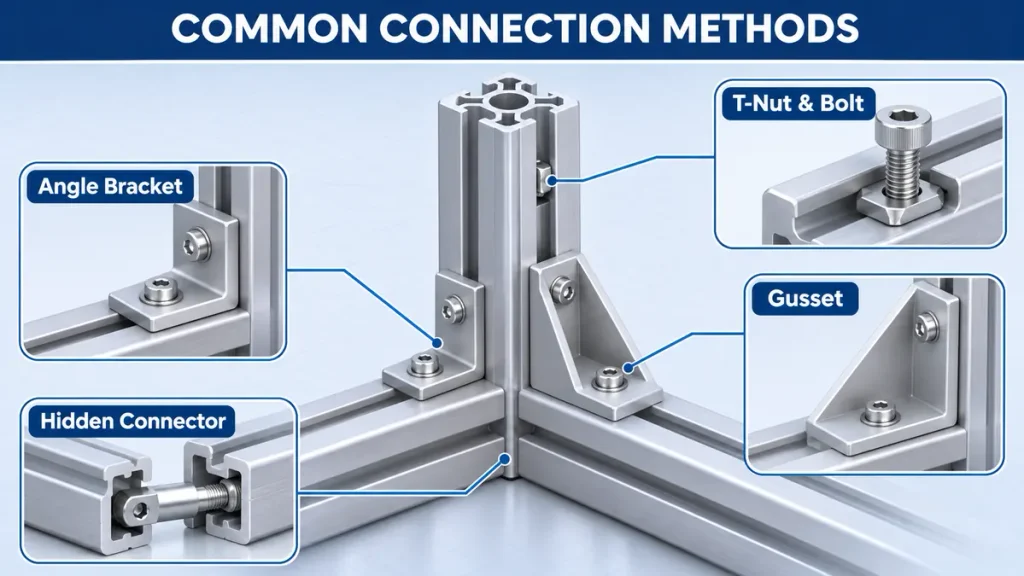
Standard T-nuts slide in from the end and give the highest clamp load. Roll-in nuts have a spring-loaded head inserted through the slot mouth at any point, which suits frames already partly assembled. Drop-in and hammer-head nuts place fastest but bear on a smaller shoulder area, so reserve them for light connections.
Brackets, Gussets and Joining Plates
Angle brackets join two profiles at 90 degrees and carry load through the bracket rather than the slot. Gussets add a diagonal and are the cheapest way to raise corner stiffness. Joining plates bolt across two profiles for splices and T-joints. For frames that must resist racking, one diagonal brace per bay does more than extra hardware at the corners.
Hidden Fasteners and End Tapping
Where the frame is visible, or a slot must stay clear for a sliding panel, hidden connectors are used. An end tap cuts a thread into the core void, and a bolt through an access hole in the mating profile pulls the two together. The joint is stiff and leaves no external bracket, but it needs accurate drilling, so it suits frames produced more than once.
T-Slot vs V-Slot: Which Fits the Build?
The difference is the slot profile. A T-slot has a flat-bottomed channel with squared shoulders that seat a nut for structural clamping. A V-slot has 45 degree angled faces that double as a track for wheels, making it a motion component as well as a structural one.
| Feature | T-slot | V-slot |
| Slot geometry | Flat bottom, squared shoulders | 45 degree V faces |
| Primary function | Structural framing | Framing plus linear motion |
| Wheel compatibility | Not compatible | Takes matching V-wheels |
| Clamping area | Wide, high torque | Narrower, lower clamp load |
| Typical build | Machine frames, guards, benches | Light gantries, small CNC |
For a frame that holds a machine, choose T-slot. For an axis that must travel, choose V-slot, or combine a V-slot axis with a T-slot base, as many small gantry machines do.
Finishes, Tolerances and Order Checklist
Two finished profiles of identical section can differ more than two different sections, because finish and tolerance are specified separately from geometry. Both must appear on the order rather than be assumed.
Anodizing and Powder Coating
Clear anodizing at 10 to 15 micrometres is standard indoors; outdoor or washdown equipment usually specifies 20 to 25 micrometres. Hard anodizing at 25 to 50 micrometres adds wear resistance but changes the slot dimension slightly, since coating grows into the slot as well as onto the outer faces. Powder coating adds colour and thicker protection but is dielectric, which matters wherever the frame is an earth path. Request masking on any surface that must stay conductive.
Tolerances That Matter
Cut length is the one most buyers check, usually plus or minus 0.5 mm on a precision saw, but four others decide whether a frame assembles. Twist and bow affect how two profiles sit against each other. Slot position affects bracket alignment. Slot mouth width controls nut retention. Wall thickness sets the clamp load a joint takes. Published aluminum extrusion tolerances follow national standards, and a supplier that cannot name the standard it works to is not controlling these dimensions.
What to Specify Before Ordering
A complete line item carries alloy and temper, series and section drawing number, slot width, cut length and tolerance, twist and bow limits, finish type and thickness, masking requirements, machining, and packing. Naming the extrusion standard closes the last gap, because it converts nominal dimensions into an acceptance criterion.
FAQ
Are T-slot profiles from different suppliers interchangeable?
Only if slot geometry matches, which a nominal series does not guarantee. Mouth width, throat depth, shoulder height, and corner radius vary between dies, and a nut that fits one profile may bind or slip in another. A T-slot aluminum extrusion profile from a second source can share a frame, but the joint should be sample fitted first.
What is the maximum length supplied?
Six metres is the standard extrusion length, set by handling and by anodizing tank capacity. Longer runs are spliced with joining plates or internal connectors, which is acceptable if the splice sits at a low moment location. For export, practical lengths are often limited by container dimensions, so agree cut lengths early.
Can profiles be machined after anodizing?
Yes, but every operation exposes bare aluminum and removes the coating locally. Machining before anodizing keeps the finish intact and is the normal route. If post anodizing work is unavoidable, state it on the drawing so the supplier can allow for coating thickness inside tapped holes.