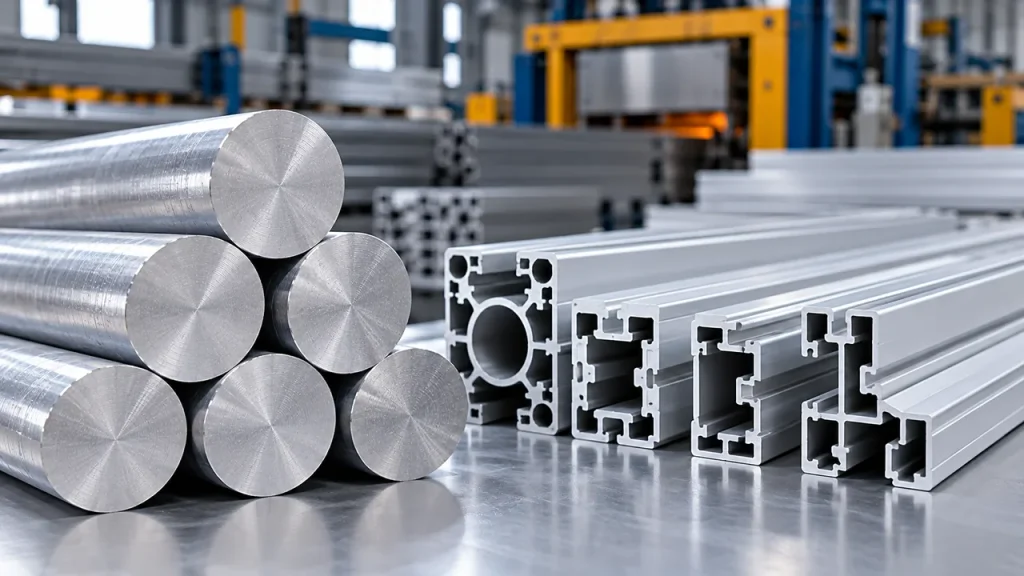
Aluminum extrusion is one of those procurement categories where the answer looks simple and isn’t. Standard shapes are widely available from almost any metal service center, but the moment a drawing calls for a hollow profile, a tight wall tolerance, or a specific alloy temper, the choice of supplier narrows fast. Most buyers lose time not because they can’t find extruders, but because they don’t know which of the four supply channels actually fits their volume, tolerance and finish requirements.
The four main places to buy extruded aluminum are direct from the extrusion mill, through a metal service center or distributor, through an online standard-profile supplier, or through an extruder that only does contract work. Standard shapes in common alloys come fastest from distributors and online suppliers. Custom profiles, hollows, or anything with a controlled drawing should go to a mill that builds its own tooling, and the further downstream you buy from, the less control you keep over tolerances, alloy traceability and lead time.
What follows breaks down each channel, then covers how the extrusion process shapes what you can order, what the material actually costs, and what to send with an RFQ so the quotes you get back are comparable.
Where can you actually buy extruded aluminum?
Buyers get extruded aluminum from four channels: the producing mill, a distributor or service center, an online standard-shape supplier, or a contract extruder. The right choice depends almost entirely on whether you need a standard shape or a custom profile, and on how much you need per year.
Direct from the extrusion mill
This is the channel for custom work. A mill that presses its own billets and builds its own dies gives you control over alloy, temper, wall thickness, cross-section geometry and surface treatment. It also gives you the shortest path to a fix when something runs off tolerance, because the people who made the die are in the same building as the press.
Most large architectural and industrial producers run presses in the 500 to 5000 metric ton range, with billet diameters matched to the profile’s circumscribing circle. Some operate their own die shops, which matters more than buyers usually expect—die design is what determines whether your profile can actually run at production speed. Reading about a supplier’s die capability is a reasonable proxy for how seriously they take your part. Working with a custom aluminum extrusion dies manufacturer gives you a clearer picture of tooling capability before you commit to a quote.
The tradeoff is minimum order quantity. Custom dies and profiles typically carry MOQs in the range of 500 kg to 1 metric ton per design, because die manufacture is a fixed cost that has to be recovered somewhere (per-die MOQ ranges per supplier published guidance, checked 10 October 2026).
Distributors and metal service centers
Service centers stock standard shapes — angle, channel, I-beam, H-beam, rod, bar, tube, and the common T-slot framing profiles — in the alloys most fabricators use. They hold inventory, cut to length, and often saw, drill, or punch in-house.
This is the sensible channel for prototypes, machine frames, guarding, and any job where you need material in a few days rather than a few weeks. The limits are alloy availability, wall thickness range, and geometry. If your profile is a closed hollow with a non-standard wall, a service center probably can’t help.
Online standard profile suppliers
Online suppliers of standard extrusions work well for small quantities and non-critical dimensions. Several offer pieces as low as a single meter with MOQs around 300 to 500 kg for common profiles. For a bracket, a rail, or a frame member where the profile is a catalog item, this route is fast and inexpensive.
Be careful about two things. An MOQ quoted per piece is not the same as an MOQ quoted per kilogram, and the alloy grade behind a low price isn’t always stated explicitly. Ask for the temper designation and the mill certificate before you commit.
Which channel fits your volume
| Procurement scenario | Recommended channel | Why | Main risk |
|---|---|---|---|
| Catalog profile, prototype or small batch | Distributor or online supplier | No tooling cost, ships in days | Limited alloys and wall thickness |
| Machine frame or guarding, moderate volume | Distributor with secondary ops | Cut-to-length and machining in one order | Standard geometry only |
| Custom solid profile with a controlled drawing | Extrusion mill with in-house die shop | Full control over geometry and tolerance | Die cost, 6 to 12 week lead time |
| Hollow or multi-cavity profile | Extrusion mill, die specialist | Hollow tooling is the hard part | Higher die cost, tighter process window |
| High-volume architectural or structural | Large mill | Press size and finishing capacity | Longest qualification cycle |
What is aluminum extrusion used for?
Aluminum extrusion is used wherever a part needs a consistent cross-section, low weight, corrosion resistance and the ability to be finished, machined or welded — building systems, transportation, heat management, machinery frames, and consumer goods all rely on it.
The application determines the specification, not the other way around. Common domains:
| Application area | Typical profiles | What drives the spec |
|---|---|---|
| Building and architecture | Window and curtain wall systems, framing members | Wall thickness, finish consistency, coating thickness |
| Transportation | Rails, battery trays, heat exchanger frames | Alloy strength, impact behaviour, weldability |
| Electronics and thermal management | Heat sinks, cold plates, housings | Thermal conductivity, fin geometry, flatness |
| Industrial machinery | T-slot framing, guards, conveyor rails | Tolerance on mounting features, anodized surface |
| Consumer goods | Frames, handles, casings | Cosmetic finish, low unit cost, cosmetic consistency |
Aluminum is also one of the most recyclable metals in use, which shapes how specifiers think about material choice over a product’s life cycle. The Aluminum Association publishes detail on recycling rates and the energy saved by reusing aluminum, and most buyers find it worth reading before committing to a material family.
Understanding the aluminum extrusion process
The extrusion process heats an aluminum billet until it softens, then forces it through a hardened steel die under high hydraulic pressure. The metal takes the shape of the die opening, is cut to length, cooled, aged to the required temper, and then finished.
The practical part for a buyer is what the process does to your design decisions.
Direct and indirect extrusion
In direct extrusion, the billet sits in the press container and the ram pushes it straight through the die. The billet skin — the oxidized outer layer — ends up on the profile surface. In indirect extrusion, the die moves toward the billet instead, which gives a cleaner surface and better control over the profile, at the cost of a more complex die and container design.
Which method a supplier runs matters less than whether they run the right one for your geometry. Tooling for these routes is a specialist product: hot extrusion dies covers the die types and wear considerations involved, and it’s worth asking any mill what die class it will build for your part.
What the process means for your drawing
Three things decide whether a profile runs smoothly:
- Wall thickness ratio. Thin walls next to thick walls force uneven metal flow and can cause cracking or distortion. Constant wall thickness around 1.2 to 2.5 mm is the usual design target for extruded profiles.
- Contour size. A profile’s bounding circle must fit the press’s die and container size. Bigger circles need bigger presses.
- Symmetry and transitions. Symmetrical shapes flow more predictably than offset ones. Abrupt section changes and deep undercuts slow the press and increase scrap.
If you can’t change the geometry, at least ask the supplier for a manufacturability review before the die is cut. It’s a cheap step that catches expensive problems.
How much does extruded aluminum cost?
A finished extrusion price is the sum of base metal, extrusion processing, finishing, tooling amortization and logistics. A supplier quoting per pound is usually quoting the extrusion only, so the first question is what the number includes.
Where the money actually goes
Published supplier and industry cost breakdowns for custom extrusion put the pieces roughly like this (figures checked 10 October 2026, and they vary by region and specification):
| Cost component | Typical range | Notes |
|---|---|---|
| Raw aluminum, base metal | roughly $1.10 to $1.50 per lb | Commodity base price only |
| Extrusion processing | roughly $0.50 to $1.50 per lb | Driven by shape complexity |
| Anodizing or powder coating | roughly $1,200 to $1,400 per metric ton added | Depends on coating spec and colour |
| CNC machining and secondary ops | roughly $200 to $300 per metric ton added for simple drilling | Complex machining adds its own tooling |
| Die tooling | roughly $300 to over $5,000 per profile | Depends on geometry and hole count |
| Freight and regional premium | Highly variable | In the US, the Midwest premium has historically added roughly $0.60 to $0.80 per lb over base |
Two of those lines need care. Anodizing and machining numbers are usually quoted as additions per metric ton of material, not per part, so a small, heavy part looks very different from a large, light one. And the regional premium is a market condition, not a supplier margin — in a tight primary market it applies regardless of who you buy from.
Tooling amortization, the part buyers miss
Die cost is a one-time charge. Extrusion cost per part is not, because the same die runs across your whole order. The relationship is simple:
Tooling cost per unit = die cost ÷ total units planned from that die
An illustrative example from published supplier guidance: a $2,000 die expected to run 40,000 kg adds about $0.05 per kg to production. The same die spread across only 500 kg adds about $4.00 per kg. Nothing about the metal changed — only the volume. This is why the same drawing can be quoted at two very different prices, and why a supplier asking about your annual volume isn’t small talk.
Published die life figures vary with geometry and alloy. One supplier’s guidance puts solid dies at 20,000 to 50,000 kg of extrusion and hollow dies at 10,000 to 30,000 kg, with high-strength alloys such as 7075 reducing die life noticeably. Treat these as typical ranges, not guarantees for your specific part.
What changes your per-unit price
- Alloy. 6063 is the baseline for most profiles. 6061, 6082 and higher-strength grades carry premiums, and some alloys aren’t stocked so minimums apply.
- Geometry. Multiple hollows, tight corners and thin walls reduce press speed and increase die wear.
- Tolerance. Tight straightness, twist and wall thickness requirements mean more inspection and more scrap risk.
- Finish. Mill finish is the cheapest. Anodizing, powder coating, electrophoresis and wood-grain effects all add cost.
- Order volume. Moving from a few hundred to several thousand units can materially reduce per-unit cost, because setup, die preparation and inspection are spread further.
- Lead time. Expedited runs carry rush fees.
What to send with your RFQ
Send a controlled drawing with every critical dimension toleranced, the alloy and temper written out, the finish specified by standard, and the inspection scope defined. Without those four things, quotes aren’t comparable and you’ll be chasing the difference later.
A drawing that gets a useful response includes:
- All critical dimensions with their tolerances, including straightness and twist limits
- Wall thickness requirements and any variation in wall thickness along the length
- Alloy grade and temper designation
- Surface finish, referenced to the applicable standard, with a colour reference where appearance matters
- The required length and whether cut pieces are acceptable
- Quantity for this order and expected annual volume
- Any tolerance-critical functional features that need to be called out separately
On the commercial side, state what you need in writing before quoting starts: minimum order quantity per design, tooling ownership and maintenance terms, sample lead time, packaging requirements, and shipping terms. For a first order, staged payment and a pre-shipment inspection against the approved sample are worth the small cost.
The documentation to request before production releases: mill test certificates confirming alloy composition and mechanical properties, a dimensional inspection report against the drawing, finish records including coating thickness and adhesion results, and first article documentation if your application warrants it.
Cheaper alternatives to aluminum extrusion
When extrusion looks expensive, the answer is usually a different process rather than a different material — CNC machining from plate or bar, high-pressure die casting, roll forming, injection moulding, or a hybrid profile that combines extrusion with a machined or joined section.
| Alternative | Better suited to | Relative cost behaviour | Main limitation |
|---|---|---|---|
| CNC machining from solid plate or bar | Prototypes, low volume, complex features | Higher unit cost at volume, low tooling cost | Slow and wasteful in large batches |
| High-pressure die casting | High volume, thin walls, complex 3D shapes | Low unit cost at high volume | Requires minimum order quantities, different alloy options |
| Roll forming | Thin-gauge, constant-section sheet parts | Competitive for long runs | Limited to simple sections and gauge range |
| Injection moulding | Small precision parts, consumer volumes | Competitive at very high volume | Not practical for large structural profiles |
| Hybrid extrusion plus machining | Critical features on a standard-ish profile | Middle ground | Adds a secondary operation and fixturing |
Two design moves reduce extrusion cost without changing the supplier. Consolidating features into a single profile removes a die and simplifies assembly. And asking whether an existing die in the supplier’s inventory already meets your geometry can eliminate tooling entirely — standard shapes also ship faster.
How to verify a supplier before you commit
Verify by checking three things: the legal entity and factory behind the quotation, the documents they can produce on request, and a sample that matches a signed drawing.
Before issuing a purchase order, confirm the supplier’s legal entity, business licence, factory address, and whether the entity quoting is the factory or a trading company. Ask for a manufacturability review and a quotation tied to a revision-controlled drawing, alloy, temper, finish, tolerance scheme, inspection plan and shipping term. For significant orders, use a third-party inspection service at the point of shipment.
Certificates should be verifiable in the issuing body’s database — check the certificate number, the legal entity, the site address and the scope. A certificate covering a different plant than the one producing your parts is not a certificate for your order.
Ask to see or visit the die shop. Die condition tells you more about a supplier’s real output than a brochure does.
Frequently asked questions
Can I buy extruded aluminum by the piece rather than by weight?
Yes, for standard shapes. Most online suppliers and service centers will sell cut pieces or standard lengths, commonly with minimums in the range of a few hundred kilograms for common profiles. Custom profiles are almost always sold by weight or by length against a die charge, because the tooling has to be amortized somewhere.
How long does it take to receive a custom extrusion?
Published lead time guidance for custom orders falls broadly in the 6- to 12-week range, covering die development, extrusion, surface treatment, and basic secondary operations. Repeat orders using an existing die can ship considerably faster. A supplier that quotes a much shorter lead time for custom work without explaining the tooling plan is worth asking about.
Is it cheaper to import extruded aluminum from another region?
It can be, but landed cost changes the math. Base metal prices vary by region, and published figures put the US Midwest premium at roughly $0.60 to $0.80 per lb above the base commodity price in some periods. Freight, duty, inspection and long lead times can absorb the savings, particularly on low-volume orders where the tooling amortization is already spread thin. Ask for a delivered price, not an ex-works price, and compare on the same basis.