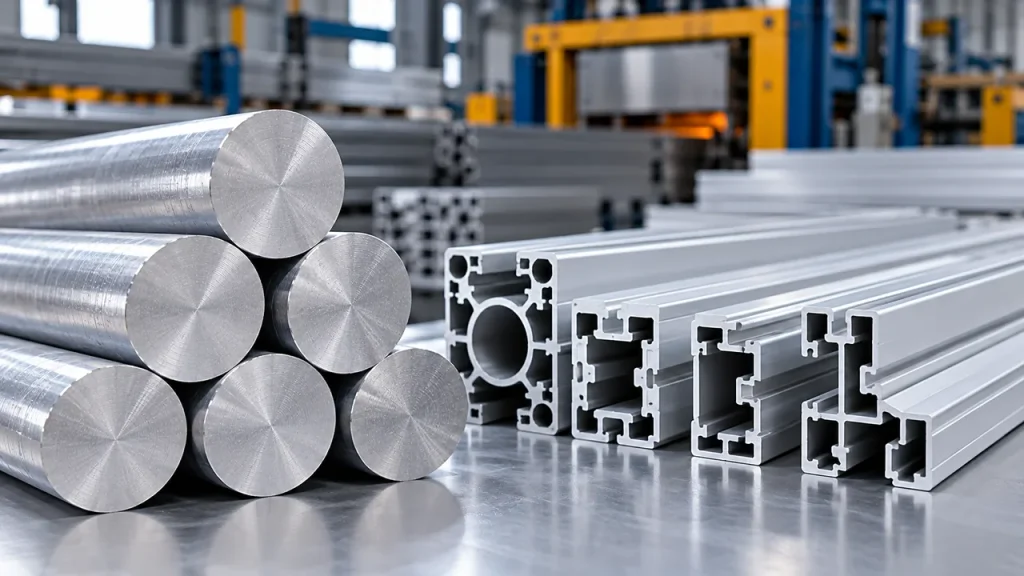
Two buyers order the same 40 x 40 mill-finish section in the same month and pay prices that differ by more than double. Neither is being cheated. One bought two full bars from a local distributor and collected them himself; the other ordered eighty pieces cut to length and had them delivered in three boxes. The metal was identical. What differed was how much handling, cutting, stocking and freight sat inside each number, and most of that difference was invisible on the quotation.
The cheapest place to buy aluminum extrusion is not one particular channel. It is the overlap of three conditions: a standard cross-section that already has a die, an order size that matches how the chosen channel sells, and every quotation converted to the same landed-cost basis before you compare them. When all three line up the price is genuinely low; when one is missing, a low headline number usually becomes an expensive order.
The sections below work through the channels first, then the arithmetic that decides which of them is actually cheapest for your quantity.

Where Can You Buy Aluminum Extrusion Cheaply?
Four channel types cover almost every purchase: local service centers and metal distributors, online cut-to-length retailers, B2B marketplaces and factory-direct suppliers, and surplus or remnant stock. Each is cheapest inside a different band of order size, and none is cheapest across all of them.
Prices spread because each channel sells a different bundle, not a different metal: availability and credit from a distributor, your exact cut list from a retailer, press time by the kilogram from a factory.

Local Service Centers and Metal Distributors
They stock common sections, sell by the length, bundle or kilogram, and most will cut. They are rarely the lowest rate per kilogram, but often the lowest total cost for anything needed within a week, because the material is already on the floor and there is no import leg. Collecting it yourself removes a delivery charge that can exceed the margin on a small order.
Online Cut-to-Length Retailers
Web-based sellers price per piece and per cut, stock the popular series and often bundle fasteners. The per-kilogram rate is the highest of the four channels, because you are buying the absence of waste and of your own saw time. They win for prototypes, fixtures and repairs where a full bar would sit unused.
B2B Marketplaces and Factory-Direct Suppliers
Volume buyers move here, and this is where per-kilogram prices fall furthest. The trade-off is that a factory quotation is assembled from parts distributors fold into one number: metal, extrusion charge, heat treatment, finish, packing and freight to port. A quotation naming only a per-kilogram rate is not a quotation yet. For a non-standard cross-section the tooling is priced separately, and aluminum extrusion dies carry their own cost, lead time and ownership terms. Whether the die is charged once, amortized, or retained by the supplier changes the economics of a small order more than the metal rate does.
Surplus, Offcut, and Remnant Stock
Remnant and clearance stock is the cheapest material per kilogram in the market: lengths are unpredictable and batches are mixed. For jigs, workbenches, machine guards and prototypes it is often the right purchase. It is not right for structural or safety-related work unless alloy, temper and traceability can be documented. Unknown mixed 6000-series material will bolt together perfectly well and then fail a stiffness calculation you had already signed off. Ask for the mill certificate before the price, not after.
Which Buying Channel Is Cheapest for Your Order Size?
Match the channel to the order rather than to the price list. Prototypes and repairs are cheapest from distributors and remnant stock, repeat medium volumes from distributors or mills on tiered pricing, fixed sections at high volume from a factory, and non-standard sections only make sense with a dedicated die whose cost is spread across the run.
There is no universal minimum order quantity worth memorising, because the threshold is set by four variables: weight per metre, die cost, press capacity and order value. A heavy section reaches a factory minimum in a few hundred metres; a light one may need several kilometres. The table is a starting point for which channel to compare first, not a rule about volumes.
| Buying Scenario | Channel to Compare First | Why It Usually Wins |
| Prototype, a few bars of a standard section | Local distributor, remnant stock | No setup cost, no import leg, material available now |
| Small volume needing accurate cut lengths | Online cut-to-length retailer | Cutting and waste priced in, no second operation |
| Repeat medium volume, same section | Distributor account or mill with tiered pricing | Rate improves on forecast volume without a die commitment |
| High volume, fixed section | Factory direct | Press time sold by weight, lowest per-kilogram rate |
| Non-standard section, long-term demand | Custom supplier with dedicated tooling | One die amortized across the programme, not per order |

Two errors cost the most. A fifty-kilogram requirement sent to a factory invites a quote dominated by setup, so the per-kilogram figure that comes back is meaningless. A tonne bought at retail prices pays a handling margin on every kilogram.
How Much Does Aluminum Extrusion Cost?
A price only means something with six conditions attached: region, quantity, alloy and temper, surface finish, trade term and quotation date. Without all six, two numbers cannot be compared, and any published range is a benchmark rather than a rate. As one reference point, the metal itself has been expensive: the average United States ingot spot price rose 39 percent in 2025 to 180 cents per pound, according to the Mineral Commodity Summaries 2026.
That ingot figure is the price of metal, not of a finished extrusion, and the distinction explains most of the confusion here. Raw material commonly accounts for 60 to 75 percent of the cost of a standard profile, with extrusion processing taking 15 to 25 percent, finishing 5 to 15 percent, and labour and overhead the remainder. A finished, cut and anodized profile sold at the ingot price does not exist; a supplier quoting close to it is either excluding something or will add it later.
The quotation unit compounds the problem: five conventions are in daily use, each bundling a different scope.
| Quotation Unit | What It Usually Includes | Where It Appears |
| Per kilogram | Metal, extrusion, heat treatment; finish and packing often extra | Factory and mill quotations |
| Per pound | Same scope, converted; common in North American trade | Distributor and mill quotations |
| Per tonne | Metal plus extrusion and heat treatment, before finishing | Bulk and commodity contracts |
| Per metre | A specific section at a stated weight per metre | Stock bar sold by length |
| Per foot | Retail and small-lot pricing, usually finish included | Web stores and hardware supply |
A separate breakdown of aluminum extrusion cost by component, with the effect of alloy and profile geometry on each line, is worth reading before a first factory negotiation.
How to Compare Aluminum Extrusion Quotes
Convert every quotation to a landed cost per kilogram or per finished piece before comparing anything. The lowest ex-works number is frequently not the lowest landed number; the gap sits in freight, duty, cutting charges and how the die was priced.
Weight-Based vs Length-Based Quotations
A quotation per kilogram and one per metre are not interchangeable. The per-kilogram quote usually covers metal, extrusion and heat treatment, leaving finish, cutting and packing to be added. The per-metre quote from a stockholder typically includes the cut and the packaging. Comparing the two directly makes the stockholder look expensive when the factory figure was simply incomplete.
The Landed Cost Formula
The conversion is mechanical once the components are named: landed cost per kilogram equals ex-works price plus freight, insurance and documentation, duty and any trade remedy measure, port and inland handling, and inventory carrying cost, all divided by net received weight.
Take 2,000 kilograms quoted at USD 3.00 per kilogram ex-works, which is 6,000. Add 900 freight, 120 insurance and documentation, 200 port and inland handling, and 600 duty at whatever rate applies to that origin and classification. The order lands at 7,820, or 3.91 per kilogram, roughly 30 percent above the headline, before lead time and working capital are counted.
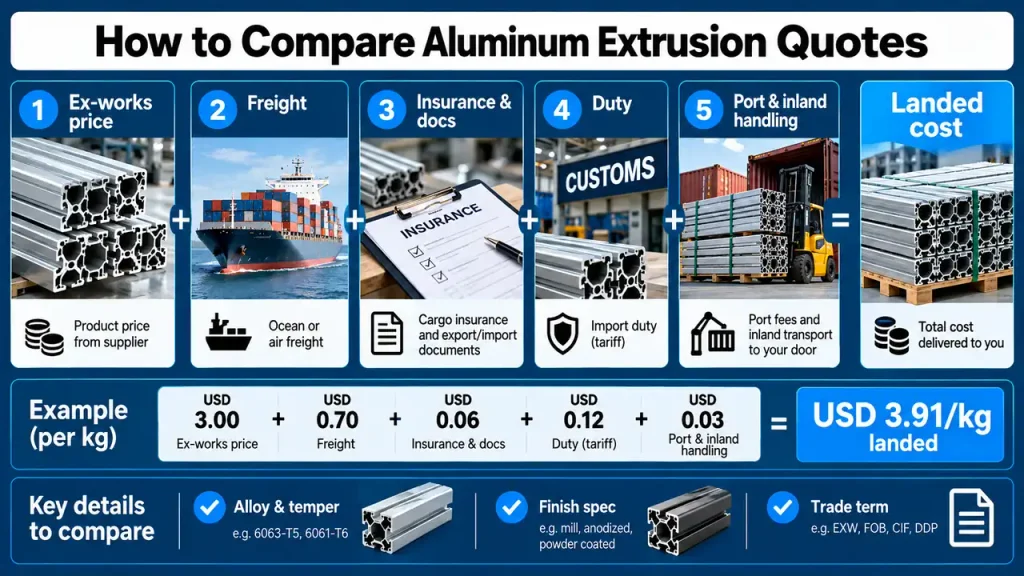
Two adjustments belong in the same calculation. Cutting charges, billed per cut or per piece, can move a landed cost several percent on short lengths, and drop material you pay for but cannot use is a real cost.
What Every Quote Should Disclose
A comparable quotation states alloy and temper, weight per metre, surface finish and its specification, lengths and quantities, trade term, validity period, and whether the die is charged separately. If any are missing, request them before negotiating; a supplier who cannot state them is not quoting the same product.
How to Reduce Aluminum Extrusion Costs
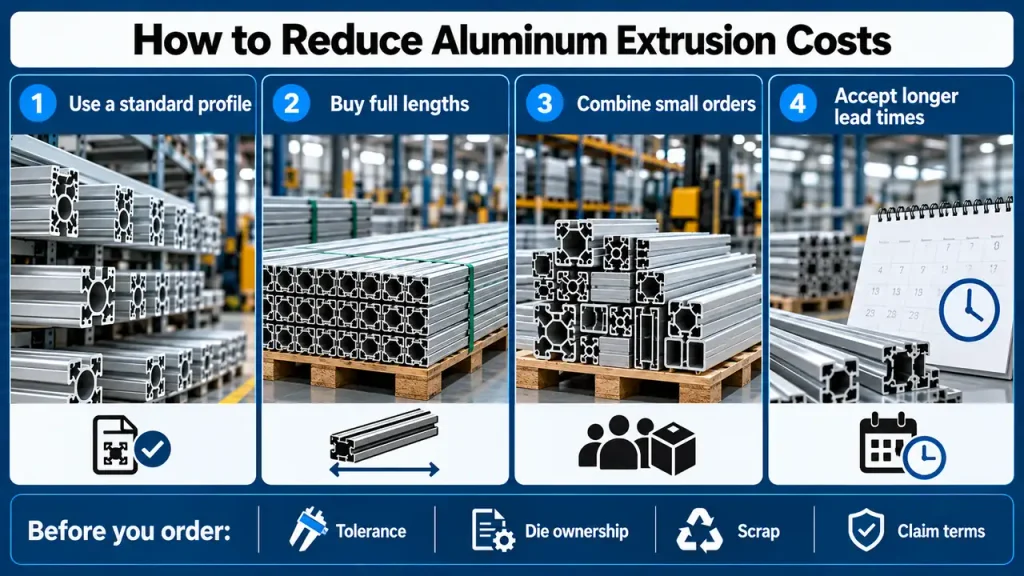
The largest savings rarely come from a few cents per kilogram. They come from design and order decisions: use a section that already has a die, buy full lengths where the cut list allows, combine small requirements into one run, and accept a longer lead time in exchange for a place in the press schedule.
Start with the section. A standard profile carries no tooling charge because the die already exists and has long been paid for. Designing around an available section is the highest-leverage decision in the exercise, and it is made before any supplier is contacted.
Where a new section is genuinely required, geometry drives cost more than anything else a buyer controls. Symmetric sections with uniform wall thickness extrude more easily and hold tolerance better than asymmetric shapes with thin walls and tight internal corners, a point the Aluminum Extruders Council makes in its design guidance. Every unnecessary hollow, every wall below one millimetre and every generous circumscribing circle adds press difficulty, die wear and scrap rate at once.
Order structure is the second lever. Full stock lengths cut in-house trade your saw time for the supplier’s cutting charge and remove drop from the invoice. Combining small requirements into one run spreads setup and freight across more kilograms, and accepting a standard slot instead of a rush date usually costs nothing but calendar time. Finish is the third: mill finish is adequate for frames, jigs and anything painted downstream, and a decorative coating on a part that lives behind a guard is a pure premium.
Where a dedicated section cannot be avoided, the tooling route is worth shopping. Sourcing through OEM ODM Extrusion Die Services lets the die be specified for the run length you actually have, because a die built for a long programme is wasted on a short one and a lightweight die will not survive a long one.
How to Tell a Genuinely Cheap Supplier from a False Economy
A genuinely cheap supplier answers four questions in writing before the order: what tolerance the section is held to, who owns the die, who owns the scrap, and what the payment and claim terms are. A price that only survives because none of those were asked is not cheap. The cost has moved to your inspection bench or your second order.
| Check Item | What to Ask | How a Weak Supplier Deflects |
| Dimensional tolerance | Which standard governs the section, and the tolerance on wall and twist | Quotes a nominal size and calls tolerance a production matter |
| Die ownership | Is the die charged, amortized into unit price, or retained by the supplier | Describes the die as free without stating conditions |
| Scrap and drop | Is unusable drop billed, credited, or excluded from net weight | Answers in gross weight only |
| Alloy documentation | Can a mill certificate accompany the shipment | Offers a generic composition statement instead |
| Surface specification | Which finish standard, and which thickness or coating weight | Names the finish without a specification |
| Claim terms | What happens if delivery fails inspection, and who pays return freight | Refers to standard practice without defining it |
Two steps remove most of the risk. Ask for a short sample length of the exact section and finish before the full run, and measure it against your own drawing rather than the supplier’s. Then state the inspection basis in the purchase order, so acceptance is defined before arrival rather than argued after it. If you are still shortlisting, the questions worth asking when choosing an aluminum extrusion manufacturer overlap with the table above.
What Is a Cheaper Alternative to Aluminum Extrusion?
The cheapest alternative to a custom aluminum extrusion is usually another aluminum extrusion: a standard section that already has a die and carries no tooling charge. Substituting the material comes second, and only pays when the load case, the environment or the weight target genuinely allows it.
The alternatives win narrowly. Steel wins where stiffness per unit of cost dominates and weight is irrelevant, and loses on corrosion and handling weight. PVC and engineering plastics win on cost, insulation and chemical resistance, and lose on creep, temperature limits and fastener pull-out. Timber needs no tooling and works with hand tools, but moves with moisture. Composite wins on corrosion and weight, and loses on price and joint design. For load-bearing or safety-critical structures, none of these should be decided on price alone.
Frequently Asked Questions
Four questions decide most first orders: whether buying direct pays, what sets the minimum quantity, whether to buy bars or cut lengths, and whether profiles from different suppliers can share one frame.
Is buying aluminum extrusion directly from a manufacturer cheaper?
Only above the point where setup and tooling are spread thinly enough. A manufacturer prices press time, and a small order carries the same setup and documentation as a large one, so a short run can cost more per kilogram than a distributor’s stock.
What is the minimum order quantity for custom aluminum extrusion?
It is set by the smallest billet the press can run, the run length needed to justify the die, and whether the supplier accepts a short run at a premium. Suppliers therefore state a minimum weight per profile per run, not a minimum number of pieces. Ask for both numbers.
Is it cheaper to buy extrusion cut to length or in full bars?
Full bars are cheaper per kilogram, cut lengths cheaper per finished piece, and the winner depends on how much of the bar you can use. If your cut list consumes most of a stock length and you have a saw, buy full bars. If the requirement is short and irregular, the drop costs more than the cutting charge.
Can I combine profiles from different suppliers in one frame?
Possible, with three checks. Alloy and temper should match across the assembly, or stiffness and fastener behaviour will differ between members. Slot geometry varies slightly within the same nominal series, so brackets may bind or sit loose. And anodized batches from different lines rarely match in colour. Verify with a jointed sample first.