Extruded aluminum shows up in more places than most people notice. Window frames, laptop enclosures, solar panel borders, and the rails inside industrial machines all start the same way. Specifiers and buyers meet the term on drawings and quotes, and a closer look at what is extruded aluminum helps explain why the material behaves the way it does.
Extruded aluminum is aluminum alloy that has been pushed through a shaped die while hot to form a piece with one fixed cross-section. The process turns a heated billet into long, uniform lengths, and those lengths become window frames, heatsinks, rails, and thousands of other parts.
The sections below cover how the process works, the profile types you will meet, where they are used, and what drives their cost.
What does “extruded aluminum” mean?
Extruded aluminum is the finished shape that leaves the press: a length of aluminum alloy with a single, repeated cross-section, made by forcing heated metal through a die. The word points to the result, not the machine.
The term describes a form of aluminum, not a single alloy or grade. Any 1000-, 3000-, 5000-, or 6000-series alloy can be extruded, so “extruded aluminum” tells you how the piece was made and what shape it has, not its exact chemistry. What stays constant is the cross-section: cut the piece anywhere along its length, and the face looks the same.
That consistency is the main reason designers reach for it. A profile can carry a complex outline across meters of length without joins, welds, or secondary assembly. It also makes stock predictable: a standard profile from one supplier will match the same profile from another, which simplifies repair and scaling.
How the aluminum extrusion process works
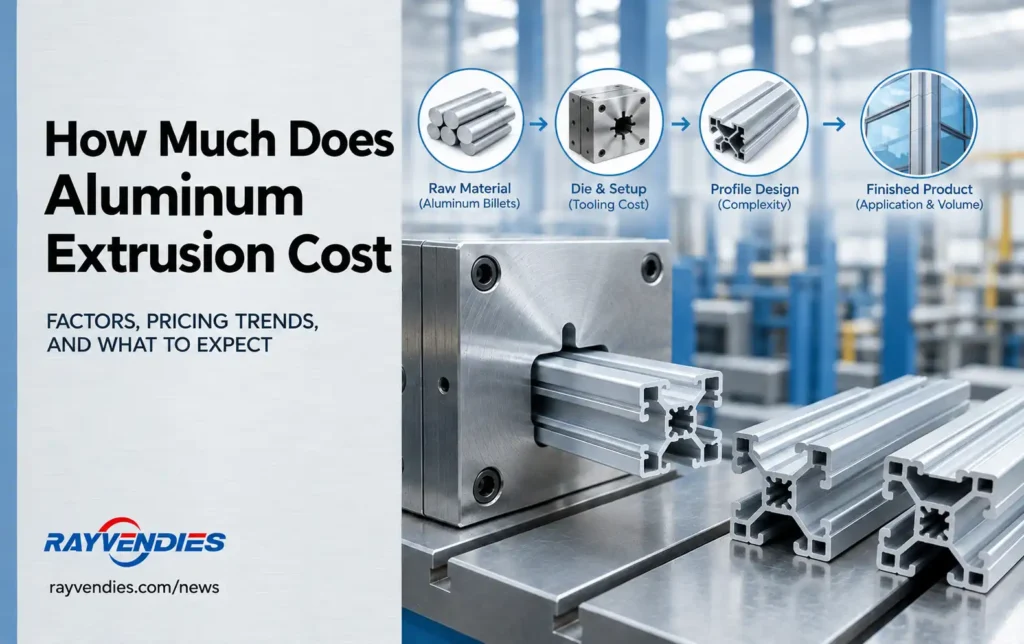
The process heats a solid aluminum billet until it is soft, then drives it through a steel die at high pressure so it exits as a long piece that matches the die’s opening.
The work happens in a clear sequence. Each step changes the metal a little until a raw log becomes a finished profile.
From billet to finished profile
- A die is cut and preheated, usually to about 450 to 500 degrees Celsius, so the metal flows evenly.
- A billet is sawn to length and heated to roughly 400 to 500 degrees Celsius. It turns malleable but does not melt.
- Lubricant is added, and the billet is loaded into the press container.
- A hydraulic ram pushes the billet, often under forces up to several thousand tonnes, toward the die.
- The soft metal is forced through the die opening and emerges as a continuous profile.
- The profile cools on a run-out table with air or water.
- A stretcher pulls it straight and work-hardens the metal.
- Saws cut it to the lengths the order specifies.
- An aging oven brings the alloy to its target temper, commonly T5 or T6.
The Aluminum Association describes extrusion as a plastic deformation process in which a solid cylinder of aluminum is forced by compression through a smaller die opening, which matches what happens on the press floor (aluminum extrusion process).
Alloys commonly used
Most commercial profiles come from a few families.
| Series | Typical members | Why it is chosen |
| 1000 | 1050, 1070 | High purity, good conduction, strong corrosion resistance |
| 3000 | 3003, 3103 | Manganese-bearing, used in transport and brazing |
| 6000 | 6060, 6063, 6061 | Easy to extrude and weld; the workhorse for structures and architecture |
Within the 6000 series, 6063 suits architectural shapes such as window and door frames, while 6061 is picked when a part needs more strength, such as frames and brackets. Choosing the series early avoids rework, because not every alloy anodizes to the same shade.
Common aluminum extrusion profiles
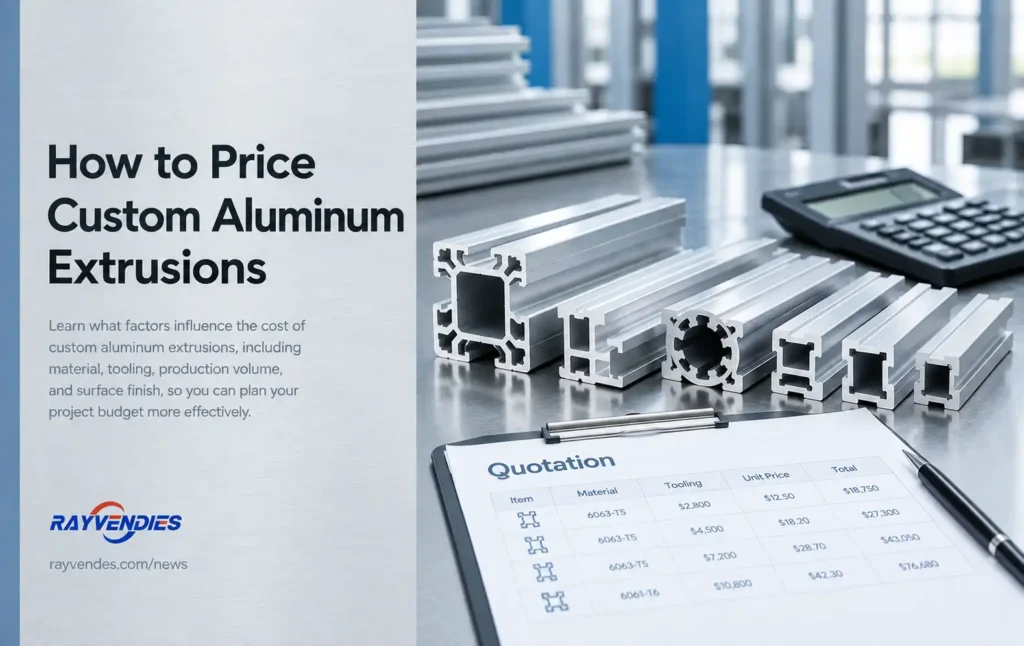
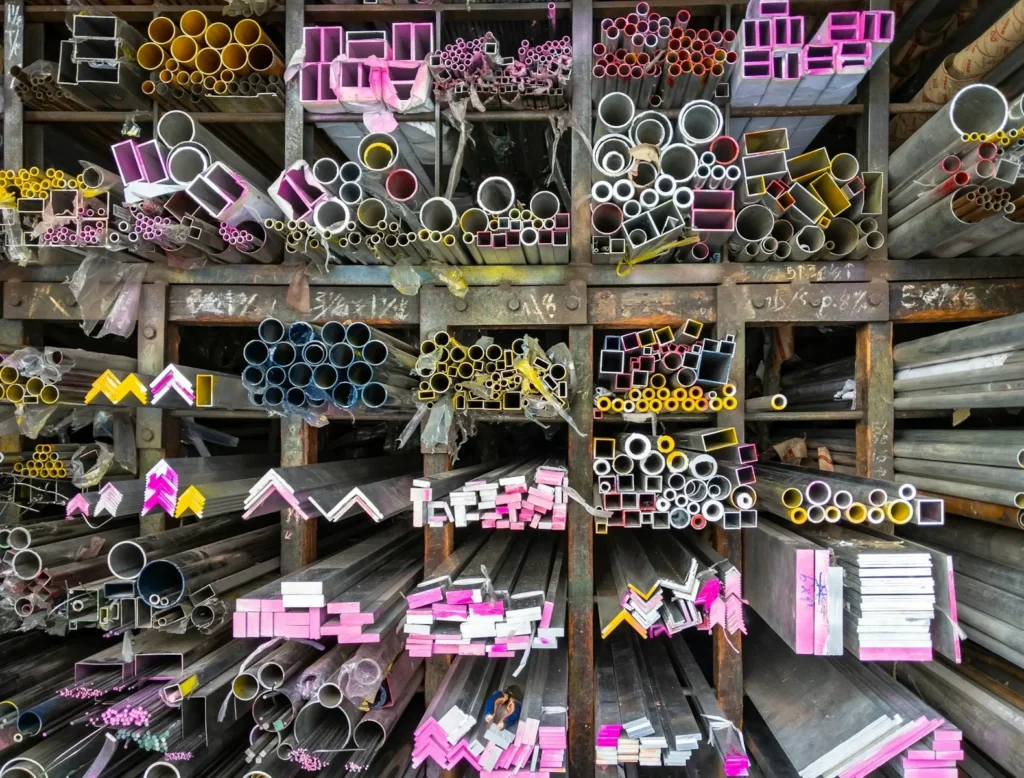
Extruded profiles split into three groups, solid, hollow, and semi-hollow, named for whether the cross-section encloses open space.
The die shape decides the group, and the group decides what the part can do.
Solid profiles
These have no enclosed voids. Bars, angles, beams, flat strips, T-sections, and Z-sections are all solid. They are the simplest to make because the die has one continuous opening, and they carry load well along their length.
Hollow profiles
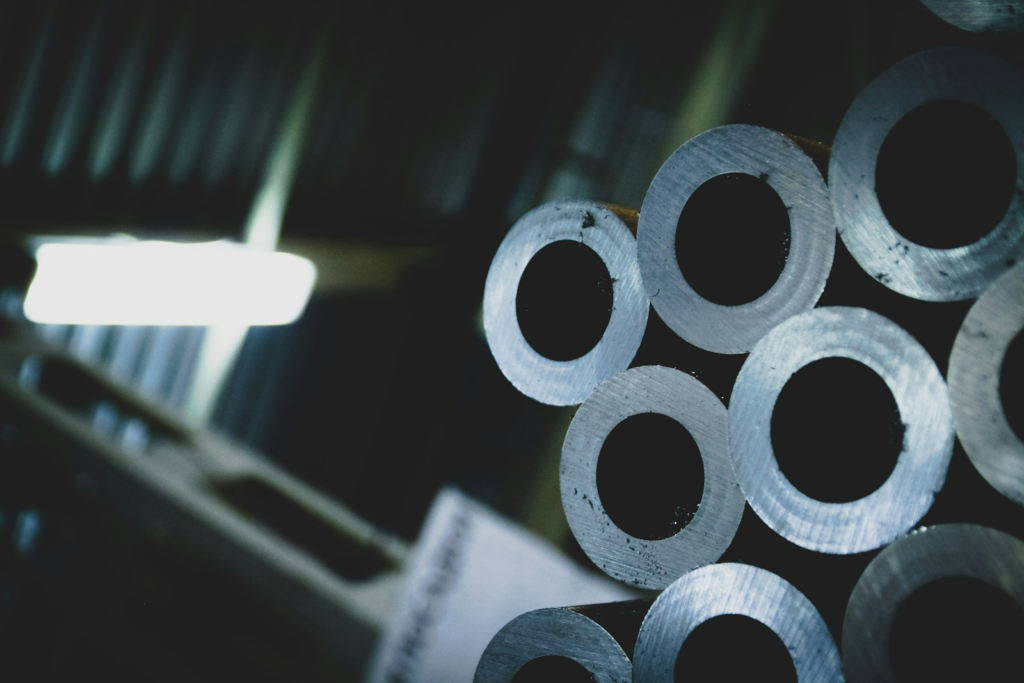
Hollow profiles enclose one or more voids. Round, square, and rectangular tubes are the common examples. Making them needs a die with a mandrel or piercing pin that forms the inner wall as the metal flows around it.
Semi-hollow profiles
Semi-hollow profiles have a partially enclosed void, such as a C-channel or U-channel. They sit between the other two in difficulty: the opening is narrow enough that the die tongue needs support to avoid deflection.
| Type | Void | Examples |
| Solid | None | Bar, angle, beam, T, Z |
| Semi-hollow | Partial | C-channel, U-channel |
| Hollow | One or more | Tube, square, and rectangular box |
What is aluminum extrusion used for?
Extruded aluminum enters construction, transport, electronics, energy, and industrial equipment because it is light, strong, and easy to shape into exact profiles.
The same properties that help the process also help the applications. A light part that resists corrosion and sheds heat fits many jobs at once.
Construction and architecture
Window and door frames, curtain walls, handrails, and structural inserts rely on extruded sections. The metal takes anodized or painted finishes that hold up outdoors, and the hollow profiles keep weight down without losing stiffness. Because the sections nest and clip together, installers build frames faster than with welded steel.
Automotive and transportation
Vehicle builders use extrusions for chassis parts, crash structures, roof rails, and battery enclosures in electric models. Cutting mass from a body improves range and handling, and the profiles can be joined by welding or bonding.
Electronics and renewable energy
Heatsinks, LED housings, and equipment enclosures use the metal’s ability to move heat away from components. Solar frames and mounting rails use their strength-to-weight ratio and resistance to weather. For a fuller list of sectors and parts, see aluminum extrusion applications.
Is extruded aluminum strong?
Extruded aluminum is strong for its weight: it carries a serious load at about one-third the mass of steel, and many grades get stronger as the temperature falls.
Density tells the first part of the story. Aluminum sits near 2.7 grams per cubic centimeter, against roughly 7.8 for steel, so a profile can do the job of a heavier steel part while weighing far less. Heat-treated 6000-series tempers raise tensile strength well above the as-extruded state, and 6061-T6 in particular is a common choice where a part must bear load.
Cold helps rather than hurts. Unlike some metals that turn brittle in the cold, aluminum keeps its toughness as temperature drops, which is why it appears in refrigeration and outdoor structures. What it does not do is match steel or brass in raw mass-based strength, so designers size profiles for stiffness and load path rather than bulk. For parts that must flex without cracking, the alloy’s ductility is an advantage, and tempers can be chosen to trade some strength for better formability.
Advantages and disadvantages of aluminum extrusion
Extrusion gives you complex shapes at a modest tooling cost and full recyclability, but it carries die setup expense and works best at volume rather than one-off runs.
The balance matters when you choose a manufacturing method.
Main advantages
Extruded aluminum is light, which cuts shipping and handling weight. It forms a thin oxide layer that resists corrosion without extra coating. It conducts heat and electricity well, stays non-magnetic, and takes tight tolerances across long lengths. It is also fully recyclable, so offcuts return to the supply chain instead of being landfill. It also machines cleanly when a profile does need a hole or slot, so extrusion rarely removes every later step.
Main disadvantages
The die is a fixed cost, so very small orders can look expensive once setup is spread across few pieces. The process suits constant cross-sections, not parts that change shape along their length. Where a design needs heavy mass for inertia or impact, aluminum’s low density works against it, and some finishes need surface prep before they bond.
| Strengths | Limits |
| Light and easy to handle | The cost is spread over volume. |
| Corrosion-resistant | Constant cross-section only |
| Recyclable and conductive | Lower mass-based strength than steel |
| Tight, repeatable tolerances | Some finishes need prep. |
Understanding aluminum extrusion price and value
Extruded aluminum is priced by alloy, profile complexity, order volume, and finish, and it usually costs more than plain bar stock because the die and setup sit behind every part.
Cost is not one number. Several factors move it, and understanding them helps you read a quote.
What drives the cost?
Alloy choice sets the base metal price, with 6000-series grades typical for most work. Wall thickness and tolerance affect how hard the die is to hold and how much scrap the run makes. Secondary operations such as cutting, drilling, bending, anodizing, or powder coating add steps after the press. Volume is the largest lever: a long run spreads the die and setup across many pieces, while a short run carries the same fixed cost on fewer kilos. Lead time also matters: a new die can take weeks, while a stock profile ships from inventory.
Why extruded aluminum commands a premium
The premium reflects what the part replaces. A near-net-shape profile often removes machining that a solid bar would need, so you pay for form as well as metal. Design freedom lets one section replace several assembled parts, which saves labor and joints. Recyclability and performance per kilo add value over the part’s life. For broader context on supply and demand, the aluminum market tracks where prices and volumes are moving.
How can you tell if aluminum is extruded?
You can usually spot extruded aluminum by its uniform cross-section, faint die seam lines, and a surface grain that runs along the length.
A few checks separate it from cast or machined parts. Cut or look at the ends: an extrusion keeps the same outline from one end to the other, while a casting may vary or show parting lines from a mold. Run a finger along the length and you may feel a thin, straight seam where the two die halves met. The piece feels light for its size and will not stick to a magnet, which rules out steel. Many extrusions also show an anodized or powder-coated finish that the process pairs with easily. A quick check with calipers along the length will show the section holds the same dimensions end to end, which a machined part may not if it was trimmed after cutting.
Frequently asked questions
Is extruded aluminum the same as cast aluminum?
No. Casting pours molten aluminum into a mold to make a fixed, often complex shape, while extrusion pushes heated billet through a die to make a long piece with one cross-section. Cast parts can change shape along their length; extrusions cannot. Each suits different volumes and geometries.
Can extruded aluminum be recycled?
Yes. Aluminum keeps its properties through recycling, so offcuts and end-of-life profiles return to production without loss of quality. Industry figures put a large share of all aluminum ever made still in use, which is why the material is treated as a closed-loop feedstock rather than scrap.
What tolerances can aluminum extrusion hold?
Standard commercial profiles commonly hold tolerances around 0.15 millimeters per side, and precision mills can hold tighter on request. The achievable number depends on profile size, wall thickness, and alloy, so complex or thin-wall sections may need a specified tolerance agreed before the die is cut.