
Most buyers ask this twice: when the first quotation lands above budget, and when a second supplier returns a price forty percent lower for the same drawing. Aluminum is not scarce, the process is over a century old, and the equipment is not exotic, so the gap comes down to a handful of cost layers that behave nothing like each other.
Aluminum extrusion is expensive because its price is assembled from five separate cost layers, and only two of them scale with weight. Billet is priced by a global exchange rather than by the extruder, the die must be paid for before the first meter runs, press time is billed by the hour whatever the yield, finishing is priced by area and part count, and setup work spreads across the order however small it is.
What follows traces one custom profile from billet to packed carton and shows which parts of that price you can actually move.
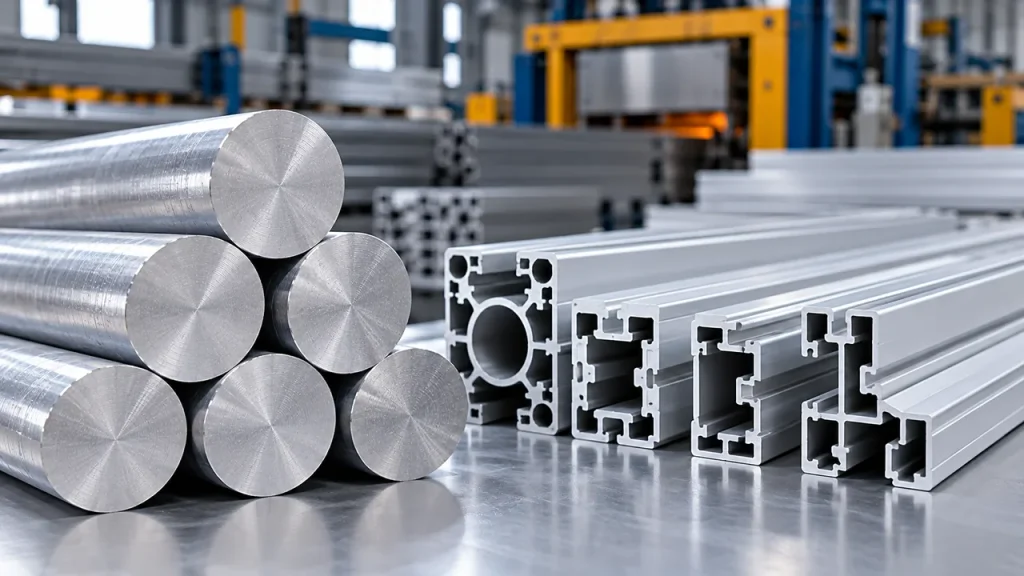
What You Are Actually Paying For
A quotation is not a material price with a margin bolted on. It is five cost layers added together, and only material and part of the conversion charge scale with weight. That is why two profiles of identical mass can carry very different prices per kilogram.
Unit cost per kilogram of accepted profile = (billet price / process yield) – scrap credit + die amortization + press conversion + finishing + inspection, packing and freight
| Cost layer | What drives it | One-time or recurring |
| Billet and alloy | Exchange price, regional premium, billet conversion fee, alloying, scrap credit | Recurring |
| Die and tooling | Envelope, die type, cavity count, die life, correction work | One-time |
| Press conversion | Tonnage, speed, yield, butt loss, setup time | Recurring |
| Finishing and fabrication | Surface area, finish specification, machining, tolerance class | Recurring |
| Inspection, packing and freight | Acceptance criteria, part length, packaging, delivery terms | Recurring |
Mixing one-time and recurring terms is the most common reason buyers misjudge a price. Every layer sits downstream of one tool, and the spread between a balanced section and a difficult one can exceed the spread between two suppliers quoting the same drawing, so buyers should see how aluminum extrusion dies are specified: the die fixes the press, the speed and the yield.
Why Raw Aluminum Is a Major Cost Driver
Billet is usually the largest single line in a quotation, but its share is not fixed. On a long run of a simple mill-finish profile it can dominate the price; on a short run of a small anodized and machined part it can fall below tooling and secondary operations combined.
The figure in your quotation is not the exchange price in the news. It is four additions stacked on one benchmark, each priced on a different basis, and only the benchmark is published daily.
| Component | What it represents | Who sets it |
| Exchange benchmark | Global reference for primary metal | The LME official aluminum price, daily |
| Regional premium | Physical availability of metal in your region | Market balance, assessed periodically |
| Billet conversion fee | Casting primary metal into extrusion logs | Smelter or integrated extruder, bilateral |
| Alloying additions | Magnesium, silicon and copper content | Smelter |
| Scrap credit | Recovery on butt, trim and rejects | Agreed recovery rate |
Alloy choice works the same way, though not for the reason usually given. Both 6063-T5 and 6061-T6 are supplied in heat-treated tempers, so the contrast lies in alloy chemistry and aging path rather than in treated against untreated. 6061 carries more magnesium and silicon, needs higher pressure and runs slower at the same weight, and its scrap is harder to return to the same melt stream.
Why Aluminum Prices Remain Volatile in 2026
The market has been unusually tight and has also begun to loosen. US Section 232 duties on imported aluminum content rose from 25 to 50 percent in June 2025, and later adjustments widened the product scope, so the effective rate depends on classification, origin and content. Gulf disruption removed over 1.4 million tonnes of output, and exchange inventories stood near 236,000 tonnes in the week of 19 October 2026, the lowest since 1990.
Easing is equally real. Gulf smelters are restarting and Indonesian shipments have grown. Reuters reported in October 2026 that Japanese fourth-quarter premiums settled at 255 dollars per tonne, down thirty-five percent, the first decline in four quarters. LME cash settlement reached a monthly high of about 3,352 dollars per tonne on 9 September 2026 and had eased to roughly 3,040 dollars by late October, according to CRU, while S&P Global’s October 2026 aluminum market analysis expects supply growth to test prices in 2027.
Why Die Cost Is a Fixed Fee, and It Punishes Small Orders
A die costs the same whether you order four hundred kilograms or twenty tonnes, so its contribution to price per kilogram is purely a function of order size. That is the strongest reason a small custom order looks disproportionately expensive, and the one cost you can influence at the drawing stage.
Beyond section complexity, die price moves with the envelope and press required, expected die life and die steel, cavity count, tolerance class and correction work.
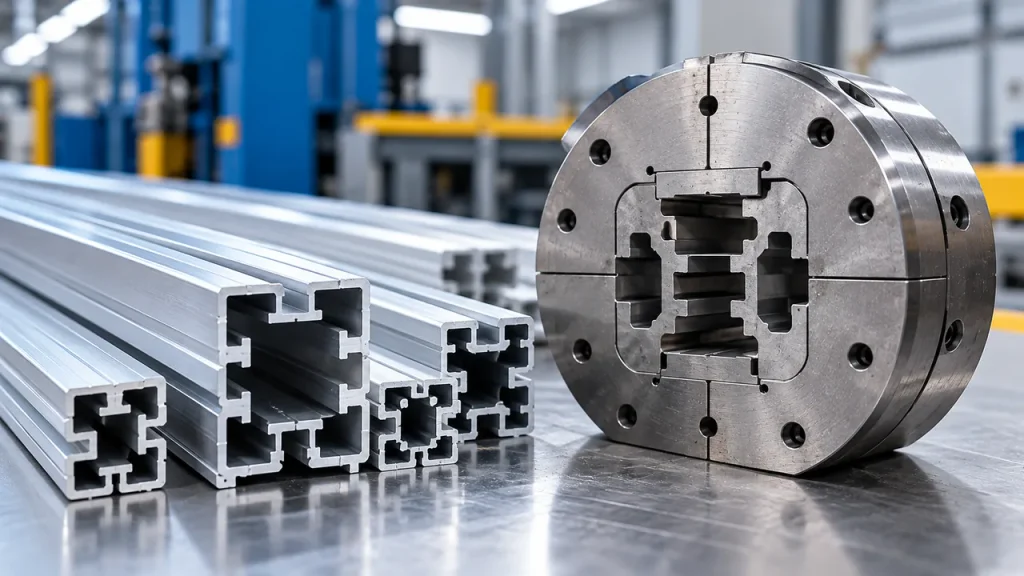
| Die type | Typical construction | What pushes the price up |
| Solid flat die | Single cavity, no enclosed chamber | Large envelope, high tongue ratio, unbalanced walls |
| Semi-hollow | Partially enclosed section | Bridge or porthole features, correction work |
| Hollow die | Enclosed chambers with a mandrel | Chamber count, mandrel support, flow balance |
| Multi-cavity | Several sections per stroke | Die size, alignment, flow balance across cavities |
Tooling for ordinary architectural and industrial profiles commonly falls between a few hundred and a few thousand US dollars, with sections needing a 2,000 to 4,000 tonne press at the top of that band. That is an order of magnitude, not a quotation: die price moves with region, die shop capacity and die steel cost, and hollow sections cost more because they contain more parts and more flow to balance, which is where the premium in hollow aluminum extrusion dies originates.
Die Cost per Kilogram Falls With Volume
Against a hypothetical 2,000 dollar die:
| Order quantity | Die cost per kilogram |
| 500 kg | 4.00 USD |
| 2,000 kg | 1.00 USD |
| 5,000 kg | 0.40 USD |
| 20,000 kg | 0.10 USD |
These assume the whole charge is carried by one order. Suppliers sometimes amortize tooling across an agreed volume or credit it back at a threshold, which changes the picture more than a metal discount.
A multi-cavity die is not automatically the more expensive route per kilogram. It raises output per stroke and can lower long-run unit cost, but only if volume keeps every cavity busy; a four-cavity tool on eight hundred kilograms wastes capacity.
Why Press Time Is the Real Conversion Cost
Conversion charges pay for press hours, not metal. A section running at twenty meters per minute and one running at eight can share weight and die cost, yet the slower one is quoted higher per kilogram because it consumes more than twice the machine time.
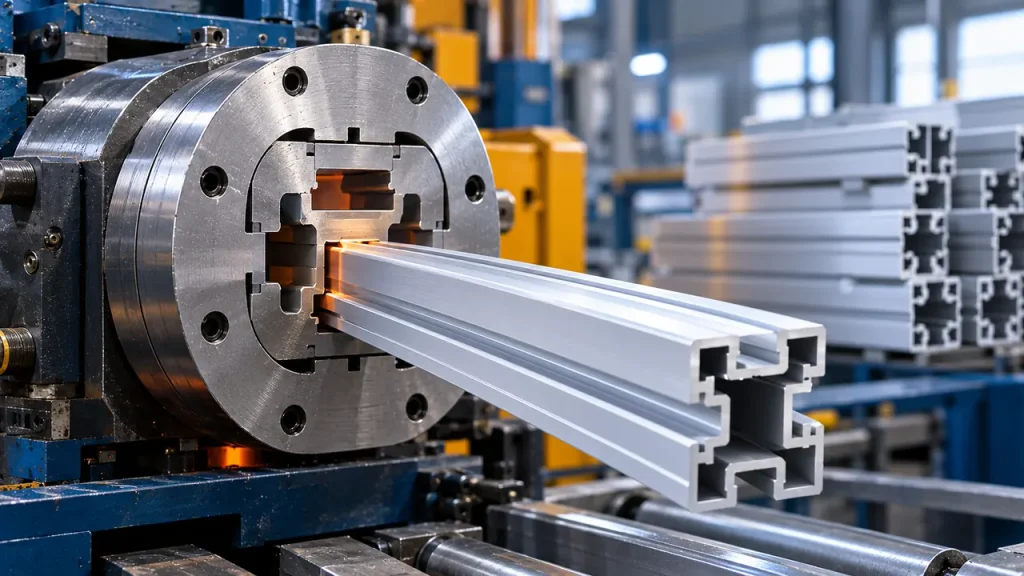
Tonnage is the first constraint: a larger envelope demands a larger press, and larger presses carry higher hourly rates. Speed is the second. Wall thickness, perimeter, tongue ratio and finish requirements limit how fast a section can be pushed while holding tolerance, and the industry guidance published as key design considerations names the same levers: balanced walls, minimal hollows, generous tapers, symmetry and a low perimeter-to-cross-section ratio.
A high tongue ratio behaves like a larger section on the press, so a lightweight, intricate profile can cost more per kilogram than a heavy, simple one.
Yield, Butt Loss, and Why Scrap Appears in Your Quote
Nobody extrudes only the metal they sell. Each run produces a butt left in the container, trim at both ends, start-up material and rejects, and process yield is the ratio of accepted output to billet consumed. Uneven walls cause distortion and short runs spread fixed setup scrap over fewer saleable kilograms, which is why consolidating orders beats negotiating a rate.
Finishing and Secondary Operations Add Cost After Extrusion
Finishing is priced by surface area, part count and batch rather than weight, so a light profile with a large perimeter can cost more to anodize than a heavy one with a compact section. Machining is priced by operations and fixtures, which is why tolerance class moves the price more than buyers expect.
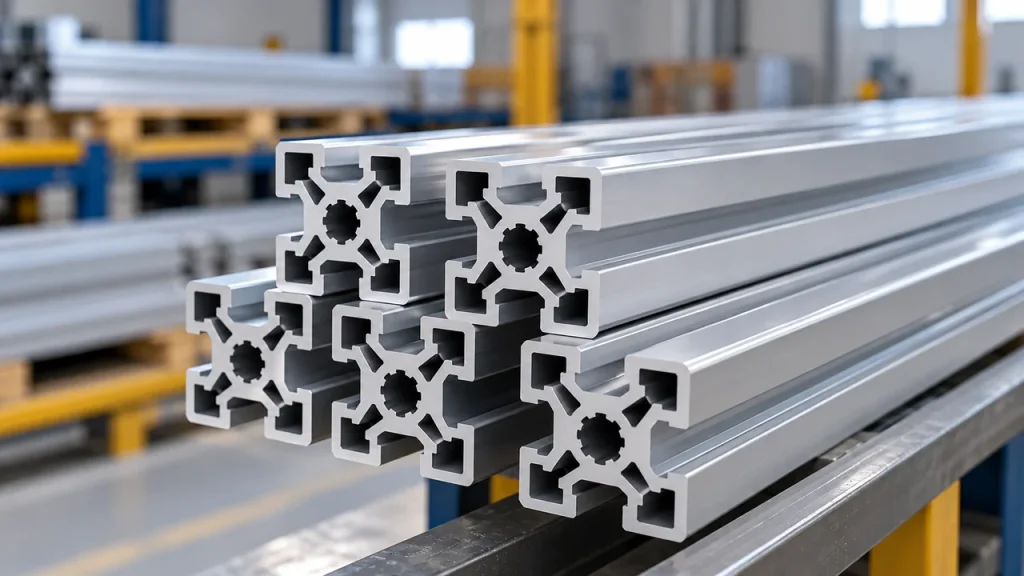
Anodizing is quoted on surface area and film thickness rather than weight. Color, masking and cosmetic acceptance each add handling, and a batch charge sits underneath for loading, racking and line time. Powder coating follows the same logic with a stronger batch effect, because color changes and pretreatment are paid once per run.
Machining is priced per piece and per operation. Fixtures, programming and first-article inspection are fixed per batch, while cutting, drilling, milling and tapping scale with the number of features and the cycle time each adds.
Machining, Cutting, and the Real Cost of Tight Tolerances
Tolerance is the quiet multiplier. A dimension tighter than the process naturally holds forces slower running, extra straightening, dedicated gauges and more inspection. Applying that to every dimension instead of only mating and sealing features adds cost without function, which is why the limits of aluminum extrusion tolerances are worth checking before a die is cut.
Why Two Suppliers Quote Very Different Prices
A large gap between two quotations does not mean one supplier is overcharging. Suppliers may be pricing different materials, tolerances, tooling arrangements, yields or delivery terms, and until those assumptions are on the table the numbers are not comparable.
| Item to confirm | Why it changes the number |
| Tooling included or excluded | A quote without tooling looks far cheaper on a small order |
| Alloy and temper | 6061-T6 against 6063-T5 changes pressure, speed and aging |
| Yield assumption | Ninety percent against eighty percent prices the drawing differently |
| Tolerance standard | Standard section tolerances against drawing-specific ones |
| Finishing scope | Mill finish against anodized, cut against cut and drilled |
Compare Quotations on the Same Finished-Part Basis
Convert every offer to a cost per accepted finished piece: fix the length, machining scope, inspection and delivery term, then divide order value by the pieces that pass inspection.
Worked Example: What a Custom Extrusion Really Costs per Kilogram
The figures are illustrative and represent no supplier’s pricing. The profile is a solid 6063-T5 section at 1.2 kilograms per meter, anodized and cut to length, ordered at 2,000 kilograms against a 2,000 dollar die. Billet is 3.65 dollars per kilogram, process yield 88 percent, scrap credited at 70 percent of billet value, conversion 1.10, anodizing 1.30, cutting, packing and inspection 0.30.
Material is the only line that needs working out. At 88 percent yield, one kilogram of accepted profile consumes 1.136 kilograms of billet, which costs 4.15 dollars. The 0.136 kilograms lost to butt, trim and rejects returns 70 percent of billet value, or 2.56 dollars per kilogram, giving a credit of 0.35 dollars. Net material is therefore 3.80 dollars per kilogram.
| Cost layer | Per kilogram of accepted profile |
| Net material, 1.136 kg at 3.65 USD less 0.35 USD scrap credit | 3.80 USD |
| Die amortization, 2,000 USD spread over 2,000 kg | 1.00 USD |
| Press conversion | 1.10 USD |
| Anodizing | 1.30 USD |
| Cutting, packing and inspection | 0.30 USD |
| Total | 7.50 USD |
At 20,000 kilograms only one line moves: die amortization falls to 0.10 dollars and the total to 6.60 dollars per kilogram, a twelve percent drop with no change to section, alloy or supplier. Tooling amortization is one reason large orders price lower, and it is why a supplier bundling die design, trial correction and OEM ODM extrusion die services can beat a chain billing trial work three times.
Is Extruded Aluminum Worth More Than the Alternatives?
Extruded aluminum is worth more only when it replaces something else entirely. Its value case is functional equivalence with fewer parts, not a lower price per kilogram, and the comparison belongs at assembly level rather than material level.
| Option | Tooling to start | Cost at low volume | Strength to weight | Where it fits |
| Aluminum extrusion | Moderate die cost | High per kg, falls with volume | High | Complex sections, corrosion resistance |
| Steel section | Low, often stock | Low per kg | Lower | Heavy loads, low volume frames |
| PVC profile | Moderate to high die cost | Moderate | Low | Non-structural, thermal break |
| Injection molded plastic | High tooling | Very high at low volume | Low | High volume, small parts |
| Welded sheet assembly | Low | Low at low volume | Moderate | Prototypes, one-offs, enclosures |
What a Cheaper Alternative Actually Costs You
The cheaper material usually arrives with more parts. A steel frame replacing one extrusion may need four cuts, eight welds, a corrosion coating and an inspection step, operations that never appear in a material comparison. A single extrusion absorbing three parts and two joins usually wins the per-assembly test even at the highest price per kilogram.
How to Bring the Price Down Without Losing Quality
Cost comes out of a profile in a predictable order, and the cheapest change is almost always a tolerance that was never needed. The most expensive is a redesign after the die has been cut, so work down this list rather than starting with the drawing.
- Relax tolerances that carry no function. Reserve tight limits for mating, sealing and assembly features and let everything else follow the applicable standard.
- Remove finishing the application does not require. A hidden structural part rarely needs a decorative film, and mill finish is a legitimate engineering choice.
- Check whether an existing die fits, legally and technically. A near match works only if dimensions, alloy, tolerance, press route, die condition and ownership all check out.
- Optimize the section itself. Balance wall thickness, cut the tongue ratio, remove deep narrow channels and reduce the perimeter-to-cross-section ratio, all of which raise speed and yield.
- Move assembly cost into the section. Screw ports, T-slots, snap fits and interlocking joints remove fasteners downstream, and the principles behind aluminum extrusion design trade a harder die for a cheaper assembly.
- Structure the order instead of discounting it. Larger batches, scheduled call-offs and index-linked metal pricing cut the per-kilogram number without touching the drawing.
Items one to three cost a conversation; four and five repay engineering time over the die’s life.
Frequently Asked Questions
Can I Reuse an Existing Die to Avoid the Tooling Charge?
Only after verification, not because the section looks similar. The tool must match the required dimensions, alloy, tolerance class, press route and die condition, and ownership must allow it. A die that has run thousands of tonnes may need polishing or correction before it holds tolerance, and that work is charged.
Why Do Extrusion Quotations Expire or Carry a Metal Price Clause?
Because the metal component is repriced every trading day and no supplier can absorb that exposure on a fixed number. Validity windows of a week to a month are normal, and longer agreements reference an exchange average over a defined period plus the premium at shipment. Ask for the index definition in writing.
Is Recycled Aluminum Cheaper for Extrusion?
Often, but not automatically, and the gap depends on alloy control rather than on the word recycled. Secondary billet avoids most of the smelting electricity, but extruders need consistent chemistry to hold mechanical properties. Compare per kilogram of accepted profile, not per tonne of input.

