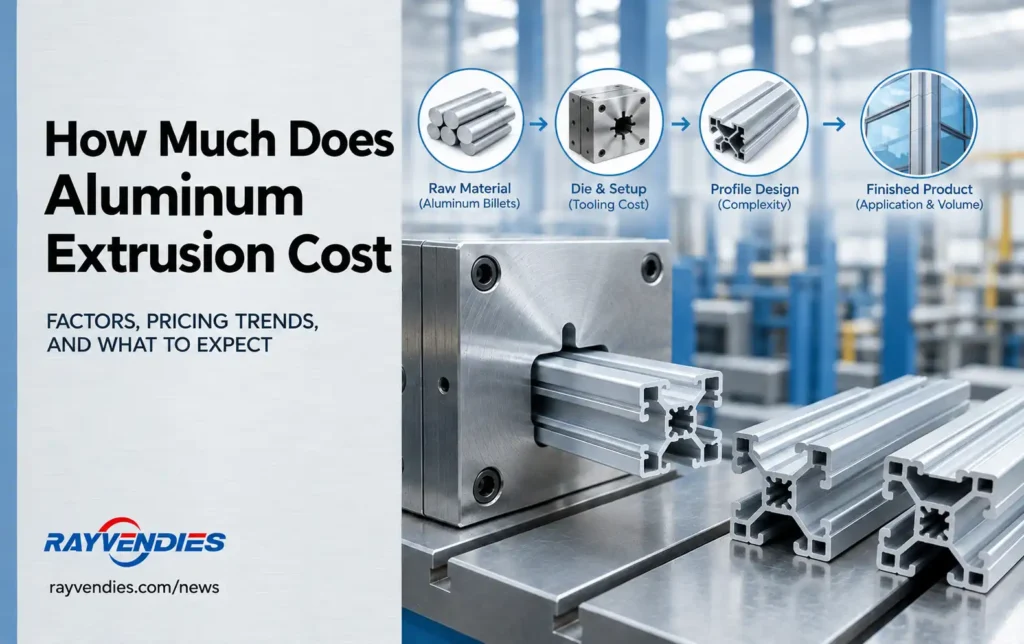
What is extruded aluminum? It is aluminum alloy that has been heated to a controlled temperature, softened without being melted, and forced through a specially designed steel die to create a continuous profile with a precise cross-sectional shape.
This manufacturing method is known as aluminum extrusion, and it is one of the most versatile ways to transform aluminum billet into useful components for construction, transportation, machinery, electronics, renewable energy, automation, and countless other applications.
A simple way to understand what is extruded aluminum is to imagine squeezing toothpaste through a shaped opening. The toothpaste takes the shape of the opening, while heated aluminum behaves similarly under extremely high pressure. Once the aluminum exits the die, it is cooled, straightened, cut, and, when required, heat-treated or finished.
That basic principle makes aluminum extrusion particularly valuable because manufacturers can create profiles with channels, ribs, grooves, hollow sections, mounting surfaces, and other functional features in one continuous production process.
Today, aluminum extrusion is more than a conventional metal-forming process. It is increasingly connected with lightweight vehicle design, modular automation, energy-efficient buildings, solar equipment, battery systems, industrial machinery, and sustainable manufacturing. The global market continues to expand, although regional demand and cost conditions are becoming more complex. One 2026 market forecast estimates the global aluminum extrusion market at approximately $105.8 billion in 2026, with automotive, construction, electrical, and industrial applications among major growth areas.
What Is an Aluminum Extrusion?
An aluminum extrusion is a finished or semi-finished aluminum profile produced by forcing a heated aluminum billet through a die.
A practical Aluminum extrusions definition is:
Aluminum extrusion is a metal-forming process in which a heated aluminum alloy billet is compressed through a die to produce a continuous profile with a fixed cross-sectional geometry.
This definition explains why aluminum extrusion can produce so many different shapes. Unlike cutting a shape out of a solid block, extrusion creates the desired geometry directly along the length of the material.
Common extruded aluminum profiles include:
- Flat bars and solid sections
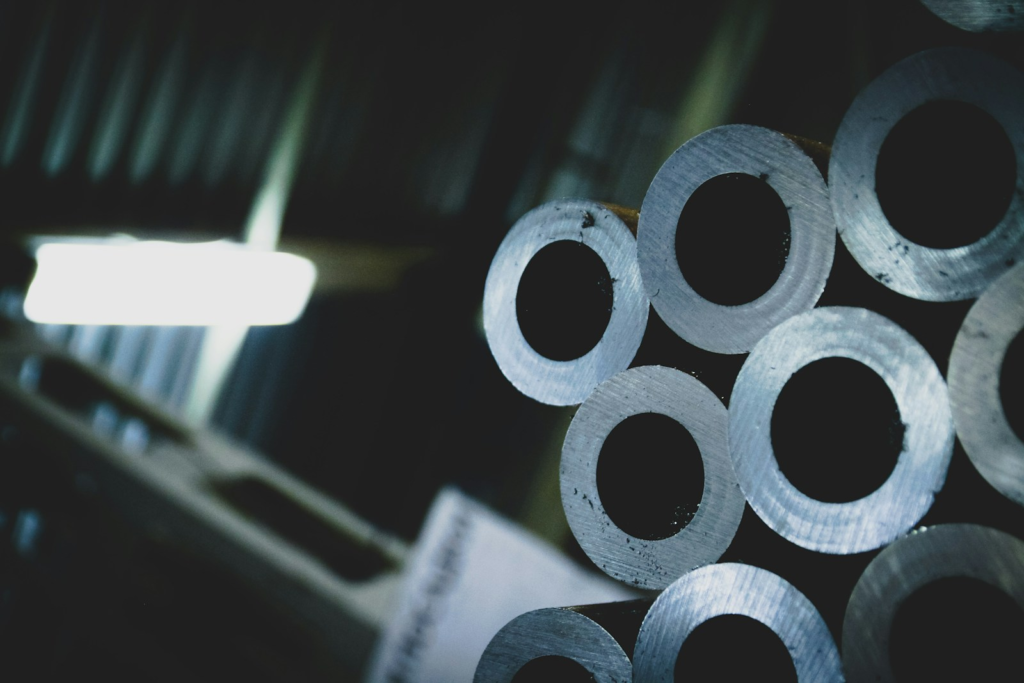
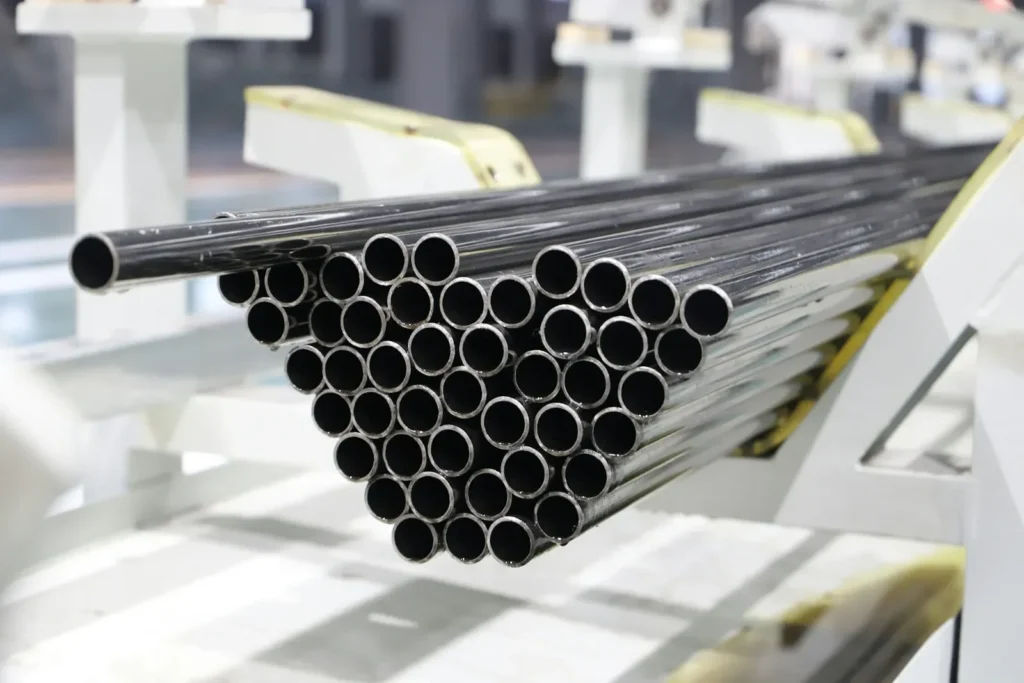
- Round and rectangular tubes
- U-shaped and C-shaped channels
- Structural framing profiles
- T-slot framing
- Heat sink profiles
- Window and door profiles
- Custom hollow sections
- Rails and tracks
- Angles and brackets
- Architectural profiles
The profile is created by the die, so changing the die allows manufacturers to produce a different geometry.
This is also why custom aluminum extrusions are widely used when a standard profile cannot satisfy the dimensional, structural, thermal, or assembly requirements of a project.
How Extruded Aluminum Is Made
Understanding How extruded aluminum is made helps explain why this material works so well for industrial applications.
The basic stages are straightforward, but each stage requires engineering control.
1. Aluminum Billet Preparation
The process starts with an aluminum billet, sometimes called an aluminum log. The billet is manufactured from a selected alloy such as 6061 or 6063, depending on the intended application.
Alloy selection matters because different alloys provide different combinations of strength, surface quality, corrosion resistance, machinability, weldability, and extrusion performance.
For example, 6061 aluminum extrusion is frequently selected for applications requiring higher structural strength, while 6063 aluminum extrusion is widely used when surface finish, formability, and architectural appearance are particularly important.
2. Billet Heating
The billet is heated to a controlled temperature range that makes it sufficiently soft and plastic for forming.
It is not simply melted into a liquid. Instead, the aluminum becomes much more workable while remaining solid.
The exact heating conditions depend on alloy chemistry, billet size, profile complexity, extrusion speed, and production requirements.
3. Die Preparation
The die determines the cross-sectional shape of the finished profile.
A simple die can create a solid shape, while a more sophisticated die can produce hollow or semi-hollow geometry.
This step is especially important for custom aluminum extrusion projects because the die must balance geometry, material flow, dimensional accuracy, wall thickness, cooling behavior, and production efficiency.
4. Extrusion Pressing
The heated billet enters the container of an aluminum extrusion press.
A powerful ram applies pressure and forces the billet through the die.
The aluminum flows through the die opening and emerges as a long continuous profile.
This is the essential What is aluminum extrusion process question in practical terms: heat the billet, force it through a die, form the cross-section continuously, then control the resulting profile through cooling and finishing.
5. Cooling
Once the material exits the die, the extrusion must be cooled under controlled conditions.
Depending on the alloy, geometry, and required mechanical properties, cooling can involve air, water, or other controlled methods.
The cooling rate can influence final properties and dimensional stability.
6. Stretching and Straightening
The extrusion may develop stresses during forming and cooling.
A stretcher is therefore used to straighten the profile and improve dimensional consistency.
7. Cutting
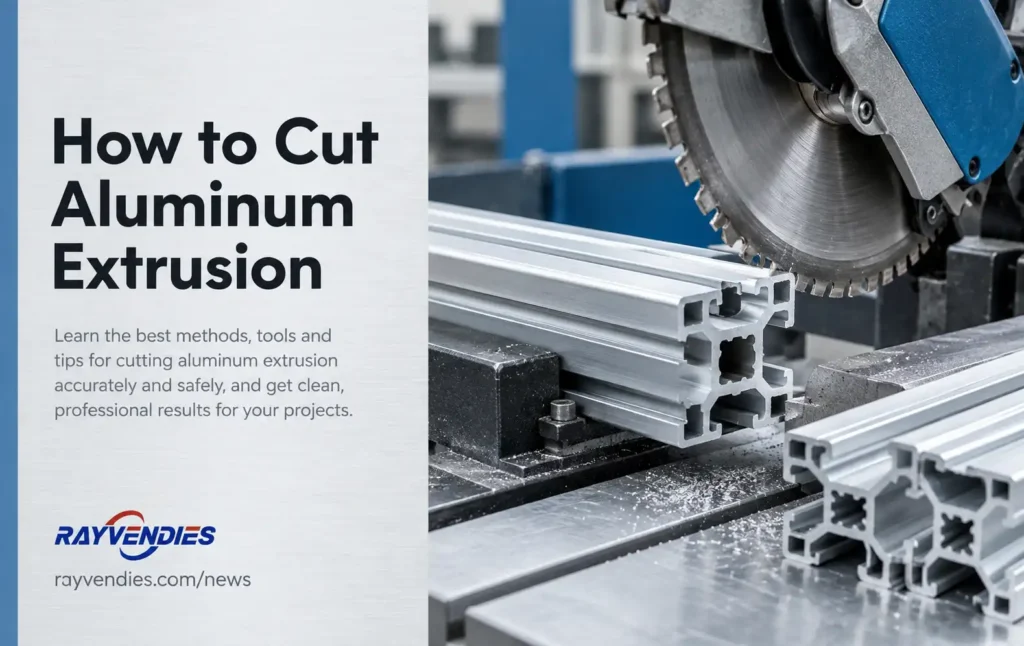
The long profile is then cut into specified lengths.
Customers may require standard stock lengths, custom lengths, or precision-cut parts ready for assembly.
8. Aging and Heat Treatment
Certain alloys require artificial aging to achieve the specified mechanical properties.
This is particularly important when the profile is used for structural applications or engineered assemblies.
9. Surface Finishing
The final stage can include anodizing, powder coating, painting, polishing, brushing, or other treatments.
The result can be a functional industrial component, an architectural profile, or a finished assembly component.
How Does Aluminum Extrusion Work?
So, How does aluminum extrusion work from an engineering perspective?
The key is controlled plastic deformation.
The press generates enough force to push the heated billet through the die. As the aluminum passes through the die opening, the material plastically deforms and continuously adopts the shape of the die.
Because the cross-section remains essentially constant along the extrusion length, one die can produce many meters of usable profile during a production run.
The efficiency of aluminum extrusion comes from this continuous production model.
For example, instead of machining every groove and structural channel from a solid block, an engineer can design those features directly into the extrusion profile.
That can reduce:
- Material waste
- Machining time
- Assembly complexity
- Component count
- Production steps
- Manufacturing cost
This is one reason aluminum extrusion is so common in modular framing and industrial equipment.
What Is Extruded Aluminum Used For?
Many people searching what is extruded aluminum used for are surprised by the range of applications.
The answer extends far beyond window frames.
Construction and Architecture
Architectural applications remain one of the largest markets for aluminum extrusions.
Common applications include:
- Window frames
- Door frames
- Curtain wall systems
- Handrails
- Storefront systems
- Solar shading structures
- Building facades
- Interior partitions
- Ceiling systems
The combination of low weight, corrosion resistance, appearance, and design flexibility makes architectural aluminum extrusions particularly attractive.
Automotive and Transportation
Transportation manufacturers use aluminum extrusion to reduce weight while maintaining structural performance.
Potential applications include:
- Vehicle structural members
- Crash-management components
- Roof rails
- Battery enclosures
- Heat-management systems
- Interior frames
- Commercial vehicle components
Demand from electric vehicles is particularly relevant. Market research continues to identify vehicle lightweighting and EV battery-related applications as major growth drivers for aluminum extrusion.
Solar and Renewable Energy
Solar systems frequently use aluminum profiles because they can provide lightweight structural support while resisting outdoor corrosion.
Typical products include:
- Solar panel frames
- Mounting rails
- Support structures
- Brackets
- Equipment enclosures
Electronics and Thermal Management
Aluminum conducts heat efficiently, making it useful for thermal management components.
Applications include:
- Heat sinks
- LED lighting components
- Electronics enclosures
- Power electronics
- Industrial control housings
- Battery cooling structures
Automation and Robotics
Modular framing has become especially important for automation systems.
Profiles can be connected with brackets, bolts, T-nuts, plates, and other hardware without extensive welding.
This is where aluminum extrusion frame, aluminum extrusion connectors, and aluminum extrusion hardware become valuable.
What Are 80/20 and T-Slot Aluminum Extrusions?
One of the most searched applications is modular structural framing.
Terms such as extruded aluminum 80/20, 8020 aluminum extrusion, 80 20 aluminum extrusions, and 80/20 aluminum extrusion generally refer to modular aluminum framing systems that use standardized profile dimensions and T-slots.
A T-slot profile contains one or more longitudinal slots that allow fasteners and accessories to slide into the profile.
Common examples include:
- 1010 aluminum extrusion
- 2020 aluminum extrusion
- 3030 aluminum extrusion
- 4040 aluminum extrusion
- 4080 aluminum extrusion
- 8080 aluminum extrusion
- 1515 aluminum extrusion
- 1530 and 3060 framing profiles
- 2040 aluminum extrusion
- 2080 aluminum extrusion
For example, 20×20 aluminum extrusion is often used for lightweight frames, while 4040 aluminum extrusion and 4080 aluminum extrusion can support larger machine frames, workstations, guards, or equipment structures.
The major advantage is modularity.
A user can cut profiles to length and connect them using:
t nuts for aluminum extrusion, corner brackets, joining plates, internal connectors, bolts, hinges, caster assemblies, leveling feet, and other extruded aluminum accessories.
This approach makes aluminum extrusion t-slot systems popular in automation, prototyping, machine building, laboratories, manufacturing plants, and maker applications.
Aluminum Extrusion Sizes and Common Profile Types
There is no single standard size for all projects.
Actual aluminum extrusion sizes depend on the series, slot configuration, wall thickness, alloy, application, and supplier.
A simplified comparison is shown below:
| Profile | Typical orientation | Common applications |
|---|---|---|
| 1010 aluminum extrusion | Small framing | Light-duty frames, instrumentation |
| 2020 aluminum extrusion | Compact square | 3D printers, small automation |
| 2040 aluminum extrusion | Rectangular | Linear structures, machine frames |
| 3030 aluminum extrusion | Medium square | Automation and guarding |
| 4040 aluminum extrusion | Medium/heavy | Machine frames and workstations |
| 4080 aluminum extrusion | Rectangular heavy-duty | Structural frames and equipment |
| 6063 aluminum extrusion | General-purpose alloy | Architectural and industrial profiles |
| 6061 aluminum extrusion | High-strength alloy | Structural and engineered components |
A supplier may also offer 10 series aluminum extrusion, 15 series aluminum extrusion, or larger industrial series.
The best profile is not necessarily the largest one.
It depends on loading, span, deflection, vibration, connection method, environment, cost, and assembly requirements.
Aluminum Extrusion vs Cast Aluminum
A common question is extruded aluminum vs cast aluminum.
Both manufacturing methods are useful, but they create different types of components.
| Factor | Aluminum Extrusion | Cast Aluminum |
|---|---|---|
| Manufacturing principle | Billet forced through a die | Molten metal poured into a mold |
| Typical geometry | Long constant cross-section | Complex 3D shapes |
| Best for | Profiles, rails, frames, channels | Housings, irregular components |
| Internal channels | Excellent | More difficult depending on geometry |
| Continuous production | Yes | No continuous profile |
| Surface quality | Often very good | Depends on casting method |
| Custom profile flexibility | Excellent | Excellent for 3D forms |
| Machining requirement | Often limited | Frequently required |
So, What’s the difference between extruded aluminum and cast aluminum?
The key difference is how the material is shaped.
Extrusion forces solid aluminum through a die, while casting pours molten aluminum into a mold.
Extrusion is usually better for long, consistent profiles. Casting is usually better for complex three-dimensional components that would be difficult to manufacture as a continuous profile.
How to Tell If Aluminum Is Cast or Extruded?
For How to tell if aluminum is cast or extruded?, examine the geometry and surface.
An extruded component typically has a consistent cross-section along its length. Long channels, tubes, T-slots, and rails are common indicators.
A cast component tends to have a more three-dimensional shape, irregular wall transitions, bosses, ribs, and other features that are not continuous through the entire length.
However, visual inspection is not always definitive. Machining and secondary processing can disguise the original manufacturing method.
Is Extruded Aluminum Stronger Than Steel?
The question Is extruded aluminum stronger than steel? requires a more precise answer.
In general, steel has higher strength and stiffness than aluminum. However, aluminum has a substantially lower density.
This creates a key engineering advantage: a properly designed aluminum profile can deliver excellent structural performance while weighing far less than an equivalent steel construction.
The right comparison therefore depends on:
- Yield strength
- Tensile strength
- Elastic modulus
- Cross-sectional geometry
- Weight
- Deflection
- Corrosion exposure
- Connection design
- Required safety factor
For weight-sensitive applications, aluminum extrusion can offer an excellent strength-to-weight ratio.
That does not mean aluminum is universally stronger than steel.
What Are the Advantages of Aluminum Extrusion?
The major advantages of aluminum extrusion include:
- Lightweight construction
Aluminum is much lighter than steel, making profiles easier to transport, install, and reconfigure. - Design flexibility
Complex channels, grooves, ribs, and hollow sections can be incorporated directly into the profile. - Corrosion resistance
Aluminum naturally forms a protective oxide layer. - Good thermal conductivity
This makes it suitable for heat-management applications. - Good electrical conductivity
It can be useful in electrical and power-related applications. - Machinability
Aluminum profiles can be drilled, cut, tapped, milled, and fabricated. - Surface finishing options
anodized aluminum extrusions can provide enhanced appearance and surface protection. - Recyclability
Aluminum is well suited to circular material flows. - Modularity
T-slot designs allow components to be assembled and modified without extensive welding. - Customization
custom aluminum extrusions suppliers can develop profiles around application-specific requirements.
What Are the Disadvantages of Aluminum Extrusion?
Despite its advantages, What are the disadvantages of aluminum extrusion? is an important question for engineers and buyers.
First, tooling is required for custom profiles, which creates an initial die cost.
Second, extrusion is best suited to profiles with a consistent cross-section. It is not necessarily the most economical choice for complicated three-dimensional components.
Third, material price can fluctuate.
Fourth, aluminum has a lower modulus of elasticity than steel, meaning that structural designs may require larger profiles to control deflection.
Fifth, certain high-strength alloys may be less suitable for complex extrusion shapes than softer extrusion-friendly alloys.
Finally, profile quality depends heavily on billet quality, die engineering, press conditions, cooling, stretching, heat treatment, and finishing.
For this reason, selecting the right aluminum extrusion manufacturer is often as important as selecting the alloy itself.
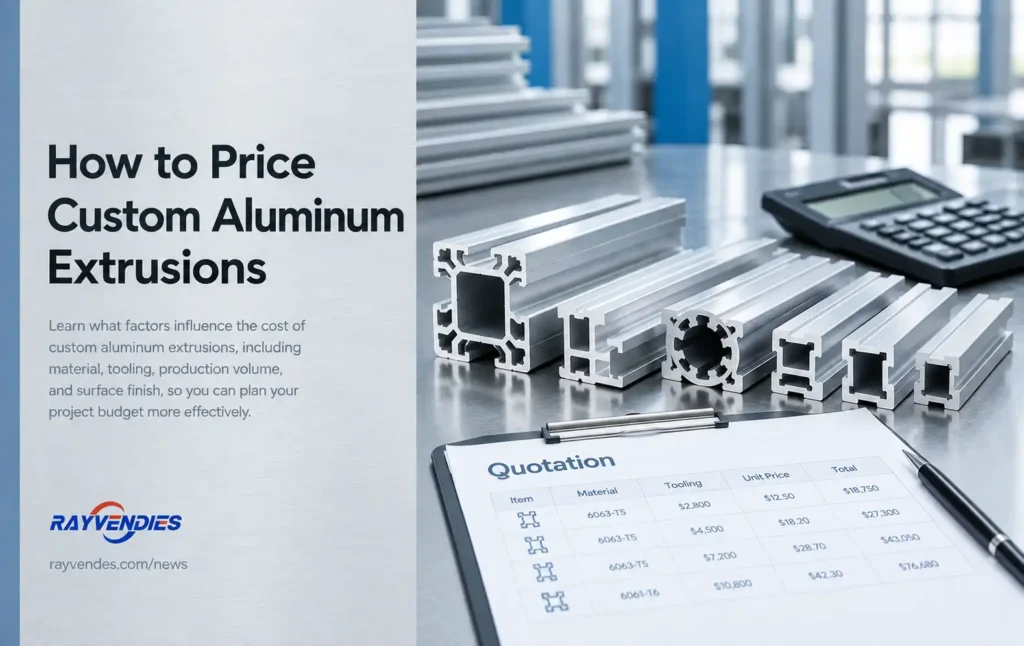
What Is the Price of Extruded Aluminum?
The extruded aluminum price is not a single fixed number.
A realistic quotation depends on:
- Aluminum alloy
- Profile weight per meter
- Billet price
- Die cost
- Order quantity
- Profile complexity
- Dimensional tolerances
- Surface treatment
- Cutting requirements
- CNC machining
- Packaging
- Freight
- Current regional market conditions
The biggest mistake is to compare suppliers using only a price-per-kilogram figure.
A lower raw material price can become more expensive once tooling, finishing, machining, packaging, and logistics are included.
For a serious project, buyers should request a complete quotation from qualified aluminum extrusion suppliers rather than relying on a generic online price.
What Is Extruded Aluminum Scrap?
Another important commercial topic is what is extruded aluminum scrap.
Extruded aluminum scrap includes offcuts, production remnants, rejected parts, machining waste, and used aluminum profiles that can be recovered for recycling.
Clean extrusion scrap is generally more valuable than heavily contaminated mixed scrap because sorting and processing are easier.
So, what is extruded aluminum scrap price?
The answer changes continuously according to alloy, cleanliness, local demand, quantity, market conditions, and whether the material is sorted or mixed.
The aluminum extrusion scrap price should therefore be treated as a market-based value, not a permanent number.
Recycling is particularly important as manufacturers pursue lower-carbon production and stronger circular-material strategies. In 2026, major producers continue to emphasize recycled aluminum and higher recycling margins, while North American extrusion volumes show signs of gradual recovery after a weaker start to the year.
Aluminum Extrusion and Sustainable Manufacturing
Sustainability is becoming a stronger consideration when selecting materials.
Aluminum can be recycled repeatedly, creating an opportunity to reduce dependence on primary metal production.
For manufacturers, this means sustainability is not just about recycling finished parts.
It also involves:
- Efficient billet utilization
- Optimized profile geometry
- Scrap recovery
- Recycled input materials
- Lower-carbon electricity
- Lightweight product design
- Longer component life
The trend is especially relevant to the growing use of aerospace aluminum extrusions, aircraft aluminum extrusions, EV components, renewable-energy systems, and energy-efficient building products.
At the same time, market conditions remain uneven. CRU reduced its forecast for U.S. semi-fabricated aluminum consumption growth in 2026 from 2.0% to 0.4%, while its expected U.S. extrusion consumption growth was revised from 3.3% to 1.6%.
This makes supplier flexibility increasingly important.
Custom Aluminum Extrusions vs Standard Profiles
Standard profiles are appropriate when the application can be solved using an existing geometry.
But custom aluminum extrusions become more attractive when the project requires:
- Special dimensions
- Unique mounting interfaces
- Integrated cable channels
- Reduced assembly parts
- Lightweight structures
- Custom thermal paths
- Tight dimensional control
- Brand-specific visual requirements
A custom profile can combine functions that would otherwise require several separate components.
For example, an aluminum extrusion enclosure can be designed with integrated mounting points, cable routing, panels, and fastening channels.
Likewise, an aluminum extrusion rail can combine structural support and guided movement features.
Common Aluminum Extrusion Applications
The flexibility of aluminum extrusions makes them useful for both simple and highly engineered systems.
Common examples include:
Industrial automation: machine frames, safety guards, conveyor structures, robotic workstations, control enclosures.
Workstations: an aluminum extrusion workbench, aluminum extrusion desk, or aluminum extrusion table can be configured around the operator.
Additive manufacturing: aluminum extrusion for 3d printer frames provide a rigid and modular structure.
Machine building: aluminum frame extrusions allow manufacturers to create repeatable platforms and guards.
Retail and displays: lightweight frames can be assembled and modified quickly.
Solar systems: profiles can be used for rails and mounting structures.
Electronics: thermal and structural profiles can be integrated into housings.
Transportation: lightweight structural elements can support vehicle weight reduction.
Architecture: doors, facades, partitions, railings, and decorative structures benefit from the flexibility of architectural aluminum extrusions.
Aluminum Extrusion with T-Slots and Accessories
A major advantage of modular framing is the ecosystem around the profile.
Useful aluminum extrusion brackets and aluminum extrusion connectors include:
- Corner brackets
- Joining plates
- Angle brackets
- Internal connectors
- Pivot joints
- T-nuts
- Sliding nuts
- End caps
- Casters
- Leveling feet
- Hinges
- Panel fasteners
These components make aluminum t-slot extrusion much more than a metal profile.
It becomes a construction platform.
A manufacturer can produce an aluminum extrusion frame kit, ship the components separately, and assemble the system onsite.
This approach is especially useful when equipment layouts may change over time.
Aluminum Channel Extrusions, Tubes, Angles and Frames
Not every application needs T-slots.
Other common profiles include:
- aluminum channel extrusions
- aluminum extrusion channel
- aluminum extrusion tube
- aluminum tube extrusion
- aluminum angle extrusion
- aluminum corner extrusion
- aluminum frame extrusion
- slotted aluminum extrusion
- t-slotted aluminum extrusions
The appropriate geometry depends on the intended load and assembly method.
For simple structural support, an aluminum extrusion tube can be effective.
For cable management or edge support, an aluminum extrusion channel may be more appropriate.
For modular machinery, t slotted aluminum extrusion is often the better choice.
Aluminum Extrusion Near Me: What Should You Look For?
Searches such as aluminum extrusions near me, aluminum extrusion near me, 8020 aluminum extrusion near me, or aluminum extrusion suppliers often reflect an important purchasing goal: finding a supplier who can support the whole project rather than simply selling raw profiles.
When evaluating an aluminum extrusion company, consider:
| Evaluation factor | Why it matters |
|---|---|
| Alloy selection | Determines performance and finish |
| Die design capability | Enables profile customization |
| Extrusion capacity | Determines profile size and production feasibility |
| Tolerances | Influences assembly and dimensional consistency |
| Finishing | Improves appearance and durability |
| CNC machining | Reduces downstream fabrication |
| Cutting | Simplifies assembly |
| Packaging | Protects finished profiles |
| Engineering support | Helps optimize the profile |
| MOQ flexibility | Important for prototypes and smaller projects |
Local sourcing can be useful, but geographic proximity alone does not guarantee technical capability.
The better question is whether the manufacturer of aluminum extrusions understands your application and can control the complete production chain.
Why Work With Rayven for Aluminum Extrusion Projects?
For businesses buying profiles for production rather than one-off DIY projects, the most valuable supplier is usually one that can translate a product requirement into a manufacturable profile.
Rayven can be positioned around that value proposition: helping customers move from concept and drawing requirements to practical aluminum profile solutions.
Rather than treating aluminum extrusion as a commodity product, Rayven’s approach can focus on the complete project requirement:
- Profile geometry
- Alloy selection
- Die development
- Dimensional requirements
- Surface finishing
- Cutting
- Fabrication
- Assembly requirements
- Packaging
- Delivery planning
This is particularly valuable for customers developing custom extrusion aluminum solutions or applications where standard profiles do not provide the required performance.
A successful custom project often starts with a drawing, CAD file, sample, or even a description of the problem.
From there, an experienced aluminum extrusion company can evaluate whether an existing profile is sufficient or whether a custom die will produce a better overall solution.
For engineering teams, this approach can reduce unnecessary machining, decrease component count, simplify assembly, and create a cleaner final design.
How to Choose the Right Aluminum Extrusion Alloy
Alloy selection should be based on application rather than popularity.
6063 Aluminum
6063 is commonly selected for architectural and appearance-focused profiles because it offers good extrudability and finishing characteristics.
It is frequently found in window frames, architectural products, decorative profiles, and general-purpose extrusions.
6061 Aluminum
6061 provides higher strength and is frequently used for structural and engineered applications.
It is a common choice when mechanical performance is more important than achieving the easiest possible extrusion geometry.
Other Alloys
More demanding applications may require other alloy families depending on strength, corrosion resistance, machinability, weldability, or thermal requirements.
The best supplier should therefore recommend the alloy according to the finished application rather than simply quoting whichever material is most readily available.
Frequently Asked Questions About Aluminum Extrusion
What is extruded aluminum?
What is extruded aluminum in simple terms? It is aluminum alloy formed by pushing a heated billet through a shaped steel die. The resulting continuous profile retains the cross-sectional geometry of the die.
What is the difference between extruded aluminum and cast aluminum?
Extruded aluminum is formed by forcing a heated solid billet through a die, while cast aluminum is created by pouring molten aluminum into a mold. Extrusion is particularly effective for long, constant profiles, while casting is useful for complex three-dimensional forms.
Is extruded aluminum stronger than steel?
Not generally. Steel is normally stronger and stiffer, but aluminum is much lighter. The engineering question is therefore whether aluminum extrusion can provide sufficient strength and stiffness at a lower overall weight.
What is extruded aluminum scrap?
It is recyclable aluminum material generated from production offcuts, machining waste, discarded profiles, and other extrusion-related sources. Its value depends on alloy, cleanliness, volume, and current market conditions.
What are the disadvantages of aluminum extrusion?
The major limitations include die costs for custom profiles, restrictions associated with constant cross-sections, lower stiffness than steel, alloy-dependent strength, and sensitivity to material and energy prices.
Can aluminum extrusion be customized?
Yes. custom aluminum extrusions can be engineered for specific dimensions, interfaces, functions, and appearance requirements. Custom dies make it possible to create profiles that are not available as standard stock.
The Future of Aluminum Extrusion
The future of aluminum extrusion will likely be shaped by several connected trends.
First is lightweighting.
Automotive companies, transportation manufacturers, and equipment producers continue to search for ways to reduce weight without compromising functionality.
Second is electrification.
EV battery systems, charging equipment, thermal-management components, and electrical infrastructure can all benefit from aluminum’s combination of low density, corrosion resistance, thermal conductivity, and design flexibility.
Third is modular manufacturing.
T-slot systems and 80/20 aluminum extrusions have demonstrated how quickly engineers can construct and modify frames, workstations, production cells, and prototypes.
Fourth is sustainability.
Increasing attention to recycled content, scrap recovery, energy efficiency, and lower-carbon materials is strengthening the role of aluminum in circular manufacturing.
Fifth is customization.
As manufacturers increasingly differentiate their products, standard profiles may not be enough. Engineered custom aluminum extrusion solutions can integrate structural and functional features that reduce assembly time and simplify downstream production.
North American market forecasts also point to continuing growth over the medium term, with one forecast estimating a 7.8% CAGR for the regional aluminum extrusion market from 2026 to 2033.
This suggests a market that remains attractive while simultaneously becoming more competitive and cost-sensitive.
Final Thoughts: What Is Extruded Aluminum and Why Does It Matter?
So, what is extruded aluminum?
It is more than aluminum shaped into a particular form.
It is a manufacturing method that allows engineers to combine material efficiency, geometry, structural performance, thermal management, modularity, and attractive finishing into a single continuous profile.
From 2020 aluminum extrusion used in compact equipment to 4040 aluminum extrusion used in machine frames, from aluminum extrusion t-slot structures to architectural profiles, the possibilities are extensive.
The best solution depends on the right combination of alloy, profile geometry, tolerance, finish, fabrication, quantity, and application.
For companies seeking standard profiles, modular framing components, or custom aluminum extrusions suppliers, working with an experienced manufacturer can help prevent costly design mistakes before production begins.
Rayven can support customers looking beyond generic stock aluminum extrusions toward application-driven solutions. Whether the requirement involves an aluminum extrusion enclosure, an aluminum extrusion frame, a structural rail, a custom channel, a T-slot system, or a fully customized profile, the objective should be the same: create the right aluminum solution for the finished product.
Have a drawing, sample, specification, or existing profile that needs to be improved?
Contact Rayven to discuss your aluminum extrusion requirements, evaluate standard and custom options, and develop a profile solution aligned with your application, production volume, finishing requirements, and target cost.