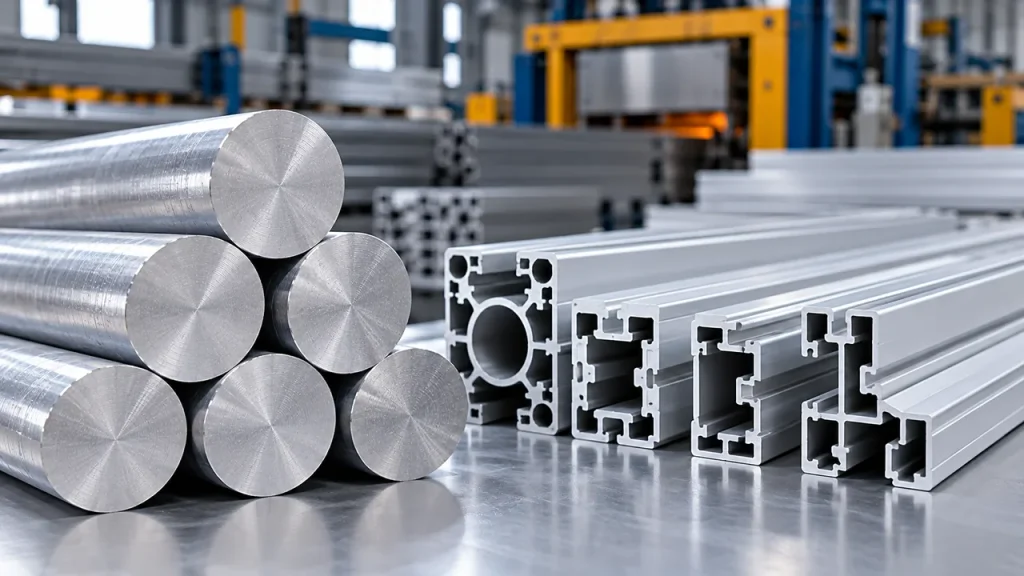
Aluminum profiles appear in more products than most people notice. Window frames, car battery trays, heat sinks, solar panel rails, and conveyor frames all tend to start the same way: as a long piece of aluminum with a fixed cross-section. Making those shapes at volume is what aluminum extrusion is for. Every profile starts with a die, and a custom aluminum extrusion dies manufacturer designs, cuts, and corrects that tool before a single billet goes into the press.
Aluminum extrusion is a metal forming process in which a heated aluminum billet, a solid cylindrical log, is pushed by a ram through a die with a shaped opening. The metal that comes out is a long profile with the same cross-section as that opening. The billet is soft but never molten, closer to stiff dough than to liquid. A pasta maker runs on the same idea: press soft material through a shaped disc, and the shape keeps coming for as long as you keep feeding it.
The sections below walk through the process step by step, the dies that make it work, the profiles and alloys it produces, and what the whole thing costs.
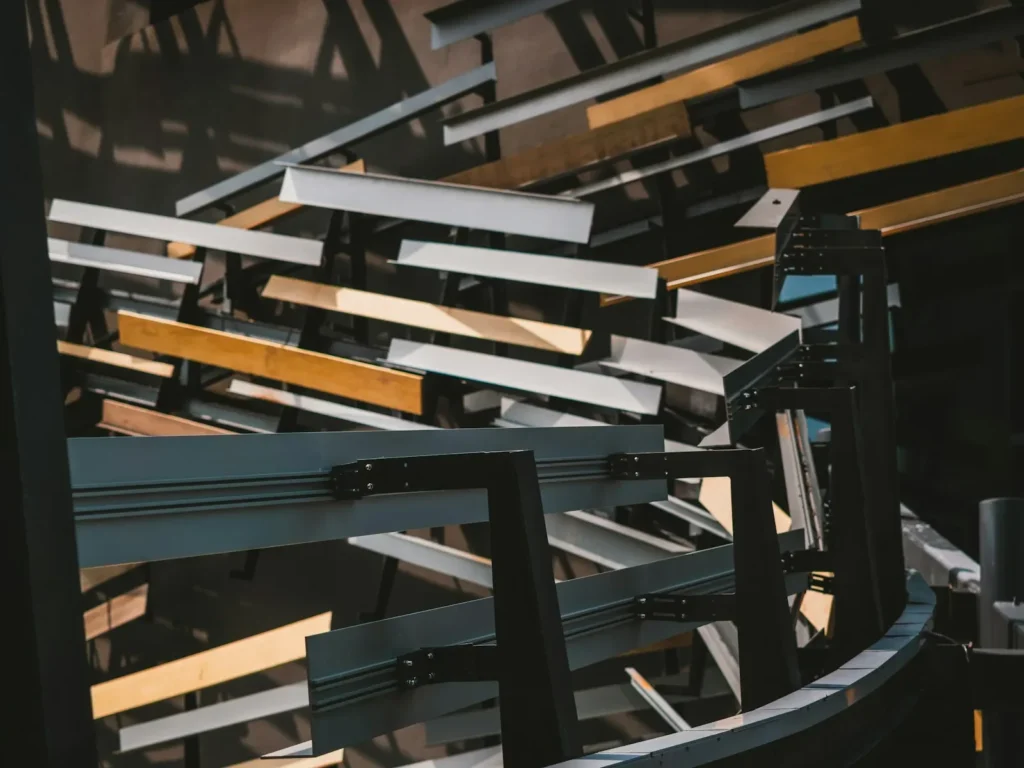
How the aluminum extrusion process works
A press pushes a heated billet through a preheated die, and the profile that exits is quenched, stretched, cut, and aged until it reaches its final strength. Six stages cover the full cycle, three inside the press and three after the metal leaves the die.
Inside the press
The preparation. The die is a thick disk of H13 tool steel with the profile opening machined through its center. The shop preheats it to 450–500°C before it enters the press, which reduces thermal shock and helps metal flow evenly through the opening.
Billet heating. A billet is cut from a longer aluminum log and heated to 400–500°C. At that temperature the alloy is malleable but still solid. A release agent is applied to the billet and the ram so nothing sticks under pressure.
Extrusion. The billet drops into the press container. The ram closes in and applies enormous force, up to 15,000 tons on large presses. The aluminum expands to fill the container, then has nowhere to go except through the die opening. It emerges as a fully formed profile.
After the die
Quenching. A puller grips the profile and carries it down the runout table at exit speed. Water baths or fans cool it along the way. The cooling rate matters because it shapes the grain structure and sets up the final temper.
Stretching and sawing. Long profiles twist slightly as they exit, so both ends are gripped and pulled until the piece is straight and within tolerance. Stretching also work-hardens the metal. A hot saw cuts the extrusion to table length, and a finish saw cuts the final lengths once it cools.
Aging. Profiles that need higher strength go into aging ovens, which speed up the natural hardening that would otherwise take months. This is where the alloy reaches its T5 or T6 temper. Surface treatments such as anodizing or powder coating happen further downstream, after the profile has been aged.
| Step | Key parameter | Purpose |
|---|---|---|
| 1. The preparation | 450–500°C die preheat | Protect the die, even out metal flow. |
| 2. Billet heating | 400–500°C billet temperature | Soften the alloy without melting it. |
| 3. Extrusion | Up to 15,000 tons of ram force | Push metal through the die opening. |
| 4. Quenching | Water bath or air cooling | Set the metallurgical structure. |
| 5. Stretching and sawing | Controlled stretch, hot saw | Straighten, harden, cut to length |
| 6. Aging | Oven aging to T5 or T6 | Build final strength. |
Direct vs. indirect extrusion
In direct extrusion the ram pushes the billet through a stationary die at the front of the container. In indirect extrusion the die is mounted on a hollow ram and pressed into the billet from the other side. Direct extrusion is the standard setup for most aluminum profiles.
Direct extrusion is simpler and covers the widest range of profile sizes, which is why most presses run this way. Its cost is friction: the billet slides along the container walls, so the ram has to overcome more resistance, and heat builds up near the die. Indirect extrusion removes most of that friction because the billet stays still relative to the container. The press needs less force, and the metal flows at a more even temperature. The tradeoffs are a more complex press design and a narrower range of profile sizes, so indirect extrusion remains the less common of the two.
The role of the extrusion die
The die sets the cross-section, but it also decides surface finish, dimensional accuracy, and how much each ton of profile costs to produce. Tooling quality shows up in every meter of output.
How the die shapes the metal
A die looks simple, a steel disk with a hole in it, but the surfaces around the opening do precise work. These bearing surfaces control how fast metal flows through each part of the section. If flow is uneven, the profile twists, waves, or tears. Die designers balance the bearings so every part of the section fills at the same rate, then correct the die after first trials until the profile measures up. Complex sections often need two or three correction cycles before production starts.
Die life, support tooling, and cavities
Dies are usually cut from H13 tool steel and heat treated for a hard working surface. Under press loads they wear, so die shops re-nitride and rework them many times before retirement. A diebacker and bolster sit behind the die to carry the full ram force, and for small sections, one die can carry several openings, called cavities, to raise output per cycle.
For buyers, the die is also the main tooling decision. Standard shapes use existing dies and carry no tooling cost. Custom shapes need a new die, which means design time, machining, heat treatment, and trial runs before production. Once made, that die amortizes across every meter the order runs.
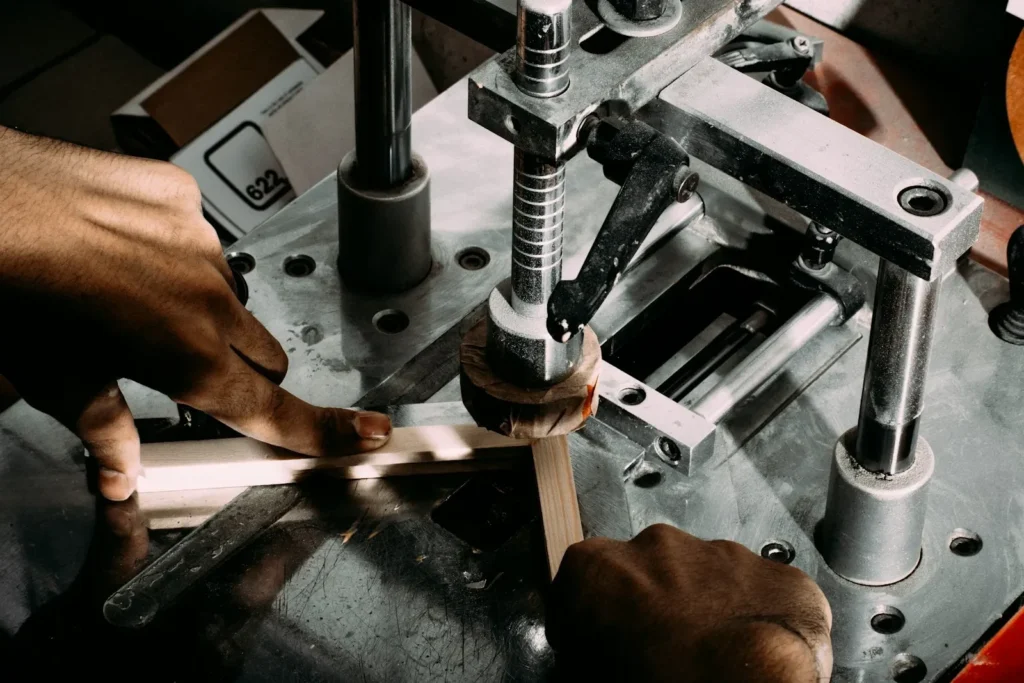
Common aluminum extrusion profiles and alloys
Extruded shapes fall into three classes, solid, hollow, and semi-hollow, and 6000 series alloys, mainly 6063 and 6061, cover most of the aluminum extrusion profiles made today.
| Shape | Cross-section | Typical profiles |
|---|---|---|
| Solid | No enclosed voids | Rods, bars, angles, beams |
| Hollow | One or more enclosed voids | Round and rectangular tubes |
| Semi-hollow | A partially enclosed void | C channels with a narrow gap |
| Alloy | Character | Common use |
|---|---|---|
| 6063 | Smooth surface, takes anodizing well | Window and door frames, trim |
| 6061 | Higher strength, machines cleanly | Structural frames, machine parts |
| 2xxx and 7xxx series | Heat-treatable to high strength | Aerospace structures |
Alloy and temper decide strength. Untreated 6061 in the T4 state has a tensile strength of about 241 MPa; after artificial aging to T6, it reaches about 310 MPa, a gain of nearly 30% from oven time alone (per published 6061 property data, checked 29 September 2026). That is why the aging step in the process table is not optional for structural work.
What is aluminum extrusion used for?
Any part that needs a constant cross-section, useful lengths, and low weight is a candidate for extrusion. Construction and transportation take the largest share of output.
| Industry | Typical extruded parts |
|---|---|
| Construction | Window and door frames, curtain wall systems, handrails |
| Transportation | Crash structures, battery trays, roof rails, train car panels |
| Electronics | Heat sinks, enclosures |
| Renewable energy | Solar panel frames, mounting rails |
| Industrial equipment | Conveyor frames, workstations, machine bases |
| Consumer goods | Furniture frames, ladders, sports tubing |
The pattern across these uses is the same. The part is long relative to its width, the same shape along its whole length, and better off light. A heat sink is the clearest example: thin fins that would be slow to machine come out of a die in one push, in lengths limited only by the press and the saw.
Extruded aluminum vs. cast aluminum
Extrusion pushes a solid, heated billet through a die; casting pours molten aluminum into a mold and lets it solidify. Extrusion wins on constant cross-sections and strength; casting wins on complex 3D shapes.
| Feature | Extruded aluminum | Cast aluminum |
|---|---|---|
| Starting material | Solid billet, heated but never molten | Molten aluminum poured into a mold |
| Geometry | Constant cross-section along the length | Free-form 3D shapes with ribs and bosses |
| Grain structure | Refined and aligned along the profile | Granular, uniform in all directions |
| Internal soundness | Dense, low porosity | Porosity can form as the metal solidifies. |
| Strength behavior | Directional, boosted by T5 or T6 aging | Isotropic, set by alloy and casting quality |
| Surface finish | Smooth as it leaves the die | Often rougher, usually machined after |
The choice usually comes down to geometry and volume. A window frame or heat sink that runs for meters in one shape points to extrusion. An engine block with internal cavities points to casting. Both routes produce fully recyclable aluminum parts, so the decision rarely rests on the material itself.
What are the disadvantages of aluminum extrusion?
The main limits are the constant cross-section, the die investment behind custom shapes, press size caps, and the lead time that new tooling adds. None of these hide the process’s strengths, but buyers should know them before committing to a custom profile.
The shape limit comes first. An extruded part has the same cross-section from one end to the other, so anything that changes shape along its length or needs geometry in more than two dimensions has to be machined, cast, or built from several extrusions joined together.
Custom tooling is the second limit. A new die means design, machining, heat treatment, and at least one round of trials and correction before parts measure up. That adds weeks and a tooling charge that only makes sense spread across enough volume.
Press capacity sets the third limit. A profile must fit inside the circumscribing circle of an available press, so very wide or very thick sections need the largest presses, and those presses are fewer on the market. Distortion control is the fourth: long, thin sections twist and bow easily and lean harder on die design and straightening. Finally, extruded grain runs along the profile, so strength is highest in that direction and lower across it, which matters for parts loaded sideways.
What affects the aluminum extrusion price?
Billet price, die amortization, order volume, alloy, and finishing drive the aluminum extrusion price. Whether the process counts as expensive depends mostly on volume and on whether a custom die is involved.
Aluminum billet is priced off the metal exchanges, so quotes move with the ingot market. The die charge is a fixed cost per order, which means the die cost per part falls as quantity rises. Standard profiles that use stock dies avoid that charge entirely and are usually the cheapest metal-forming route for long runs of constant cross-section. Custom one-offs are where extrusion feels expensive, because a small order carries the whole tooling bill. Alloy choice shifts the billet cost, with common 6xxx grades cheaper than specialty grades, and finishing such as anodizing or powder coating adds a per-meter charge.
Billet supply is also changing. Many mills now blend recycled aluminum into their billet, and the energy case is large: producing aluminum from scrap takes about 8.3 gigajoules per tonne against 186 for primary metal, a saving of roughly 95%, according to the International Aluminium Institute. Recycled content trims the energy bill and the carbon footprint attached to every tonne of billet a press consumes. For a full breakdown of quote structure and die charges, this guide to aluminum extrusion cost covers the details.
FAQ
What is the difference between hot and cold extrusion?
Hot extrusion preheats the billet to 400–500°C so the alloy flows under moderate pressure, and nearly all aluminum profiles are made this way. Cold extrusion works the metal at room temperature. It needs far higher forces, suits softer alloys and smaller sections, and leaves a harder, brighter surface because the deformation itself work-hardens the metal.
How long does it take to make a custom extrusion die?
Plan on weeks rather than days. The sequence runs from die design through machining, heat treatment, a first extrusion trial, and at least one correction cycle before the profile holds tolerance. Simple solid sections move faster; complex hollow sections with multiple voids take longer. Exact schedules vary by die shop and by how busy their machining centers are.
How long does an aluminum extrusion die last?
There is no fixed number. Life depends on the alloy being pushed, the complexity of the section, press practice, and above all, maintenance. Dies are re-nitrided and corrected repeatedly through their working life, and die shops track output per die in meters extruded. A well-maintained die runs far longer than a neglected one, which is why serious extruders treat die care as part of quality control rather than an afterthought.