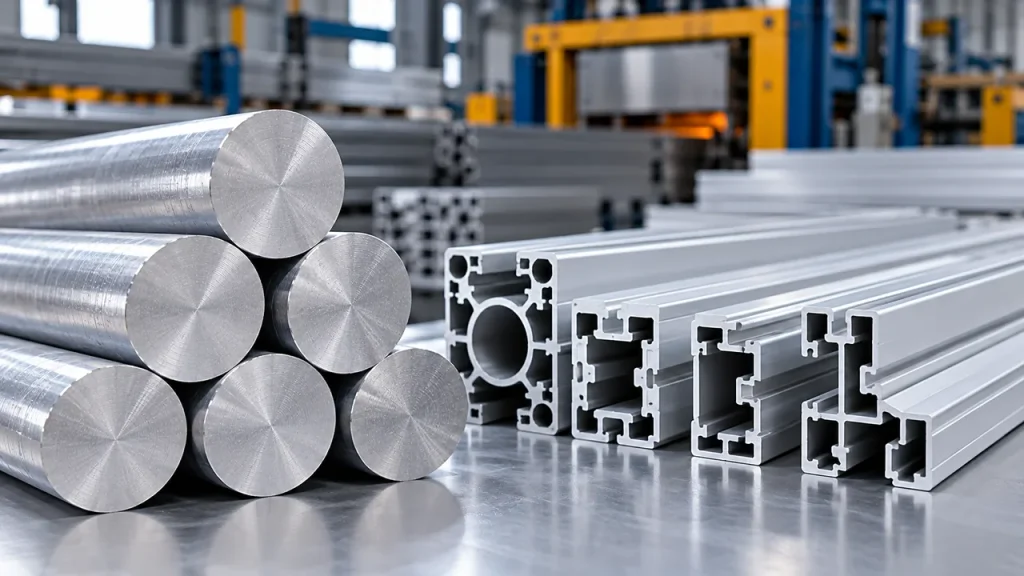
A profile specified for an MRI suite, a battery enclosure, or a sensor frame is often chosen for a property that has nothing to do with strength: it does not respond to a magnet. Get that wrong, and a bracket may end up pulled toward a scanner bore. Every profile that leaves a press, whether it comes from custom aluminum extrusion dies built for one cross-section or from a standard tool, starts from the same base metal and behaves the same way in a magnetic field.
No. Aluminum is not magnetic in the ordinary sense of the word. It is paramagnetic, with a volume magnetic susceptibility around +2.2 × 10⁻⁵. This value is reported in published susceptibility measurements, and it is so close to zero that a permanent magnet feels nothing against it. Nothing sticks, nothing holds, and nothing stays magnetized. The only effect anyone notices is dynamic: a strong magnet moving near thick aluminum slows down, and that effect is electrical induction, not attraction.
The sections below separate those two effects, then consider how they affect alloy choice, shop-floor equipment, and purchase inspection.

The short answer: aluminum is paramagnetic, not ferromagnetic
Aluminum is paramagnetic, meaning it develops a very small magnetization parallel to an applied field and loses it the moment the field is removed. Iron, nickel, and cobalt are ferromagnetic: their domains stay aligned afterwards, which is why a steel bolt can pick up a second bolt.
Three classes cover almost every metal a buyer will meet. Ferromagnetic materials align with the field and keep the alignment, giving real holding force. Paramagnetic materials let atomic moments tilt slightly toward the field, with no memory and no holding force. Diamagnetic materials are weakly repelled, an effect visible only on sensitive instruments. Aluminum’s relative permeability, about 1.000022, is close enough to that of free space that no shop-floor instrument can detect the difference.
| Metal | Class | Approximate volume susceptibility | What a magnet does |
|---|---|---|---|
| Aluminum | Paramagnetic | +2.2 × 10⁻⁵ | Nothing you can feel |
| Magnesium | Paramagnetic | +1.2 × 10⁻⁵ | Nothing you can feel |
| Titanium | Paramagnetic | +1.8 × 10⁻⁴ | No holding force |
| Copper | Diamagnetic | −1.0 × 10⁻⁵ | Weakly repelled |
| 304 stainless, annealed | Paramagnetic | Near zero | Little or no attraction |
| 410 stainless | Ferromagnetic | Field dependent, far higher | Sticks firmly |
Why the crystal structure rules out permanent magnetism
An aluminum atom has one unpaired outer electron, so each atom carries a small magnetic moment. In solid metal those moments point in random directions, held there by thermal motion, and the face-centered cubic lattice has no domains to lock them into a common orientation. A field rotates a small fraction of the moments; when the field is removed, thermal motion scrambles them again. Aluminum has no Curie point in any practical sense, because there is no magnetic ordering to break down.
How a magnet actually behaves around aluminum
A magnet sitting still beside aluminum does essentially nothing. Move one relative to the other, and the aluminum pushes back, because a changing field drives circulating currents in any conductor. The push is electromagnetic, and it scales with speed.
The mechanism is eddy current induction. Field lines sweeping through the metal generate current loops, and those loops create a field opposing the change that produced them, following Lenz’s law. Conductivity, wall thickness, magnet strength, and relative speed all determine the strength. The same effect brakes rotating equipment without contact, produces thrust in linear motors, and appears as drag in maglev guideways. In every case, the aluminum is acting as a conductor, not as a magnet.
The falling-magnet test and what it proves
Drop a strong neodymium magnet down a thick-walled aluminum tube, and it settles into a slow, steady fall. The tube is not pulling; it generates currents that oppose motion until magnetic drag balances weight. The test proves the tube conducts and is thick enough to carry useful current. It says nothing about ferromagnetism, which becomes obvious once you run the same test with copper and watch the magnet fall even more slowly.
Why people think the magnet stuck
Most reports of magnetic aluminum trace back to something else. A smooth anodized face with a film of cutting fluid can hold a small magnet by surface tension, and a light chip can be lifted by the fringe field of a strong magnet. A steel insert, rivet, or screw left in a bore holds a magnet firmly, and the magnet appears to stick to the whole part. Use a magnet able to lift several times the part’s weight and try to hang the part from it. Aluminum will not hang.
Does the extrusion process change any of this?
No. Extrusion changes grain structure, wall thickness, tolerance, surface finish, and to some degree conductivity, but not the magnetic class of the alloy. A 6063 profile is exactly as non-magnetic as the billet it came from.
The aluminum extrusion process pushes a heated billet through a die, then quenches, stretches, ages, and cuts it. Every step is mechanical or thermal, and none creates magnetic domains or adds meaningful iron, nickel, or cobalt. What the process does change is how a moving magnet reacts: a thin decorative wall and a thick structural wall of the same alloy brake a magnet at very different rates. Buyers who want the steps in detail can read what extruded aluminum actually means first.
Alloy chemistry worth checking
The 6xxx family uses magnesium and silicon as alloying elements and carries iron as an impurity. Iron is ferromagnetic, so its permitted level is the number to check, and standard limits keep it low enough that the resulting intermetallic particles produce no measurable attraction.
| Alloy | Iron limit | Typical tensile strength | Common profile use |
|---|---|---|---|
| 6063 | 0.35% max | 186 MPa in T5 | Architectural frames, heat sinks |
| 6061 | 0.70% max | 310 MPa in T6 | Structural and machined parts |
| 6082 | 0.50% max | 340 to 350 MPa in T6 | Transport, machine frames |
Recycled billet is where variation enters. A heat near the iron limit is still within specification, and magnetism is not a concern at that level, but anodizing quality and ductility can suffer.
Where magnetic complaints usually come from
When a customer reports a magnetic batch, the cause is nearly always contamination. Steel strapping on a bundle, screws packed in the same crate, pressed-in inserts, or swarf from steel tooling in a saw-cut end all hold a magnet. Follow this order: isolate every ferrous component, clean the surface, test the bare aluminum, then send a sample for chemistry. Permeability testing comes last because it is slowest and rarely finds anything new.
Why non-magnetic aluminum extrusion profiles matter in service
In several industries, this property is the reason aluminum gets specified at all. A profile that responded even slightly to a field would distort an image or drag in a motor, and strength would not compensate.
| Application | Why it matters | Typical alloy |
|---|---|---|
| MRI rooms and medical equipment | Field distortion and projectile risk near a 1.5 to 3 T scanner | 6061, 6082 |
| Electronics cooling | Fins must not form a flux path or pick up interference | 6063 |
| Battery enclosures and busbar supports | No added eddy losses from structural members | 6061, 6082 |
| Linear motors and sensor frames | No cogging, no attraction to the stator, no drag on carriages | 6063, 6061 |
The MRI case is the clearest. Frames, rails, and cable trays inside a scanner room are made of aluminum because a steel equivalent would be pulled toward the bore, while the paramagnetic response at 1.5 T stays small enough that fixtures do not move.

Where magnets and aluminum meet on a production line
Magnets are used around aluminum every day, but almost never to hold it. Separating, sensing, and braking work; lifting and clamping fail, and they fail in a way that surprises anyone used to steel.
| Task | Magnet option | What works instead |
|---|---|---|
| Lifting plate or long profiles | Not viable | Vacuum lifter, mechanical clamp, sling |
| Holding a part during machining | Not viable | Vacuum chuck, vise, toe clamps |
| Sorting mixed non-ferrous scrap | Magnetic pulley removes steel only | Eddy current separator, magnet upstream first |
| Tramp metal removal before remelt | Catches ferrous only | Magnet plus eddy current stage plus inspection |
| Position or presence sensing | Plain magnet target fails | Inductive or eddy current sensors |
| Crack detection | Magnetic particle inspection does not apply | Dye penetrant, eddy current, ultrasonic testing |
Recycling is the one place where aluminum’s electrical behavior provides an advantage. An eddy current separator throws aluminum off the belt using repulsion from induced currents, which is how mixed scrap gets sorted at scale. A magnetic drum upstream takes out the steel, and the remaining material is separated by conductivity. A line built on the assumption that aluminum is magnetic will buy the wrong equipment.
Aluminum’s real weaknesses, none of them magnetic
Aluminum’s weaknesses are mechanical and thermal. It melts at a low temperature, deflects more than steel, grows more when heated, wears faster, and creeps under sustained load when warm. Those are the properties that constrain a design.
| Weakness | Typical value for 6xxx | Effect on a design | Mitigation |
|---|---|---|---|
| Low melting range | About 585 to 650 °C | Little margin near weld heat | Keep hot spots off thin sections |
| Low elastic modulus | About 69 GPa | Deflection, springback in forming | Deeper sections, gussets |
| High thermal expansion | About 23 × 10⁻⁶ per K | Growth over long runs, insert mismatch | Slotted fixings, expansion joints |
| Low hardness | About 60 HB in 6063-T5, 95 HB in 6061-T6 | Galling, wear, thread damage | Hard anodizing, inserts, wear pads |
| Creep when warm | Noticeable above roughly 100 to 150 °C | Slow distortion of loaded parts | Lower sustained stress, stabler temper |
| Galvanic corrosion | Large potential gap with steel | Attack at joints in wet service | Isolation washers, sealant, compatible fasteners |
None of this makes aluminum a poor material; it simply has specific trade-offs, usually worth taking because density is about 2.70 g/cm³ against 7.85 for steel. A designer who knows the weak points works around them; one who treats aluminum as lighter steel finds out the hard way.
Metals that magnets will not stick to
Most metals outside the iron, nickel, and cobalt group will not hold a magnet. Aluminum, copper, brass, magnesium, titanium, zinc, lead, gold, and silver all fail the magnet test; some are paramagnetic and some are diamagnetic, but neither type produces holding force.
Stainless steel causes the most confusion. Austenitic grades such as 304 and 316 are non-magnetic when annealed, so a magnet will not stick to a fresh sheet. Cold working changes that: bending or machining can transform part of the structure and leave a weak pull. Ferritic and martensitic grades such as 410 and 430 are magnetic from the start. A magnet therefore splits stainless into two groups, but it cannot identify an alloy. It tells you what a part is not, never what it is.
How to verify before you place the order
Verification has three levels. A magnet screens, an instrument gives a number, and chemistry gives certainty, because only chemistry ties a part back to the grade on the drawing.
The magnet test separates ferrous from non-ferrous in seconds and catches the contamination behind most complaints. A conductivity meter flags the wrong temper or alloy series, since 6063 and 6061 have different values, and a permeability meter measures how much the material distorts a field, which for aluminum is at the bottom of its measurement range. Spectrometry or X-ray fluorescence then confirms the alloy family and iron content against the standard limits.
A purchase order that can pass an audit names the alloy and temper against a recognised standard, states chemistry limits, adds a non-magnetic acceptance clause with a test method and sampling rate, and requires mill certificates for each lot. Tighter iron limits, extra certificates, and third-party inspection all increase the aluminum extrusion price, so that cost should appear in the quotation as a line item, not as a dispute after delivery.

FAQ
Does anodizing or powder coating make aluminum magnetic?
No. The anodic oxide layer is ceramic, and the powder film is a polymer, and neither responds to a magnetic field in any practical way. When a coated profile does show attraction, look at the rack and hooks on the finishing line, at steel fixtures nearby, or at metallic pigment in a special coating.
Can aluminum shield a magnetic field?
Not the way steel does. A static field passes through almost undisturbed because there is no ferromagnetic material to redirect the flux. A changing field is different: eddy currents in a thick plate oppose it and attenuate it, which is why aluminum appears in some alternating-field shielding and around gradient coils in MRI systems.
Does aluminum turn magnetic at low temperatures or in a very strong field?
No. Cooling it does not create magnetic ordering, and there is no temperature at which it becomes ferromagnetic. A very strong field raises the paramagnetic response in proportion to field strength, but the force on a given volume stays negligible next to steel. Liquid nitrogen and a 7 T magnet both leave aluminum effectively non-magnetic.