Most people meet 2020 extrusion through a small build: a printer frame, a camera slider, a guard panel around a benchtop machine. It cuts with a hand saw, bolts together with an Allen key, and arrives flat-packed. Then the build gets longer, someone hangs a motor or a 5 kg tool head at the middle of a metre-long rail, and the whole thing bows. The answers online swing from “it’s plenty strong” to “it’s a toy” with no numbers in between.
A standard 2020 profile in 6063-T5 carries about 24 N at mid-span on a 1 m span before sagging 1 mm. Load it to roughly 430 N and the aluminum reaches yield, but by then the beam has already dropped 17.5 mm, so deflection limits the part long before fracture does. That puts it in light-duty territory: fine for enclosures, panels and short printer frames, too soft for a metre of unsupported rail carrying real weight. The number traces back to a 0.74 cm⁴ moment of inertia held by a closed box section, the kind of shape that comes out of custom hollow aluminum extrusion dies.
The sections below break that down by span, wall thickness and profile size.

What a 2020 profile actually is
The name is a size label, not a strength grade. 2020 means a 20 mm by 20 mm square section with a T-slot on each face, and the strength comes from the alloy, the temper and how much metal the die leaves in the walls.
| Item | Typical value |
|---|---|
| Cross-section | 20 × 20 mm |
| T-slots | Four, 6 mm wide |
| Alloy and temper | 6063-T5 |
| Wall thickness | 1.3 mm to 2.0 mm depending on series |
| Weight | 0.5 kg/m to 0.6 kg/m |
| Moment of inertia, Ix and Iy | 0.74 cm⁴ |
| Section modulus, Zx and Zy | 0.74 cm³ |
| Yield strength, typical | 145 MPa |
| Ultimate tensile strength, typical | 186 MPa |
| Modulus of elasticity | 68.9 GPa |
Two details in that table cause most of the confusion in this market. Wall thickness first: light 2020 runs near 1.3 mm, heavy 2020 near 2.0 mm, and both get sold as 2020, though the extra metal sits at the outer edge where it works hardest against bending. Then the axis. Because the section is square, Ix and Iy match, so a 2020 beam is equally stiff whichever way you turn it. That is not true further up the family.
Where the strength number comes from
A profile has two separate limits, and mixing them up is the most common design error. Stiffness decides how far it sags. Strength decides when it stays bent.
Stiffness sets the sag
Deflection follows the standard beam equation for a simply supported span with a centre load: δ = FL³ / (48EI). E for aluminum is 68.9 GPa whichever alloy you buy, so the only variable you can change is I, the second moment of area. It depends on the shape of the section, not on the temper. This is why upgrading a 2020 profile from T5 to T6 will not fix a sagging rail. Same E, same sag, more money.
The L³ term is what catches people. Double the span and deflection rises eightfold at the same load; the load that produces a given sag falls to a quarter. Span costs more than wall thickness.
Strength sets the point of no return
Bending stress is σ = M / Z, with M = FL / 4 for a centre load. At 1 m span and 24 N, stress sits near 8 MPa against a 145 MPa yield. That is about 5 percent of capacity: it flexes visibly while being nowhere near failure. Yield arrives around 430 N, by which point the sag is 17.5 mm, roughly ten times what most frames tolerate. So in practice the deflection limit is the real ceiling, not the stress check.
Why the closed section does the work
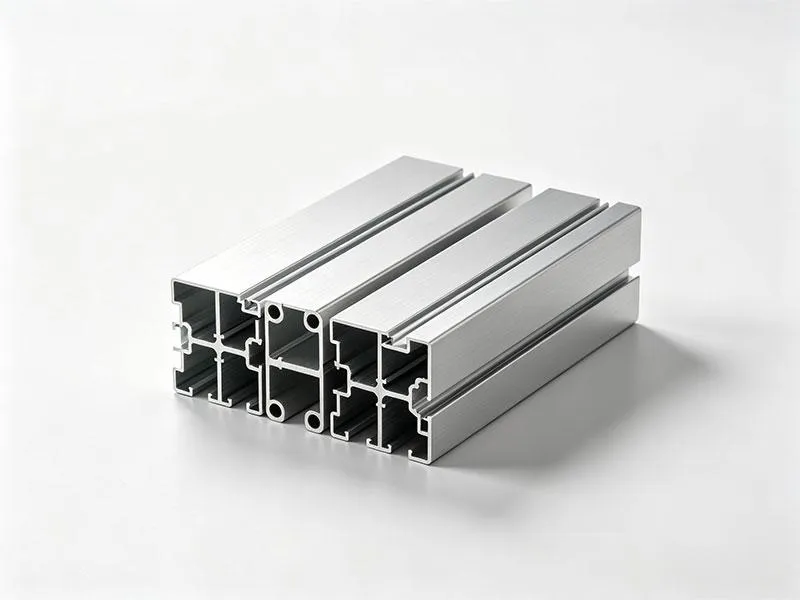
A 2020 profile is hollow. That closed cavity gives it bending and torsional stiffness far beyond an open shape of the same weight, and it is why the profile has to be run on a hollow die with a porthole feed rather than a flat die. Wall uniformity matters for the same reason: the metal flows around a core and has to rejoin cleanly on the far side.
How much weight can 2020 extruded aluminum hold
The useful question is not the breaking load, it is the load that keeps sag inside a tolerance. Engineering practice uses span divided by 1000, so a 1 m rail may sag 1 mm.
Using δ = FL³/(48EI) with E at 68,900 N/mm² and I at 7,400 mm⁴:
| Unsupported span | Centre load at 1 mm sag | Roughly |
|---|---|---|
| 300 mm | 906 N | 92 kg |
| 500 mm | 196 N | 20 kg |
| 800 mm | 48 N | 4.9 kg |
| 1000 mm | 24 N | 2.5 kg |
| 1500 mm | 7 N | 0.7 kg |
Published load tables from profile suppliers run the same formula and land on the same figure, which means any supplier’s number can be checked in one line of arithmetic against a real I value from the datasheet.
Three things move those numbers:
- Load type. A uniformly distributed load carries about 1.6 times the total weight of a centre point load at the same sag, because the moment is spread along the span.
- End conditions. Fixing both ends instead of pinning raises the allowable load by roughly four times. Brackets rarely achieve a true fixed end, so read this as an upper bound.
- Load direction. Side loads on a post behave differently, and any offset load adds twist the table does not cover.
Is 2020 extrusion strong enough for your build
For short spans and light loads, yes. Past about 800 mm with real weight on it, the honest answer is usually no, and the fix is a bigger profile rather than more brackets.
| Application | Typical span | Verdict |
|---|---|---|
| Printer frame, enclosure posts | 300 mm to 500 mm | Works, brace the corners |
| Guard panel or window frame | Up to 1 m | Works, panel weight is distributed |
| Camera slider or linear rail | 800 mm and up | Move to 2040 on edge |
| Work bench carrying tools | 1200 mm | Move to 4040 |
| Equipment base with vibration | Any | Not suitable at 20 mm |
Vertical use needs a separate check. Columns fail by buckling, at a load set by π²EI/(KL)². A 2020 post with pinned ends reaches about 5 kN at 1 m and 1.3 kN at 2 m, and real joints are never perfectly pinned, so treat those as ceilings.
What is the strongest aluminum extrusion
There is no single strongest profile, because strength belongs to a design rather than a catalogue item. The strongest section is the one with the most material farthest from the neutral axis, in the highest temper the shape can be extruded without cracking.
Depth beats alloy
Bending stiffness climbs roughly with the fourth power of section depth. Going from 20 mm to 40 mm depth on an idealised solid square would multiply I by 16. A real T-slot profile lands near 12 times, because the slots and walls remove material. That is still an order of magnitude, and no alloy change gets close. The Aluminum Extruders Council’s design considerations make the same point from the tooling side: an extrusion lets you put metal where the load path needs it.
Alloy and temper come second
6063-T5 yields near 145 MPa. 6061-T6 reaches roughly 240 MPa. Those gains are real near yield but buy nothing in stiffness, because all aluminum alloys share the same modulus. Higher temper also makes a profile harder to bend after extrusion and harder to push through a complex die. For a frame that sags before it yields, the temper upgrade spends money on the wrong limit. Section type matters more: hollow and semi-hollow shapes deliver more stiffness per kilogram, which is why T-slot profiles are hollow at all.
2020 vs 8020: what actually changes
The digits describe size. 2020 is a 20 mm face, and the profile commonly called 8020 in these discussions is an 80 mm face, four times larger. The design logic is identical, so the difference is scale, weight and cost. The name also matches a company name in this industry, which is why the two get mixed up.
| Profile | Size | Ix | Zx | Bending stiffness against 2020 |
|---|---|---|---|---|
| 2020 | 20 × 20 mm | 0.74 cm⁴ | 0.74 cm³ | 1× |
| 2040, on edge | 20 × 40 mm | 5.11 cm⁴ | 2.55 cm³ | About 7× |
| 4040 | 40 × 40 mm | 8.91 cm⁴ | 4.45 cm³ | About 12× |
Note the 2040 row: it reaches 7 times the stiffness only when the 40 mm face stands vertical. Laid flat it drops to 1.35 cm⁴, barely better than a 2020. Orientation is free, and it is often worth more than a size upgrade. Above 40 mm the ladder keeps going, which is why automation frames skip straight from 2020 to 4040.
What eats the theoretical strength in a real frame
The beam is rarely the weak point in a short frame. The joints are. A T-nut pulled into a 6 mm slot can slip under load, and a corner bracket rotates a fraction of a degree before it settles. Across eight corners the frame racks at loads far below anything in the tables.
Four fixes cover most cases:
- Add a diagonal brace or a panel that acts as a shear plane.
- Use gusseted or internal corner connectors instead of a single flat bracket.
- Run two profiles side by side when a single beam is marginal.
- Add a mid-span support before stepping up a size, if the design allows it.
Preload matters too. Over-tightened T-nuts crush the slot lip, a permanent local yield in a part you cannot repair.
How wall thickness and die quality set the real number
Two profiles can both be labelled 2020 and still differ, because wall thickness, straightness and wall uniformity come from the die and the press settings, not from the name.
The aluminum extrusion process starts with a billet heated to roughly 450 to 500°C and pushed through a steel die. For a hollow profile the die splits the metal around a core and lets it rejoin in the weld chamber before it exits; the profile is then quenched and aged at around 175 to 200°C to reach T5. Each step leaves a mark on the wall. A worn die drifts on slot width, so standard fasteners sit loose. Uneven bearing length lets one wall run thicker, which shifts the neutral axis and drops real capacity below the catalogue value. Poor quenching leaves hardness low, and the slot lip dents under a tightened bolt.
That is why the same nominal profile can sit at different points on a quotation sheet. Wall thickness, tolerance class, alloy and the amortisation of the die all feed the aluminum extrusion price, and a cheap length usually gives something up in the wall.
Before ordering, ask for three measured values rather than three nominal ones: minimum wall thickness on a cut sample, actual Ix and Zx for that die, and straightness over the full length. A supplier who can produce those numbers controls the process. One who cannot is quoting a name, not a section.

FAQ
Can you drill and tap a 2020 profile without weakening it?
Yes, within limits. Keep holes away from the slot lips and out of the corner radii, and space them so no two share a cross-section. A tapped M5 hole in the centre web is normal practice. Holes along the neutral axis cost very little capacity. A row through the outer wall costs much more.
Does anodizing change the strength of 2020 extrusion?
No. The oxide layer is measured in tens of micrometres and carries no structural load, so stiffness and yield stay where they were. Very thick hard anodizing can shave fatigue life because the brittle layer cracks under cyclic strain, but for a static frame that is not worth designing around.
Will a 2020 beam spring back when the load comes off, or stay bent?
Below yield it springs back completely, which covers most of the working range. Above yield it keeps a permanent set, and the usual route there is not a heavy centre load but a local one: an over-tightened T-nut crushing a slot lip. Once that happens the profile gets replaced, not repaired.