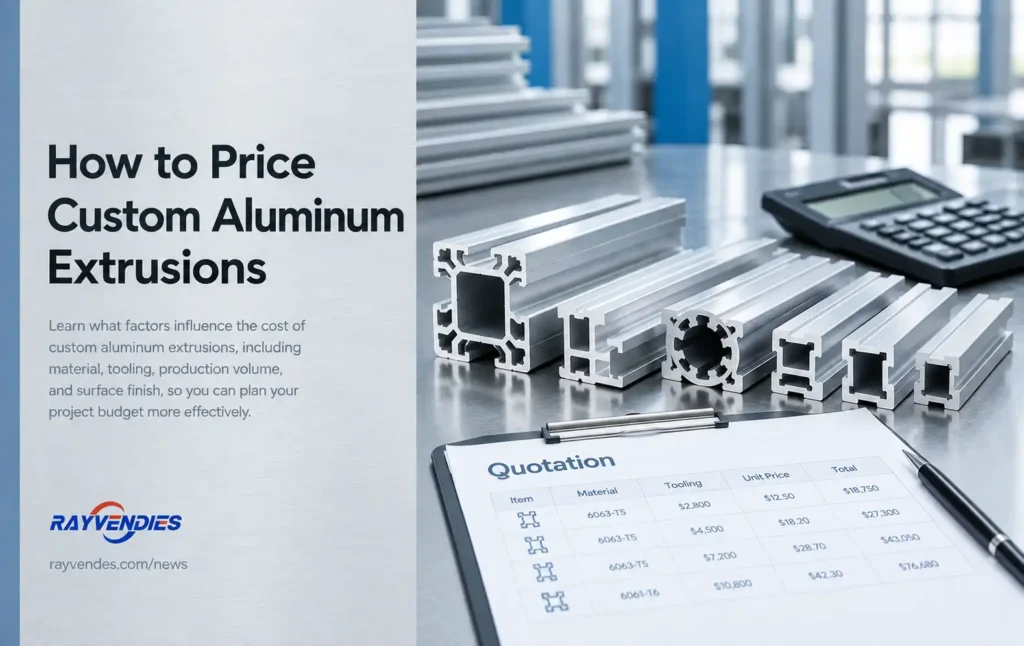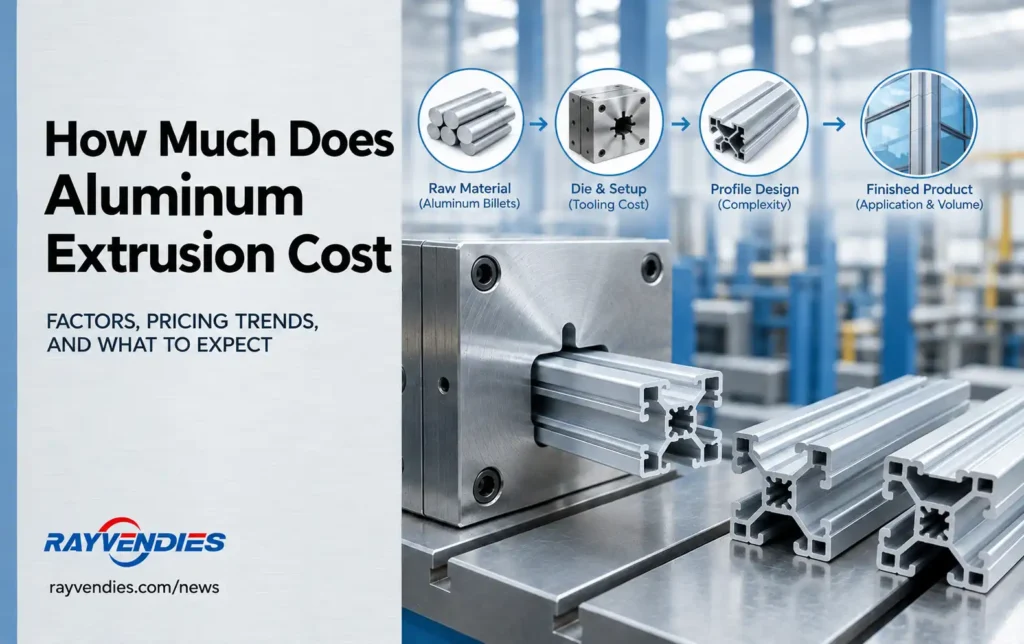
Two suppliers quote the same drawing weeks apart, and the totals aren’t close. Nothing in the drawing changed. What changed is which costs each shop folded in and how much of the fixed work it spread across your order. Custom extrusion pricing isn’t a rate you can look up. It’s five layers, and only some move with quantity. Most new programs start with tooling from a custom aluminum extrusion dies manufacturer, which is where the confusion begins.
A custom aluminum extrusion is priced as five layers added together: metal, tooling, extrusion processing, finishing and secondary operations, and logistics with duties. Metal comes from a published benchmark plus an alloy and regional premium. Tooling is one-time and spread across your order quantity. Processing and finishing are quoted per kilogram or per piece. Volume is the biggest lever, because fixed tooling divided by a small order is a large per-piece cost.
Each layer gets its own breakdown below, along with 2026 ranges and a way to compare quotes built on different assumptions.

What goes into a custom aluminum extrusion price?
Whether a supplier itemizes it or not, a quote is built from the same five layers: metal, tooling, extrusion processing, finishing and secondary work, and freight with duties. Ask for them as separate lines, and the quote becomes something you can compare.
| Cost layer | What sits inside it | Moves with volume |
|---|---|---|
| Metal | Benchmark price plus alloy and regional premium | Yes, with weight |
| Die and tooling | The design, the steel, the machining, the heat treatment, the trial run | No, one-time |
| Extrusion processing | Heating, press time, quenching, aging, straightening, cutting | Partly |
| Finishing and secondary work | Anodizing, powder coating, CNC, drilling, bending, assembly | Yes. |
| Logistics and duties | Packaging, freight, insurance, tariffs per the trade term | Yes. |
Fixed layers punish small orders. A press setup costs the same on 300 kilograms as on 3,000.
How the extrusion process shapes each cost line
A billet is cut to length, heated until it flows, and pushed through the die under pressure. The profile then gets quenched, cut, aged, and stretched straight. Heating and press time sit in processing, quenching, and aging are the temper steps, and everything after that is finishing or secondary work. Scrap sits on the same list: butt ends and start-up lengths are metal nobody ships.
Per kilogram, per tonne, or per piece
Shops quote in three units, and each hides something. A per-kilogram rate sells metal and processing weight, usually with the benchmark named and a scrap allowance inside. A per-tonne rate is the same thing at scale. A per-piece price appears when the profile is cut, machined, and finished to a drawing and can hide the weight assumption behind it.
How much does a custom aluminum extrusion cost?
Published 2026 trade pricing puts standard 6060-series profiles at roughly US$2.50 to US$3.80 per kilogram ex-works at production volumes. Structural 6061 quotes higher, complex hollows higher again, and prototype quantities can run several times the standard rate once tooling is written into the unit price.
| Profile type | Typical 2026 ex-works range | What pushes it up? |
|---|---|---|
| Simple solid sections | US$2.50 to US$3.50 per kg | Least die work, fastest pressing |
| Semi-hollow and T-slot style | US$3.00 to US$4.50 per kg | Narrow openings need flow control. |
| Hollow with internal voids | US$3.50 to US$5.50 per kg | Mandrel and bridge die, slower pressing |
| Tight tolerance or thin wall | Premium on the base range | More scrap, more inspection |
| Prototype or small lot | Above production pricing | Fixed cost over little weight |
Treat these as orientation, not quotation. They come from public 2026 trade listings and mostly exclude tooling.
Ranges by profile type
The gap between the first row and the third is tooling geometry, not alloy. A solid die is a plate with the profile cut into it. A hollow die holds a mandrel while metal flows around it, which takes more parts and longer machining.
Why two quotes for the same drawing differ
Regional labor and energy set the processing floor. Certification and testing add fixed fees rather than a rate. The trade term decides who pays freight, insurance, and duties, which swings landed cost without touching the factory price. Shops also read drawings differently, so a loose note like “straightness per standard” gets priced two ways. Normalize alloy, temper, finish, tolerance class, and trade term before comparing.
Die and tooling cost: the line you pay once
Tooling for a new profile usually runs from a few hundred US dollars for a simple solid die to several thousand for a large hollow or multi-cavity die. Because it’s one-time, how the shop charges it matters more than the price: paid upfront, amortized across the run, or credited back at an agreed volume.
| Die type | Typical tooling range | Notes |
|---|---|---|
| Simple solid | US$300 to US$800 | Fastest to cut, longest life |
| Semi-hollow | US$800 to US$1,500 | Partial bridges, added flow control |
| Hollow, mandrel, and bridge | US$1,000 to US$3,000 | More components, tighter assembly |
| Multi-cavity | US$1,500 to US$5,000 and up | Volume tooling for small profiles |
| Large section, big CCD | US$2,300 to US$10,000 | Bigger die block, bigger press needed |
Solid, semi-hollow, and hollow dies
A solid die presses metal through a shaped opening. A semi-hollow die adds partial bridges that guide metal into it. A hollow die carries a mandrel on a bridge, with metal flowing around it to close the tube behind. Each step adds parts and machining hours, which is why custom hollow aluminum extrusion dies cost more and wear faster.
How profile size and CCD drive die cost
The circumscribing circle diameter is the smallest circle containing the whole cross-section. A bigger CCD means a bigger die block, more machining, and a press with enough tonnage to push metal through it. Fewer shops can quote it, which keeps prices firm.
The amortization in practice
Run the arithmetic first. A die at US$2,000 spread across 500 kilograms adds US$4.00 to every kilogram; across 40,000 kilograms it adds US$0.05. That’s illustrative arithmetic, not a rate.
Who owns the die
Ask before you order. Does ownership transfer once the tooling is paid for, or does the shop keep it? Who pays for refurbishment after wear, and if you move the work later, does the die travel with you?
What is aluminum extrusion used for, and why does the application change the price?
Extruded aluminum goes into window and facade systems, vehicle and battery structures, solar mounting frames, heat sinks, and furniture and interior profiles. The application decides alloy, tolerance class, and finish, and those three choices create most of the price gap between two profiles of the same weight.
| Application | Common alloy and temper | Finish | Cost effect |
|---|---|---|---|
| Architectural and structural | 6063, 6082, T5, or T6 | Mill, anodized, powder coated | Finish moves price more than alloy. |
| Automotive and transport | 6061, 6005, T6 | Coated, often machined | Testing and certification add cost. |
| Solar frames and mounting | 6005, 6063, T5 | Anodized | Large sections need bigger presses. |
| Heat sinks and electronics | 6060, 6063, T5 | Mill or anodized | Tighter geometry, more scrap |
| Furniture and interior | 6063, T5 | Anodized wood effect | Decorative finishes carry the premium. |
A 2-kilogram facade profile and a 2-kilogram heat sink sit far apart in price, because one tolerates mill finish while the other needs tight geometry and a specific temper.
What drives aluminum extrusion price beyond the metal?
Four things move the number beyond the metal itself: alloy and temper, complexity and tolerances, order volume, and lead time with logistics. Metal dominates the total on most orders, but complexity and volume decide whether your order is priced efficiently or expensively.
Where the metal price comes from
The benchmark isn’t fixed. LME cash aluminum averaged about US$3,386 per tonne in the first half of 2026, roughly a third higher than a year earlier, per LME aluminum benchmark data. Quotes add a regional premium and a conversion charge. Alloy layers on top: 6063 tracks the benchmark, 6061 carries a premium because it presses more slowly, and rare high-strength grades cost more and wear dies faster.
Profile complexity, tolerances, and wall thickness
Thin walls, deep channels, and sharp internal corners slow the press and raise scrap. Tighter straightness and dimensional classes mean slower pressing and more inspection. Tolerances are normally quoted to a standard such as EN 755 or ASTM B221, and specifying a tighter class than the function needs adds cost for nothing.
Order volume and minimum quantities
Fixed costs don’t shrink with order size, so small lots carry surcharges large lots avoid. Suppliers commonly apply a small-lot premium below roughly a tonne per profile, with per-kilogram pricing settling from a few tonnes up.
Lead time, logistics, and duties
A new program needs die design and manufacture, a trial pressing and sample approval before production, commonly six to twelve weeks end-to-end, with die making alone at two to four weeks. Repeat orders against an existing die compress to a few weeks, and landed cost is the number to compare when suppliers sit in different countries.
How to use an aluminum extrusion cost calculator
Online calculators turn a cross-section, alloy, and volume into an indicative material and processing cost. They can’t know your die cost, tolerance class, or finish or freight, so treat the output as a check on the metal line rather than a budget.
Most calculators multiply weight by an alloy rate and add a conversion charge. Almost none include tooling, trial pressings, scrap, packaging, freight, duties, or testing, which are exactly the lines that decide whether a first order is viable. A spreadsheet you control is more useful. Give it these fields, and any two quotes will become comparable:
- Alloy and temper
- Weight per meter and per piece
- Order quantity in kilograms and pieces
- Die cost, separate or included
- Scrap and butt-end allowance
- Surface finish and color
- Secondary operations, itemized
- Tolerance class referenced
- Trade term and duty responsibility
- Metal price assumption and validity window
How to lower custom extruded aluminum cost without cutting quality
Most savings sit in the drawing rather than the rate negotiation. Larger radii, consistent wall thickness, symmetry, and looser tolerances on non-critical dimensions cut tooling and processing costs before the request for quotation goes out.
Give every internal corner a radius the die can machine. Keep wall thickness as uniform as the function allows, because thick and thin sections cool unevenly. Loosen tolerances nothing depends on. Combine features into one profile instead of buying two and paying assembly labor, and check whether an existing die or a close standard profile covers the requirement.
Order dies for related profiles together to share setup work, and ask about tooling credit at agreed volumes. Validate with a small first run, then buy volume once the profile proves out.
Four things are worth paying for: die steel quality and its heat treatment, tolerances that affect fit or function, the specified alloy on load-bearing parts, and sampling before production. Cheap tooling surfaces later as rework, short die life, and stop-start supply.
How to compare custom aluminum extrusion quotes
Compare line by line, not total against total. Two quotes can land on the same number while covering different scopes, and the gap shows up later as a change order, a second invoice for finishing, or a die that belongs to somebody else.
- Is tooling a separate line and credited back at volume?
- Who owns the die, and who pays for refurbishment?
- Does tooling include a trial run and sample approval?
- Are finishing and secondary operations inside the price?
- Which tolerance standard and class does it assume?
- What trade term applies, and who pays duties?
- What metal price does it assume, and how long does it hold?
- What scrap and minimum quantity sit behind the per-kilogram rate?
A supplier that answers these in writing is easier to hold to scope. The lowest total is rarely the lowest cost once tooling, finishing, and freight land are in the same column.
FAQ
What’s the minimum order quantity for a custom extrusion?
It depends on the press, not on policy. Small presses running narrow profiles handle a few hundred kilograms; wide sections need presses that won’t run tiny lots. Below roughly a tonne per profile, expect a small-lot surcharge rather than a refusal.
Are there cheaper options than a custom extrusion at low volume?
Sometimes. A standard profile that covers most of the requirements costs no tooling and ships faster. Machining from billet suits very low volumes and complex shapes at a higher cost per part. Roll forming works for simple sections in large quantities. Each route trades design freedom, per-piece cost, or tooling investment.
Does the tooling price include sample approval and a trial run?
Usually it covers die manufacture and an initial trial pressing. Extra rounds are where the money appears, and who pays often depends on whether the fault lies in the drawing or the die. Confirm what’s included and what a drawing change costs after the die has been cut.