The latest aluminum extrusion news points to a market that is growing in both volume and application complexity. Global demand for aluminum extrusion is being pushed by construction, electric vehicles, renewable energy, infrastructure, industrial automation, electronics, and lightweight transportation. According to the market data supplied for this analysis, global aluminum extrusion demand is expected to reach about 43.58 million tonnes by 2032, while the market value is estimated at approximately USD 110 billion in 2025 and could reach between USD 150 billion and USD 175 billion by 2032.
That growth creates opportunities for manufacturers, distributors, engineers, machine builders, architects, OEMs, and project contractors looking for reliable profiles and fabrication partners. At the same time, the newest aluminum extrusion news shows that buyers need to pay closer attention to billet prices, energy costs, tariffs, regional supply, alloy selection, surface finishing, and supplier capabilities.
For companies sourcing aluminum extrusion, the key question is no longer simply where to buy a profile. It is how to select the right profile, alloy, finish, fabrication process, and supplier for a specific engineering or commercial requirement.
Rayven can support this changing demand with application-oriented sourcing and customization for projects that require standard or engineered profiles, structural framing, machine building, enclosure systems, and other aluminum-based solutions.
Why Aluminum Extrusion News Matters to Industrial Buyers
The importance of current aluminum extrusion news comes from the fact that extrusion is not a standalone commodity market. It is closely connected to manufacturing investment, construction activity, transportation electrification, renewable energy deployment, and industrial automation.
The latest market data shows three major structural characteristics: solid profiles represent more than half of extruded products, construction and infrastructure remain the largest end-use segment, and Asia Pacific represents approximately 74% of the global market, with China as the dominant country by production and consumption.
For a buyer, those figures translate into practical purchasing considerations.
| Market factor | Buyer impact | What to evaluate |
|---|---|---|
| Growing EV demand | More complex lightweight profiles | Strength, hollow sections, thermal performance |
| Solar expansion | More framing and mounting demand | Corrosion resistance, finish, profile geometry |
| Automation growth | Greater demand for structural frames | T-slots, connectors, precision and straightness |
| Higher energy costs | Possible price volatility | Supplier location and manufacturing efficiency |
| Recycled aluminum demand | Greater sustainability requirements | Material source and recycled content |
| Trade changes | Potential lead-time and price shifts | Regional supply and backup sourcing |
This is why following aluminum extrusion news can help procurement teams make better decisions before a project enters mass production.
Global Aluminum Extrusion Market Outlook Through 2032
The global aluminum extrusion market has entered a period of steady long-term expansion. The supplied industry analysis estimates the market at approximately USD 110 billion in 2025, around USD 118 billion in 2026, and between USD 150 billion and USD 175 billion by 2032, with estimated annual growth of about 6% to 8%.
Different market research firms publish different values because the definition of the market is not always identical. Some reports count only extruded products, while others include downstream fabrication. Some calculate market size by tonnage and others by revenue, which can change substantially with aluminum prices.
A useful reference is:
| Year | Estimated global market size |
|---|---|
| 2024 | USD 100–105 billion |
| 2025 | Around USD 110 billion |
| 2026 | Around USD 118 billion |
| 2032 | USD 150–175 billion |
The aluminum extrusion news emerging from this growth story is that demand is becoming more diversified. Traditional building products remain important, but higher-value profiles are increasingly linked to transportation, thermal management, automation, electrical systems, and renewable energy.
A current third-party forecast published in August 2026 also estimates continued strong expansion through 2032, although its market definition and values differ from the AL Circle dataset.
For buyers, the precise headline market number is less important than the direction of travel: more profiles, more specifications, more customization, and higher expectations for engineering performance.
The Four Biggest Trends in Aluminum Extrusion News
The most important aluminum extrusion news can be understood through four connected trends: EV lightweighting, sustainable construction, recycled materials, and advanced manufacturing.
1. EV Lightweighting Is Reshaping Demand
Electric vehicles are one of the strongest growth drivers for aluminum extrusions. EV battery packs create additional vehicle mass, encouraging manufacturers to reduce weight elsewhere.
Extruded profiles can be designed for battery enclosures, structural members, crash-management systems, chassis components, thermal-management parts, and space-frame applications. The supplied market data identifies automotive and transport as one of the fastest-growing demand areas.
This creates demand for more sophisticated profiles rather than only simple structural sections.
2. Green Buildings and Solar Increase Profile Demand
Construction remains the largest application for aluminum extrusion, especially in window systems, curtain walls, structural glazing, solar mounting systems, and architectural structures.
Solar projects also benefit from aluminum’s lightweight structure, corrosion resistance, and design flexibility.
Architectural projects frequently specify anodized aluminum extrusions or coated profiles because aesthetics and environmental durability are both important.
3. Recycled Aluminum Is Becoming More Important
Sustainability is another major theme in aluminum extrusion news. The supplied data states that recycled billet can use up to 95% less energy than primary aluminum and that low-carbon materials are becoming more strategically important for markets affected by the European Union’s Carbon Border Adjustment Mechanism.
For global buyers, this means the material conversation increasingly includes carbon footprint, recycled content, traceability, and environmental requirements.
4. Advanced Manufacturing Raises the Bar
Modern aluminum extrusion companies increasingly depend on high-precision extrusion presses, complex dies, automation, and digital quality control.
Advanced manufacturing makes it possible to produce more complex profiles while reducing waste and improving dimensional consistency.
This trend is particularly relevant to customers ordering custom aluminum extrusions instead of off-the-shelf products.
Standard Profiles Buyers Search For Most Often
Many online searches connected with aluminum extrusion news actually represent very practical product searches. Engineers often begin with a dimensional or T-slot keyword and then move toward connectors, brackets, machining, and complete assemblies.
Common profile families include:
| Search term | Typical requirement |
|---|---|
| 8020 aluminum extrusion | Industrial T-slot framing |
| 80 20 aluminum extrusions | Modular machine and workstation frames |
| 80/20 aluminum extrusion | T-slot structural systems |
| 2020 aluminum extrusion | Compact framing |
| 2040 aluminum extrusion | Compact asymmetric framing |
| 4040 aluminum extrusion | General machine framing |
| 4080 aluminum extrusion | Larger structural systems |
| 8040 aluminum extrusion | Heavy-duty framing |
| 8080 aluminum extrusion | Large machine structures |
| aluminum extrusion for 3d printer | Printer and CNC frames |
| aluminum extrusion workbench | Industrial workstations |
| aluminum extrusion enclosure | Machinery and equipment guarding |
| aluminum extrusion rail | Guide and linear applications |
| custom aluminum extrusion | Engineered profile development |
| architectural aluminum extrusions | Building and decorative applications |
These sizes are often associated with modular frames, automation equipment, workstations, machine guards, conveyors, laboratory systems, robotics, and other industrial structures.
For example, a 2020 aluminum extrusion or 20×20 aluminum extrusion may suit compact equipment, while a 4040 aluminum extrusion, 4080 aluminum extrusion, or 8040 aluminum extrusion may be selected for heavier framing requirements.
The critical point is that dimensional size alone does not determine performance. Wall geometry, slot configuration, alloy, temper, length, surface finish, machining, and loading conditions all matter.
T-Slot Aluminum Extrusion and Modular Industrial Framing
One of the most commercially important areas in current aluminum extrusion news is T-slot framing.
aluminum extrusion t slot, aluminum t slot extrusion, t-slot aluminum extrusion, aluminum extrusion t-slot, aluminum t-slot extrusions, t slotted aluminum extrusions, t slotted aluminum extrusion, and t-slot aluminum extrusions are commonly used for modular industrial construction.
The advantage is flexibility. Rather than welding a structure permanently, engineers can assemble and modify a frame with mechanical fasteners.
Typical components include:
- t nuts for aluminum extrusion
- aluminum extrusion connectors
- aluminum extrusion brackets
- aluminum extrusion hardware
- aluminum extrusion parts
- Corner connectors
- Joining plates
- Sliding nuts
- Leveling feet
- Hinges
- Panel-retaining components
This ecosystem allows an aluminum extrusion frame to become a complete workstation, machine frame, guard, fixture, cart, enclosure, or production-line structure.
For system integrators, aluminum extrusion frame kits can also shorten project assembly time.
What Can You Build with Aluminum Extrusion?
The versatility of aluminum extrusion comes from the ability to combine profile geometry with connectors, brackets, panels, machining, and accessories.
Popular applications include:
Aluminum extrusion workbenches
An aluminum extrusion workbench can be configured around a specific production process, operator height, equipment footprint, or material-handling requirement.
Aluminum extrusion tables
An aluminum extrusion table is suitable for assembly stations, inspection areas, laboratories, electronics work, and industrial production.
Aluminum extrusion desks
An aluminum extrusion desk offers a modular alternative to conventional welded furniture and can be adjusted as project requirements change.
Machine frames
An aluminum frame extrusion system can support automation modules, sensors, conveyors, robotics, and industrial equipment.
Enclosures
An aluminum extrusion enclosure can provide a modular framework for electrical equipment, machinery, instrumentation, and control systems.
Rails and sliders
An aluminum extrusion rail can be incorporated into linear-motion or adjustable positioning systems.
3D printer structures
An aluminum extrusion for 3d printer applications is widely associated with modular machine frames where dimensional consistency and easy assembly are important.
Aluminum Alloy Selection: 6061 vs. 6063
Another recurring topic in aluminum extrusion news is alloy selection.
The supplied industry data identifies the 6xxx series as the workhorse extrusion family because it balances strength, corrosion resistance, and extrudability.
Two common grades in industrial sourcing are 6061 aluminum extrusion and 6063 aluminum extrusion.
| Feature | 6061 | 6063 |
|---|---|---|
| Typical positioning | Higher-strength structural applications | Profile and architectural applications |
| Extrudability | Good | Excellent |
| Surface appearance | Good | Very good |
| Structural use | Strong | Moderate |
| Architecture | Suitable | Very common |
| Complex profile suitability | Good | Excellent |
A buyer should not simply ask whether a supplier offers “aluminum extrusion.” The correct question is whether the supplier can recommend the appropriate alloy and temper for the actual application.
For example, aluminum 6063 extrusion can be particularly attractive when profile complexity, surface appearance, and extrusion quality are priorities.
Surface Finishing Trends
Surface finishing is increasingly important because profiles often become visible parts of finished products.
Common options include:
- Mill finish
- Anodizing
- Powder coating
- Brushing
- Polishing
- CNC-machined finishes
The supplied market analysis identifies mill-finished profiles as the largest category, with anodized and powder-coated finishes widely used in architecture and consumer-facing applications.
For buyers researching black aluminum extrusion, black anodizing or black powder coating may be considered depending on the required appearance and environmental performance.
anodized aluminum extrusions are particularly attractive where corrosion resistance and appearance need to be combined.
Custom Aluminum Extrusions vs. Stock Profiles
The growth of custom aluminum extrusion demand is one of the most important procurement implications of the current market.
Stock profiles can reduce tooling costs and simplify sourcing, but custom profiles may offer major advantages when a system has strict dimensional, functional, thermal, structural, or assembly requirements.
A custom profile can integrate:
- Cable-routing channels
- Mounting surfaces
- Fastener pockets
- Cooling fins
- Snap-fit structures
- Multiple functional cavities
- Integrated guideways
- Custom panel interfaces
This is where custom aluminum extrusions suppliers can create more value than commodity distributors.
Rayven can position its offering around application-driven custom aluminum extrusions, helping customers move from profile concepts and drawings to manufacturable solutions. For projects requiring a specific geometry, length, finish, machining, or assembly configuration, this approach can reduce the need to adapt the product around an unsuitable standard section.
Aluminum Channel, Angle, Tube, and Architectural Profiles
Not every extrusion project uses a T-slot profile.
Other frequently requested forms include:
- aluminum channel extrusions
- aluminum extrusion channel
- aluminum corner extrusion
- aluminum angle extrusion
- aluminum extrusion tube
- aluminum tube extrusion
- architectural aluminum extrusions
- 100 standard square tube aluminum extrusion
- slotted aluminum extrusion
- aluminum extrusion rail
These forms are relevant to framing, enclosure construction, industrial machinery, architectural systems, transport equipment, and fabricated structures.
The right geometry depends on load, connection method, bending stiffness, installation space, appearance, and manufacturing cost.
Aluminum Extrusion Manufacturing: From Billet to Finished Profile
To understand aluminum extrusion news, it helps to understand the manufacturing chain.
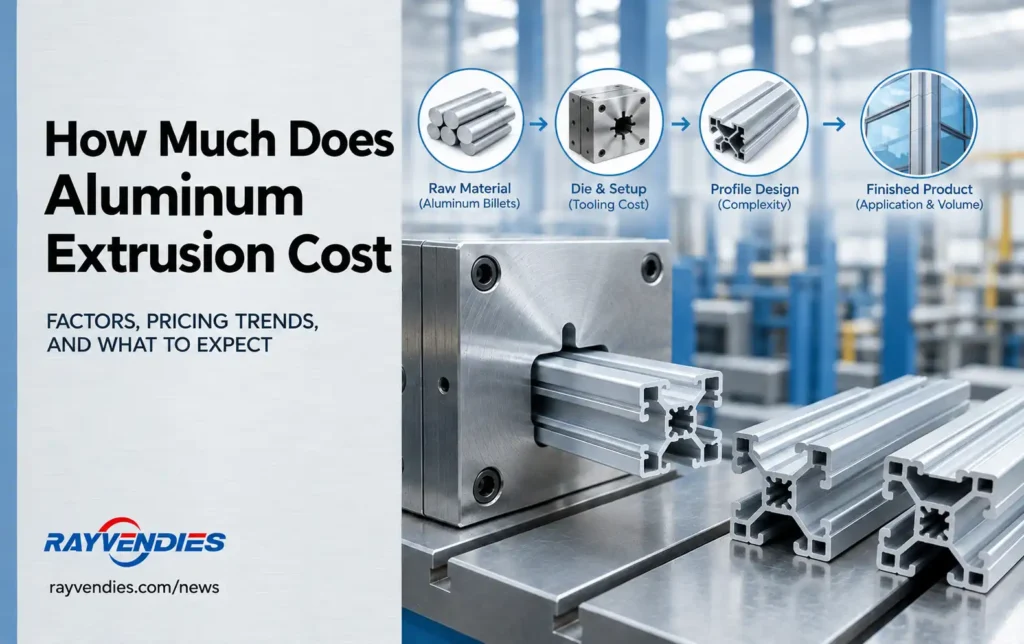
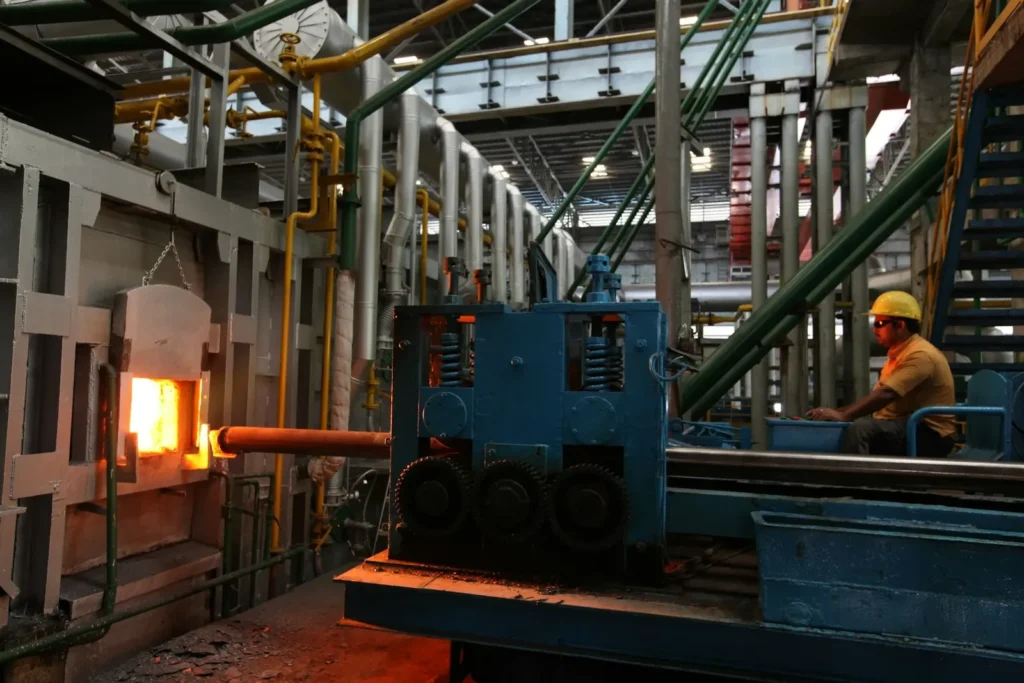
The general process includes billet preparation, heating, extrusion through a die, cooling, stretching, cutting, aging, finishing, machining, inspection, and packaging.
The central production asset is the aluminum extrusion press.
During extrusion, a heated billet is forced through a shaped die to produce a continuous profile. Complex dies can create hollow, multi-channel, or highly engineered sections.
An aluminum extrusion machine therefore does much more than create simple bars. Modern extrusion systems support industrial profiles designed around precise functional requirements.
Manufacturers may also perform:
- CNC cutting
- Drilling
- Tapping
- Milling
- Slot machining
- Surface treatment
- Assembly
- Packaging
That broader capability is why buyers should evaluate aluminum extrusion services, rather than judging suppliers only by their press capacity.
Aluminum Extrusion Prices and Scrap Market Signals
Price is another central subject in aluminum extrusion news.
According to the supplied market analysis, the cost of raw aluminum billet can represent approximately 70% to 80% of operating cost for extrusion producers. Aluminum prices are commonly linked to the London Metal Exchange plus regional premiums, while tariffs and tight supply can affect local pricing.
Energy is also a major variable. The supplied data estimates that heating billets and operating extrusion presses requires around 1,000–1,500 kWh per tonne, while high-energy regions may experience significantly higher production costs.
For buyers, this means that the aluminum extrusion scrap price can influence the economics of recycling, secondary billet, and overall material sourcing.
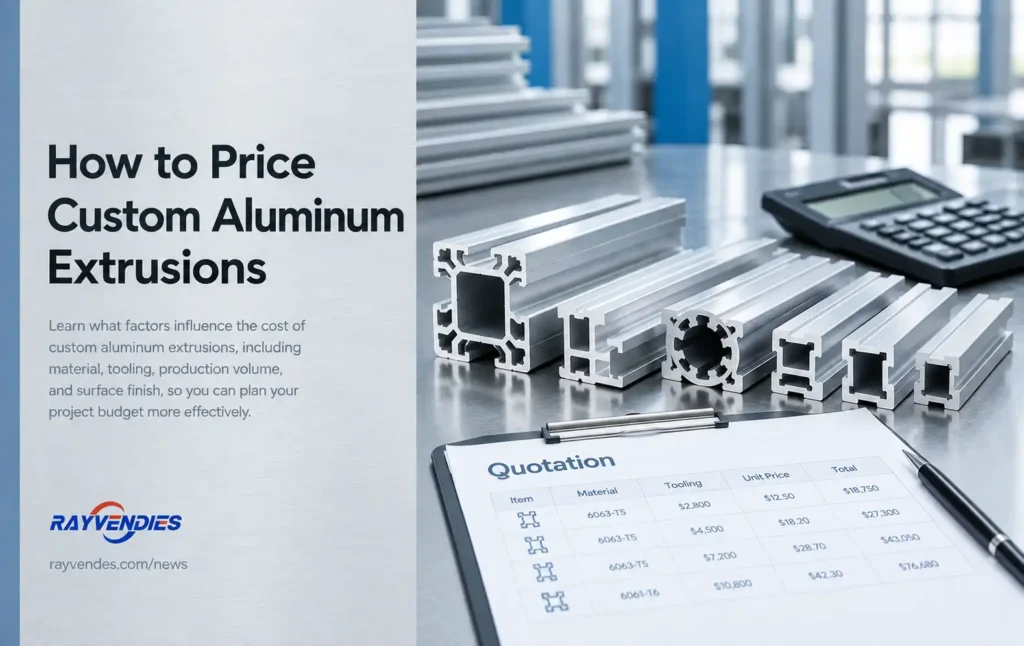
A professional quotation should therefore separate or clearly explain:
- Aluminum material cost
- Extrusion and tooling cost
- Finishing cost
- Machining cost
- Packaging cost
- Freight and logistics
- Applicable tariffs or duties
North American Supply and American Aluminum Extrusion
The North American market deserves special attention in the latest aluminum extrusion news.
The supplied market outlook identifies North America as one of the faster-growing regions, supported by EV manufacturing and infrastructure spending.
At the same time, the U.S. supply base is undergoing changes.
Hydro announced plans to close its City of Industry, California, facility on January 1, 2027, with the Delhi, Louisiana, facility scheduled to cease operations on April 1, 2027. The closures are linked to low capacity utilization and significant investment requirements, with production transfers planned within Hydro’s North American network.
That does not mean U.S. aluminum extrusion supply is disappearing. It means buyers may need stronger supply-chain planning.
Companies searching for american aluminum extrusion, aluminum extrusion near me, or aluminum extrusions near me should consider more than geographic distance. A nearby supplier is not automatically the best supplier if it lacks the required die capability, alloy, finish, machining, capacity, or lead time.
For strategic sourcing, buyers may compare local supply with qualified international aluminum extrusion suppliers and maintain multiple sourcing options.
How to Choose Aluminum Extrusion Companies
When evaluating aluminum extrusion companies, purchasing teams should assess technical capability alongside price.
A strong supplier should be able to answer questions such as:
- Which alloys can you extrude?
- What profile dimensions can your equipment support?
- Can you develop custom dies?
- What tolerances can you maintain?
- Which surface finishes are available?
- Can you provide CNC machining?
- Can you cut profiles to finished length?
- Can you support prototype and volume orders?
- What quality documentation is available?
- What packaging is used for export?
- How is material traceability managed?
For customers looking for an aluminum extrusion company, aluminum extrusion manufacturer, aluminum extrusion manufacturer, aluminum extrusions manufacturer, or manufacturer of aluminum extrusions, these questions are more informative than a simple supplier directory ranking.
Aerospace, Automation, and Advanced Industrial Applications
The newest growth areas create demand beyond traditional construction.
aerospace aluminum extrusions and aircraft aluminum extrusions require careful attention to material specification, engineering tolerances, documentation, and application requirements.
Industrial automation also continues to expand demand for modular systems.
An aluminum extrusion frame can support robotic cells, conveyors, sensors, control cabinets, inspection equipment, guarding, and operator stations.
For these systems, profiles such as 3030 aluminum extrusion, 4040 aluminum extrusion, 4080 aluminum extrusion, and 8080 aluminum extrusion may be considered depending on design loads and structural requirements.
Specialized applications may also use aluminum extrusion with iron or steel reinforcement where a hybrid construction is required. The correct material solution should be determined from the engineering load case rather than assumed from profile appearance.
Stock Aluminum Extrusions or Custom Profiles?
The decision between stock and custom is one of the most important questions buyers face.
Standard extrusion
standard aluminum extrusions are advantageous when:
- The dimensions already match the application
- Quantities are moderate
- Time to market is critical
- Existing connectors are required
- Tooling investment should be minimized
Custom extrusion
custom aluminum extrusions are advantageous when:
- The structure has unique dimensions
- Multiple functions need to be integrated
- Weight reduction is important
- Assembly must be simplified
- A proprietary product design needs a unique appearance
- Performance cannot be achieved economically with stock profiles
For buyers comparing custom extrusion aluminum, custom aluminum extrusion, and custom aluminum extrusions suppliers, the most important factor is whether the supplier can support the complete lifecycle rather than simply making the profile.
What Rayven Can Bring to Aluminum Extrusion Projects
In a market defined by customization, shorter development cycles, and increasing engineering requirements, Rayven can be positioned as a practical partner for aluminum profile sourcing and project development.
Rather than treating every order as a commodity transaction, Rayven can help customers evaluate the relationship between profile design, application, material, surface treatment, machining, assembly, and cost.
This makes Rayven particularly relevant for customers looking for:
custom aluminum extrusions, aluminum extrusion services, aluminum extrusion parts, aluminum extrusion frame kits, aluminum extrusion enclosure, aluminum extrusion brackets, aluminum extrusion hardware, and other engineered profile solutions.
For standard applications, Rayven can also help customers identify suitable profile families rather than forcing custom tooling where a standard section can do the job.
For more demanding projects, customers can discuss profile drawings, desired alloy, dimensions, surface finish, machining, quantities, and target application with the Rayven team.
The goal is simple: select a profile that performs correctly and can be manufactured efficiently.
Current Industry Events and What They Signal
The latest aluminum extrusion news is not limited to market forecasts. Industry events also show where technology and investment are moving.
The Aluminum Extruders Council announced on September 1, 2026, that exhibit space is available for ET Expo at ET ’27. The event will be held April 26–30, 2027, in Orlando, Florida, alongside the International Aluminum Extrusion Technology Seminar and Exposition.
AEC describes ET Expo as a marketplace connecting extrusion-industry suppliers with engineers, executives, plant supervisors, operations specialists, and other decision-makers. The event covers areas including extrusion technology, sustainability, recycling, automotive, construction, energy, aerospace, HVAC, and medical applications.
That broad application mix reflects the same pattern visible in global aluminum extrusion news: extrusion is becoming increasingly integrated into advanced manufacturing ecosystems.
What Buyers Should Expect Next
The next phase of aluminum extrusion news is likely to center on four procurement priorities.
First, customization will continue to grow. Customers want profiles designed around their equipment rather than adapting equipment around generic profiles.
Second, sustainability will become more commercial. Recycled billet, low-carbon aluminum, and carbon reporting are increasingly relevant to global customers.
Third, supply-chain resilience will matter more. Regional production changes, tariffs, energy prices, and freight costs mean buyers should avoid relying on a single supply route.
Fourth, the definition of a “supplier” will change. Companies will increasingly seek partners that can provide extrusion, finishing, machining, fabrication, packaging, and technical support under one coordinated process.
This is precisely where Rayven can differentiate its approach by focusing on solution-oriented aluminum profile sourcing rather than only selling raw extruded sections.
FAQ: Aluminum Extrusion News and Market Trends
What is the latest aluminum extrusion news about market size?
The supplied AL Circle-based analysis estimates the global aluminum extrusion market at about USD 110 billion in 2025 and around USD 118 billion in 2026, with a potential value of USD 150–175 billion by 2032.
What is driving aluminum extrusion demand?
Construction and infrastructure remain the largest users, while automotive and transportation are among the fastest-growing applications. Renewable energy, electrical systems, machinery, and consumer products also contribute to demand.
Which aluminum alloy is most common for extrusion?
The 6xxx family is identified in the supplied market analysis as the dominant extrusion alloy group because of its balance of strength, corrosion resistance, and extrudability.
What is the difference between 6061 and 6063 extrusion?
6061 is generally selected when higher structural strength is important, while 6063 is widely used when extrusion quality, surface appearance, and complex profile geometry are important. Application requirements should determine the final selection.
What is T-slot aluminum extrusion used for?
t-slot aluminum extrusion, t slot aluminum extrusions, and t slotted aluminum extrusion are widely used for machine frames, workbenches, automation structures, enclosures, guarding, carts, and modular workstations.
Where can I find aluminum extrusions near me?
Searches such as aluminum extrusions near me, 8020 aluminum extrusion near me, and aluminum extrusion near me can identify local distributors and fabricators. However, buyers should also compare profile availability, customization, tooling, finish, machining, lead time, and total delivered cost.
Should I choose stock or custom aluminum extrusion?
Use stock profiles when they meet your engineering requirements. Consider custom aluminum extrusion when a specialized cross-section can reduce weight, simplify assembly, combine multiple functions, or improve product performance.
What affects aluminum extrusion pricing?
Raw aluminum and billet prices, energy consumption, profile complexity, die costs, production volume, surface treatment, machining, packaging, logistics, and trade conditions can all affect final pricing.
Is recycled aluminum suitable for extrusion?
Yes. Recycled billet is increasingly important because it can significantly reduce energy consumption compared with primary aluminum. The supplied market research states that recycled billet can use up to 95% less energy.
Final Takeaway: Follow the Market, Then Choose the Right Supplier
The central message from today’s aluminum extrusion news is straightforward: global demand is expanding, but the market is also becoming more technically demanding.
Construction remains the foundation of global consumption, while EVs, solar energy, automation, electronics, aerospace, and advanced industrial applications are creating new demand for increasingly specialized profiles. Asia Pacific remains the dominant regional market, while North America continues to attract growth from EVs and infrastructure investment.
At the same time, energy prices, billet costs, tariffs, recycling, and plant-level capacity decisions are changing the economics of supply.
For buyers, this means selecting the right aluminum extrusion supplier is about much more than obtaining the lowest price per kilogram.
The right partner should understand profile design, alloy selection, finish, machining, tooling, production volume, logistics, and the final application.
Rayven is positioned to support customers looking beyond commodity sourcing and toward application-specific aluminum profile solutions. Whether you need standard T-slot profiles, industrial frames, enclosure structures, architectural sections, or custom aluminum extrusions, discussing the project requirements early can help identify a more efficient route from concept to production.
For your next aluminum profile project, contact Rayven to discuss your drawings, profile dimensions, alloy requirements, surface finish, machining needs, order volume, and delivery target. A properly engineered extrusion can become more than a structural component—it can be the foundation of a lighter, more modular, more efficient, and more scalable product.