When designing modular framing systems for industrial, commercial, or DIY projects, selecting the ideal structural component is critical. A leading option across industries is the 10s 80 20 aluminum extrusion. Made popular by 80/20 Inc., this 1-inch modular T-slotted system provides an exceptional balance of strength, lightweight performance, and adjustability.
Whether you are assembling a custom aluminum extrusion workbench, constructing a 3D printers and CNC machine chassis, or building heavy-duty safety guards, understanding how 10 series aluminum extrusion operates will streamline your engineering process.
In this comprehensive guide, we will break down what 10s 80 20 aluminum extrusion is, analyze key specifications, compare fractional and metric profiles (such as 8020 vs 2020 aluminum extrusion), highlight load capacities, and demonstrate how Rayven provides industry-leading custom aluminum extrusions tailored to your exact manufacturing requirements.
Understanding 10S 80/20 Aluminum Extrusion
The designation 10s 80 20 aluminum extrusion breaks down into two core concepts:
- 10S (10 Series): Refers to the fractional profile size family based on a 1.00-inch grid. A standard 1010 aluminum extrusion features a 1.00” x 1.00” cross-section, while a 1020 aluminum extrusion measures 1.00” x 2.00”.
- 80/20: Refers to the well-known T-slot building system brand, named after the Pareto Principle (the 80/20 rule) to highlight how 20% of the effort can yield 80% of the structural versatility.
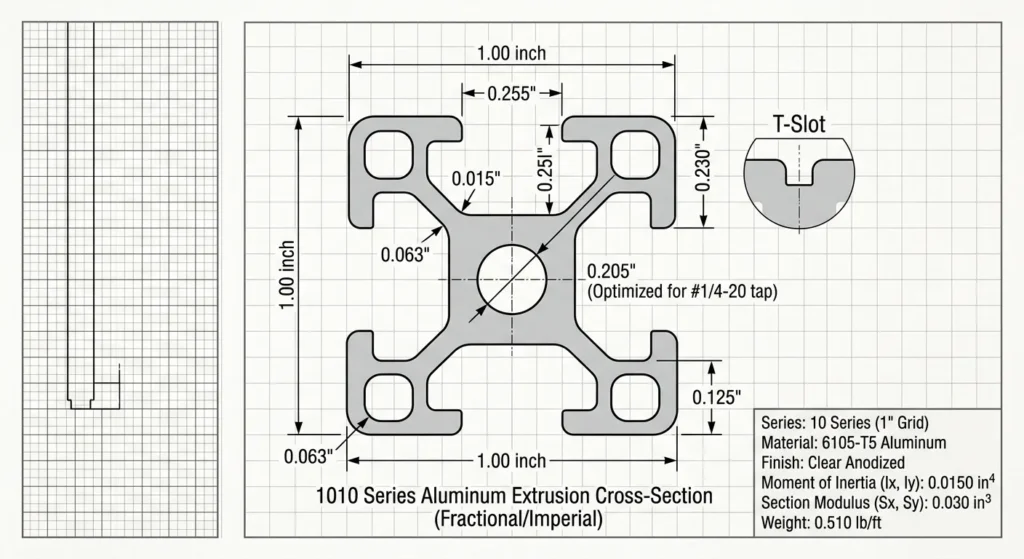
A T-slotted aluminum extrusion frame allows builders to attach fasteners, corner brackets, and paneling from any face without welding. Using basic hand tools along with standard t nuts for aluminum extrusion and bolts, structures can be modified or expanded seamlessly.
What Does 10S Mean in 80/20 Aluminum Extrusion?
The “10” in 10 Series refers to the nominal 1.00-inch profile grid used by the system. In other words, the basic dimension of the profile family is approximately one inch, while the second dimension can vary according to the profile geometry.
This is why a 1010 aluminum extrusion is approximately 1.00 x 1.00 inches, while a 1020 aluminum extrusion is approximately 1.00 x 2.00 inches. The first two digits identify the general dimensional family, while the profile number helps specify its cross-sectional form.
A useful way to understand the terminology is:
| Profile | Approximate Size | General Configuration | Typical Uses |
|---|---|---|---|
| 1010 aluminum extrusion | 1″ × 1″ | Square, 4-slot | Light framing, guards, displays |
| 1020 aluminum extrusion | 1″ × 2″ | Rectangular, 6-slot | Frames, benches, supports |
| 1515 aluminum extrusion | 1.5″ × 1.5″ | Square, 4-slot | Medium-duty structures |
| 1530 aluminum extrusion | 1.5″ × 3″ | Rectangular | Machine frames, supports |
| 2020 aluminum extrusion | 2″ × 2″ | Square, 4-slot | Stronger machine structures |
| 2040 aluminum extrusion | 2″ × 4″ | Rectangular | Heavy-duty frames |
| 3030 aluminum extrusion | 3″ × 3″ | Large square | Industrial machinery |
| 4080 aluminum extrusion | 4″ × 8″ | Large rectangular | Heavy structural applications |
These values are dimensional conventions rather than a statement that every manufacturer produces identical geometry. Slot openings, wall thicknesses, center bores, corner radii, and mechanical properties can vary between suppliers.
That distinction is important when sourcing aluminum extrusions. Two profiles with the same nominal dimensions may not be compatible with the same T-nuts or brackets.
80/20’s current fractional catalog includes 10 Series, 15 Series, and larger profiles, while its product range also includes 20 Series and other modular configurations.
Key Features & Material Specifications
The high performance of 80 20 structural aluminum comes down to material science, precision engineering, and specialized surface treatments.
Material Grades & Finishes
Most 80 20 extruded aluminum profiles are manufactured using high-tensile alloys:
- 6063 aluminum extrusion / aluminum 6063 extrusion: Offers smooth surface finishes, excellent corrosion resistance, and good structural integrity. Ideal for architectural aluminum extrusions and standard frames.
- 6105-T5 or 6061 aluminum extrusion: Preferred for structural framing requiring higher yield strength and durability under heavy vibration.
To protect the metal from ambient oxidation, anodized aluminum extrusions feature an electrochemical clear or black aluminum extrusion finish that prevents corrosion and improves wear resistance.
The Modular T-Slot Design
The defining advantage of t-slotted aluminum extrusion profile geometry is the continuous slot running along every face. This slot serves as an adjustable anchor point along the entire length of the aluminum extrusion rail.
- No Welding Required: Eliminates thermal distortion and specialized labor costs.
- Easy Reconfiguration: Fasteners can slide along the channel to adjust machine height or add cross-bracing.
- Integrated Panel Channels: Slots securely capture wire mesh, polycarbonate, or acrylic panels for enclosures.
Fractional vs. Metric Aluminum Extrusions: Complete Comparison
Choosing between imperial (10 series aluminum extrusion) and metric series (such as 20 series aluminum extrusion or 30 series aluminum extrusion) depends on your project’s region, mounting hardware, and load requirements.
The table below outlines common profiles found across an aluminum extrusion size chart:
| Profile Series | Nominal Cross-Section | System Type | Common Profiles | Typical Applications |
| 10 Series | 1.00″ Grid | Fractional (Imperial) | 1010 aluminum extrusion, 1020 aluminum extrusion | Workbenches, light automation, aluminum extrusion enclosure |
| 15 Series | 1.50″ Grid | Fractional (Imperial) | 1515 aluminum extrusion, 1530 aluminum extrusion | Heavy-duty machinery frames, structural columns, structural tables |
| 20 Series | 20mm Grid | Metric | 2020 aluminum extrusion, 2040 aluminum extrusion, 2080 aluminum extrusion | Aluminum extrusion for 3d printer, light DIY framing, robotics |
| 30 Series | 30mm Grid | Metric | 3030 aluminum extrusion, 3060 aluminum extrusion | Medium industrial guards, display racks, workstation legs |
| 40 Series | 40mm Grid | Metric | 4040 aluminum extrusion, 4080 aluminum extrusion | Heavy automation, CNC beds, industrial enclosures |
| 80 Series | 80mm Grid | Metric | 8040 aluminum extrusion, 8080 aluminum extrusion | Extreme structural loads, heavy manufacturing cells |
Evaluating 8020 vs 2020 Aluminum Extrusion
A common choice for small-to-medium builds is evaluating 8020 vs 2020 aluminum extrusion.
- 1010 (10 Series 80/20): Based on a 1.00-inch (25.4mm) grid. It utilizes a larger center bore and wider T-slot dimension, making it substantially stiffer than 20mm profiles.
- 2020 (20 Series): Based on a 20mm (0.787-inch) grid. While slightly lighter and more compact, 2020 aluminum extrusion offers less deflection resistance under horizontal loads compared to 1010 aluminum extrusion.
If your project requires imperial mounting patterns or higher rigidity in a compact footprint, 10 series aluminum extrusion dimensions provide a superior strength-to-weight ratio over standard 20mm metric extrusions.
Load Capacities: How Strong Is 8020 Aluminum?
Engineers frequently ask: How strong is 8020 aluminum?
The load capacity of an aluminum extrusion assembly depends on profile geometry, cross-sectional moment of inertia ($I$), material yield strength, and beam length.
Mechanical Properties of 10 Series Profiles
- Yield Strength: ~35,000 psi (for 6105-T5 alloy)
- Tensile Strength: ~38,000 psi
- Elastic Modulus: ~10,000,000 psi
For a standard 1010 aluminum extrusion spanning 36 inches supported at both ends:
- A center point load of approximately 250 to 300 lbs can be supported before exceeding allowable deflection limits ($\frac{L}{240}$).
- Using a 1020 aluminum extrusion in a vertical orientation increases the moment of inertia significantly, allowing for loads exceeding 750 lbs over the same span.
For multi-ton industrial loads, upgrading to a 15 series aluminum extrusion or metric 4080 aluminum extrusion provides thicker wall profiles and larger corner radii.
Common Applications Across Industries
The versatility of 80 20 aluminum extrusions makes them popular across diverse industrial sectors:
1. Industrial Workstations & Safety Guards
Manufacturers build aluminum extrusion table frameworks and aluminum extrusion workbench setups using 10 series profiles. Attached with aluminum extrusion connectors and aluminum extrusion brackets, these benches withstand rigorous daily use.
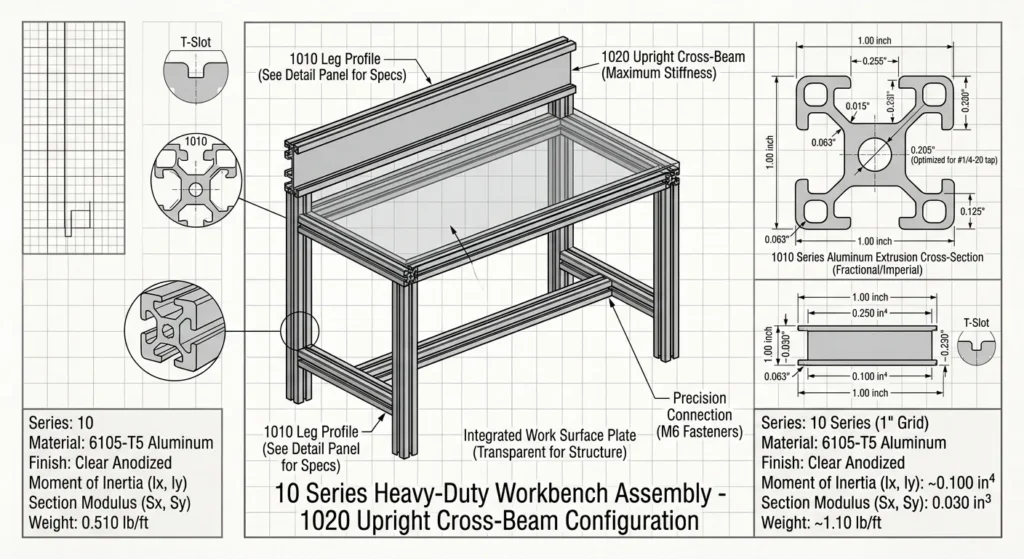
2. Robotics & CNC Machinery
precision-engineered slotted aluminum extrusion tracks support aluminum extrusion slider blocks and linear bearings, making 10 series aluminum extrusion ideal for 3D printer frames, laser cutters, and small CNC routers.
3. Enclosures & Cleanroom Shielding
Using aluminum extrusion channel slots, builders can insert glass, polycarbonate, or aluminum panels to create protective aluminum extrusion enclosure systems around high-speed equipment.
4. Specialized Transportation & Aerospace
Beyond plant floors, aerospace aluminum extrusions and aircraft aluminum extrusions demand precision tolerances, custom alloys, and strict quality certifications.
Essential Accessories & Hardware Ecosystem
An aluminum extrusion frame is only as strong as its connection points. Building a rigid structure requires selecting compatible aluminum extrusion hardware:
- T-Nuts: Inserted into T-slots to provide threaded mounting points. Available in drop-in, roll-in, or slide-in styles.
- Brackets & Gussets: Corner brackets, aluminum corner extrusion joins, and 90-degree flat plates maintain frame squareness under load.
- Fasteners: Button-head socket cap screws (BHCS) combined with t nuts for aluminum extrusion create clean, low-profile joints.
- Linear Motion:Aluminum extrusion slider blocks and roller wheels convert static profiles into smooth motion guidance tracks.
Manufacturing & Quality Standards
Behind every high-grade aluminum extrusion is a sophisticated manufacturing process:
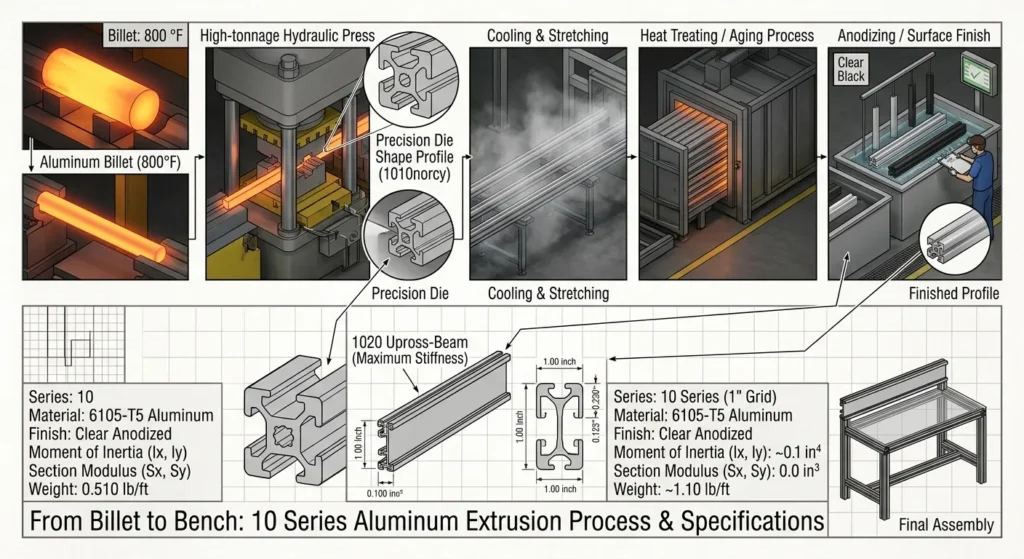
- Billet Heating: High-grade aluminum billets are preheated to approximately 800°F – 900°F (425°C – 485°C).
- Extrusion Pressing: An aluminum extrusion press forces the softened aluminum through a steel die shaped like a 1010 or 1020 profile.
- Cooling & Stretching: Extruded shapes exit onto cooling tables and are mechanically stretched to achieve straightness and relieve internal stress.
- Heat Treatment: Profiles undergo precipitation hardening (aging) to reach target tempers like T5 or T6.
- Anodizing:Anodized aluminum extrusions receive an electrolytic bath treatment that creates a durable, non-conductive, corrosion-resistant oxide layer.
When sourcing structural components, selecting a reliable aluminum extrusion manufacturer ensures uniform wall thickness, tight 10 series aluminum extrusion dimensions, and defect-free surface finishes.
Why Choose Rayven for Custom Aluminum Extrusions?
While standard off-the-shelf stock aluminum extrusions work for basic builds, specialized industrial designs often require custom dimensions, tailored slot geometry, or proprietary alloy formulations. This is where Rayven delivers exceptional value.
As an industry-leading aluminum extrusion company, Rayven specializes in end-to-end extrusion solutions—from initial profile design to volume manufacturing and secondary finishing.
Rayven’s Manufacturing Advantages
- Advanced Customization: Whether you require custom aluminum extrusions, non-standard aluminum channel extrusions, aluminum angle extrusion shapes, or specialized aluminum tube extrusion profiles, Rayven crafts dies to your exact specifications.
- Precision Tolerances: Rayven operates state-of-the-art aluminum extrusion machine equipment to ensure consistent slot dimensions and zero-play hardware fitment.
- Comprehensive Machining Services: Beyond raw profiles, Rayven provides precision CNC cutting, tapping, drilling, and custom finishing through complete aluminum extrusion services.
- Certified Quality: Rayven processes adhere to international standards, delivering high-performance aluminum 6063 extrusion and high-strength 6061 components for demanding applications.
Whether you are looking for custom aluminum extrusions suppliers, evaluating local suppliers, or seeking competitive pricing over standard distributor networks, Rayven provides factory-direct quality with global shipping capabilities.
Technical Comparison: Fractional vs. Metric Profiles
To help you choose the right profile size for your next structural build, review the technical parameters in this summary table:
| Profile Identifier | Grid System | Slot Width | Wall Thickness | Weight per Foot | Typical Application |
| 1010 aluminum extrusion | 1.00″ (Fractional) | 0.256″ (6.5mm) | 0.090″ – 0.125″ | ~0.51 lbs/ft | Light workstations, 3D printers |
| 1020 aluminum extrusion | 1.00″ (Fractional) | 0.256″ (6.5mm) | 0.090″ – 0.125″ | ~0.98 lbs/ft | Workbench frames, machine bases |
| 1515 aluminum extrusion | 1.50″ (Fractional) | 0.322″ (8.2mm) | 0.125″ – 0.150″ | ~1.12 lbs/ft | Heavy industrial frames |
| 1530 aluminum extrusion | 1.50″ (Fractional) | 0.322″ (8.2mm) | 0.125″ – 0.150″ | ~2.10 lbs/ft | Structural legs, load beams |
| 2020 aluminum extrusion | 20mm (Metric) | 0.205″ (5.2mm) | 0.060″ – 0.080″ | ~0.32 lbs/ft | DIY desktop projects, enclosures |
| 3030 aluminum extrusion | 30mm (Metric) | 0.318″ (8.1mm) | 0.080″ – 0.100″ | ~0.62 lbs/ft | Medium machinery guards |
| 4040 aluminum extrusion | 40mm (Metric) | 0.322″ (8.2mm) | 0.090″ – 0.120″ | ~0.95 lbs/ft | Factory automation, conveyors |
Step-by-Step Selection Guide for Your Project
Selecting the right t slot aluminum extrusion involves four simple steps:
- Determine Total Load:
- For loads under 150 lbs, 1010 aluminum extrusion or 2020 aluminum extrusion is sufficient.
- For loads between 150 lbs and 500 lbs, opt for 1020 aluminum extrusion or 3030 aluminum extrusion.
- For heavy machinery over 500 lbs, select 15 series aluminum extrusion or 4080 aluminum extrusion.
- Select Hardware Compatibility: Ensure your chosen nuts, bolts, and corner brackets match the specific slot width of your profile series.
- Choose Surface Treatment: Use standard clear anodized aluminum extrusions for cleanroom and interior environments, or black aluminum extrusion for low-reflectivity optical or aesthetic applications.
- Partner with a Trusted Manufacturer: Work with an experienced supplier like Rayven to ensure precise cutting tolerances and optimized raw material costs.
Get Custom Aluminum Extrusions from Rayven
Whether you need standard 80 20 aluminum extrusions, specialized aluminum extrusion frame kits, or fully custom-engineered profiles, Rayven provides the production capacity, precision engineering, and global logistics support your business requires.
Contact our engineering team today to review your CAD drawings, request a competitive quote, or explore how Rayven custom aluminum extrusions can optimize your next manufacturing project.
What are the lead times, cost advantages, and design benefits of choosing custom aluminum extrusions?
Choosing custom aluminum extrusions—such as those manufactured by Rayven—over off-the-shelf standard stock profiles (like standard 1010, 1515, or 2020 t-slot profiles) shifts the design strategy from “assembling with existing limitations” to “optimizing for exact performance.”
1. Lead Times: Stock vs. Custom Workflow
While standard off-the-shelf profiles offer immediate local shipping, custom extrusions with Rayven involve a short initial tooling lead time followed by streamlined production:
- Tooling & Die Creation (2 to 4 Weeks): Rayven designs and cuts the custom extrusion die tailored specifically to your cross-sectional geometry.
- Sample Validation & Production Run (1 to 2 Weeks): Initial sample extrusions are pulled, quality-checked for tolerances, and run through volume extrusion presses.
- Long-Term Lead Time Advantage: Once the initial custom die is built, reorders typically match or beat standard distributor lead times—eliminating dependence on third-party stock availability or backordered profile sizes.
2. Cost Advantages
While custom profiles carry an upfront die tooling fee (typically $1,000 to $4,000 depending on geometry complexity), they significantly reduce total system costs at volume:
- Elimination of Secondary Machining: Custom extrusions can incorporate pre-designed snap-fits, screw boss channels, alignment grooves, and mounting tracks directly into the die. This cuts out expensive post-process CNC milling, drilling, and slotting labor.
- Lower Material Weight & Scrap Rates: Standard stock profiles are uniformly solid or hollow, forcing you to buy excess aluminum weight to meet local strength needs. Custom profiles place material thickness only where stress analysis requires it, dropping overall part weight and raw material cost per linear foot.
- Consolidated Multi-Part Assemblies: A single custom profile can combine 3 to 5 separate stock parts, plates, and brackets into one extruded shape, drastically reducing bill of materials (BOM) complexity and inventory overhead.
3. Design & Engineering Benefits
Standard stock profiles force your product design to conform to rigid 1.0″, 1.5″, or metric 20mm/40mm grid lines. Custom extrusions give engineers complete freedom:
- Integrated Functionality: Incorporate specialized features directly into the aluminum wall, such as:
- Built-in thermal heat sink fins.
- Internal wire/cable routing channels.
- Integrated rubber/silicone seal gasket tracks.
- Hinge pivot points and snap-fit locking tabs.
- Optimized Strength-to-Weight Ratios: Tailor specific wall thicknesses (e.g., thicker load-bearing ribs paired with thin decorative exterior walls) to achieve higher rigidity with lower overall mass.
- Proprietary Aesthetics & Branding: Create custom exterior radii, unique anodized textures (e.g., custom matte black or brushed finishes), or proprietary slot dimensions that prevent unapproved third-party hardware retrofits.
Cost Comparison Breakdown
| Feature | Standard Stock Profiles | Rayven Custom Extrusions |
| Upfront Tooling Cost | $0 | One-time die fee ($1K–$4K average) |
| Unit Cost at Volume | Higher (paying for stock distributor margins) | Significantly lower (direct factory pricing) |
| Machining & Assembly Labor | High (cutting, drilling, brackets required) | Minimal (features engineered directly into profile) |
| Design Flexibility | Limited to standard catalog shapes | Unlimited cross-sectional geometries |
| Weight Optimization | Rigid cross-sections cause excess weight | Optimized wall thicknesses reduce total mass |
How do I optimize my CAD cross-section for custom aluminum extrusion?
Optimizing a custom aluminum extrusion cross-section for manufacturability (Design for Manufacturability or DFM) directly impacts die longevity, extrudability, surface finish, and tooling cost.
1. Maintain Uniform Wall Thickness
Uneven wall thickness causes non-uniform aluminum flow through the die during extrusion. Quicker flow through thick sections and slower flow through thin sections leads to profile twisting, waviness, and high internal stress.
- Target Ratio: Keep adjacent wall thickness ratios within 1.5:1 (ideally 1:1). Avoid ratios exceeding 3:1.
- Transitions: When transitioning between different wall thicknesses, use a generous radius rather than a sharp step. A blended fillet ($R \ge \text{wall thickness} \times 0.5$) maintains uniform pressure and smooth aluminum flow.
2. Standardize Corners & Radii
Sharp internal or external corners act as severe stress risers during extrusion, causing early die cracking and increasing die fabrication costs.
- External Radii: Avoid sharp 90° outer corners. Apply a minimum radius of 0.015″ to 0.030″ (0.4mm to 0.8mm) to outer edges to prevent die chipping and uneven anodizing buildup.
- Internal Fillets: Maintain an inside corner radius equal to at least 50% to 100% of the adjacent wall thickness to ensure structural integrity and prolong die life.
3. Minimize Die Tongue Ratio (Hollow & Semi-Hollow Sections)
Die cost increases significantly when moving from solid profiles to semi-hollow or fully hollow shapes. For semi-hollow channels, the Die Tongue Ratio determines die strength and risk of die breakage under press tonnage:
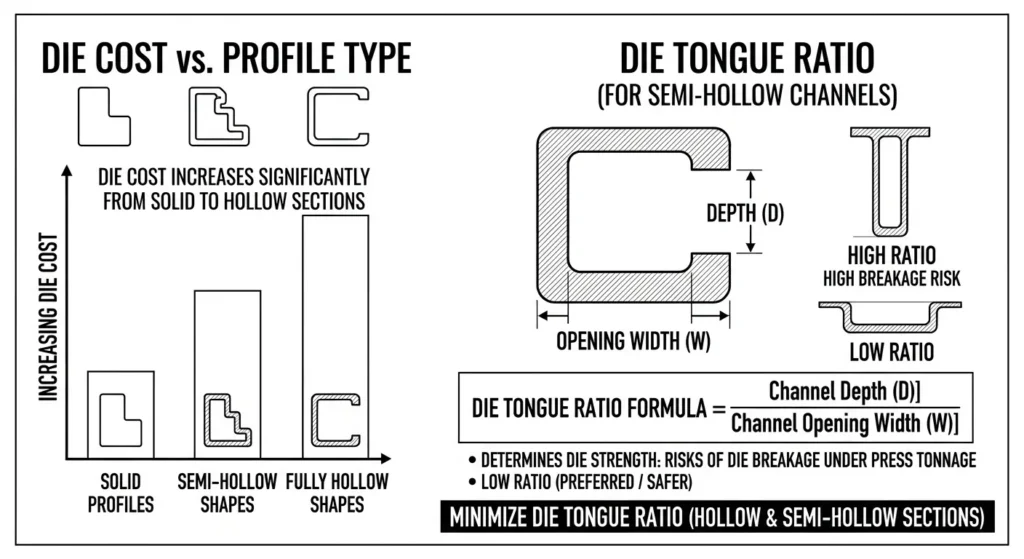
- Ideal Ratio: Keep the depth-to-width ratio under 3:1.
- High-Risk Threshold: Ratios above 4:1 require specialized support tooling, drastically increasing die complexity and failure rates.
- Cost Alternative: If a deep channel is required, consider designing an open profile with a snap-fit closure plate instead of a complex hollow die.
4. Optimize Profile Symmetry & Center of Gravity
Profiles with high symmetry extrude cleaner, require lower press pressures, and experience less warp during heat-treatment aging.
- Center the profile’s mass around the die’s central axis.
- Unbalanced or asymmetrical shapes cause the aluminum stream to curve or bow as it leaves the press, requiring mechanical stretching and post-extrusion straightening.
5. Utilize Wall Ribs for Structural Stiffness
Instead of increasing overall wall thickness across the entire profile to boost rigidity, add thin structural ribs.
- Rib Sizing: Make internal stiffening ribs 20% to 30% thinner than the primary outer wall to prevent sink marks on the visible exterior surface opposite the rib junction.
Profile DFM Checklist for Die Cost Reduction
| Feature / Element | Best Practice Rule | Impact on Die / Manufacturing |
| Profile Type | Prefer Solid > Semi-Hollow > Multi-Hollow | Solid dies cost 50%–70% less than hollow dies |
| Wall Ratio | Max $1.5:1$ between thickest/thinnest wall | Prevents profile warping and uneven cooling |
| Corner Radii | Min $0.020″$ ($0.5\text{mm}$) on all edges | Prevents die cracking and sharp edge chipping |
| Channel Openings | Keep $\text{Depth}:\text{Width} \le 3:1$ | Avoids bent die tongues under press pressure |
| Circumscribing Circle | Keep overall cross-section as small as possible | Smaller diameter dies fit smaller, cheaper presses |
What About 80 20 Aluminum Extrusion With Iron?
Searches for aluminum extrusion with iron usually reflect a desire to combine the lightweight modularity of aluminum with the stiffness or magnetic characteristics of steel.
In many designs, the better strategy is not to physically combine the materials inside one extrusion, but to use complementary components.
For example, an aluminum structural frame can be combined with:
- Steel brackets
- Steel baseplates
- Steel machine components
- Cast-iron equipment
- Steel fasteners
This hybrid approach can provide a practical balance between weight, stiffness, strength, and cost.
Aluminum Extrusion for 3D Printers and CNC Frames
Compact metric and imperial profiles have become closely associated with additive manufacturing and desktop CNC equipment.
A 2020 aluminum extrusion can provide an efficient frame for compact equipment, while larger profiles such as 2040, 4040, or 4080 can be considered for more demanding machine structures.
The most important design principle is stability.
For a moving machine, frame vibration can affect:
- Positional accuracy
- Surface finish
- Print quality
- Noise
- Repeatability
- Tool life
Therefore, choosing aluminum extrusion for 3d printer or CNC equipment should involve a full structural assessment rather than simply selecting the cheapest profile.
What Is the Future of Aluminum Extrusion?
The future of aluminum extrusion is strongly connected to lightweighting, automation, customization, sustainability, and manufacturing efficiency.
Current market research indicates continued expansion in applications including automotive, transportation, construction, electrical, energy, and industrial systems. Grand View Research estimates the global market at approximately $105.8 billion in 2026, while Fortune Business Insights estimates approximately $108.71 billion for 2026; the different figures reflect different market scopes and methodologies, but both point to a growing market.
Several trends are particularly relevant to T-slot framing:
More Modular Automation
Factories increasingly require equipment that can be modified as production needs change.
Greater Material Efficiency
Designers want structures that achieve required strength with less material and weight.
More Custom Profiles
Application-specific geometries can consolidate components and improve assembly efficiency.
Better Digital Design
CAD libraries, configurators, CNC processing, and digital manufacturing make it easier to design an extrusion-based structure before production.
Sustainability
Aluminum’s recyclability and long service life are attractive in applications where manufacturers are seeking material-efficiency strategies. Market research also identifies recyclability as one contributor to continued demand for extruded aluminum products.
Why Work With Rayven for Aluminum Extrusion Solutions?
Selecting the correct aluminum extrusion is not simply about matching a profile number to a drawing.
The best result comes from matching the profile to the application.
Rayven can be presented as an application-focused partner for customers who need help evaluating standard profiles, developing custom structures, selecting compatible hardware, or planning a complete extrusion-based assembly.
The Rayven value proposition can center on:
Application-Based Selection: Start with load, dimensions, environment, and assembly requirements rather than selling a profile in isolation.
Flexible Configuration: Support projects ranging from standard T-slot framing to custom-profile requirements.
Complete Solution Thinking: Consider profiles, brackets, T-nuts, fasteners, machining, cutting, panels, and finished assemblies as one system.
Design Support: Help customers translate an engineering concept into a practical extrusion frame.
Custom Development: For projects requiring unique geometry, explore custom aluminum extrusion designs instead of forcing a standard profile to perform a specialized function.
For customers comparing aluminum extrusion suppliers, that integrated approach can be more valuable than simply comparing price per foot.
Frequently Asked Questions About 10S 80/20 Aluminum Extrusion
What is the difference between 10 series and 15 series aluminum extrusion?
10 series aluminum extrusion is based on a 1.00-inch grid system with a 0.256-inch T-slot width, making it ideal for light-to-medium structural applications. 15 series aluminum extrusion is based on a 1.50-inch grid system with a wider slot and thicker walls, designed for heavy industrial machinery and high-load structures.
Can I connect imperial 10 series profiles with metric 20 series profiles?
While both feature T-slots, their slot widths, center bore diameters, and grid centerlines differ. Connecting them directly requires specialized step-down adapter brackets or transition fasteners. It is generally recommended to stick to one system family throughout a single build.
Why choose extruded aluminum over welded steel tubing?
An aluminum extrusion frame requires no welding, painting, or grinding. It offers easy adjustability, resists corrosion out of the box, reduces overall weight, and can be assembled using simple hand tools.
What is 10s 80 20 aluminum extrusion?
10S refers to the 10 Series family of 1-inch-based fractional T-slot profiles associated with 80/20. The family includes profiles such as 1010 and 1020, which use open T-slots for modular fastening.
Is 1010 aluminum extrusion strong?
Yes, for appropriately designed light and medium-duty structures. However, the structural performance depends on span, load, orientation, fastening, and profile geometry. A specific 1010 profile published by 80/20 uses 6063-T6 aluminum and lists a 25,000 psi yield strength.
Is 1020 stronger than 1010?
A 1020 profile generally provides greater section depth in one direction and can offer higher stiffness in that orientation. Actual performance depends on the specific profile geometry and loading condition.
What is 8020 vs 2020 aluminum extrusion?
80/20 10 Series uses an imperial/fractional dimensional system, while 2020 generally describes a metric 20 × 20 mm profile. Their hardware and slot dimensions are not automatically interchangeable.
What is the most common aluminum extrusion alloy?
6063 is one of the most widely used extrusion alloys because of its good extrudability, surface finish, corrosion resistance, and anodizing performance.
Can aluminum extrusion be used for a machine frame?
Yes. Aluminum extrusion frame systems are widely used for machine structures, automation cells, safety guards, workstations, fixtures, and equipment enclosures. The profile must be selected according to the machine’s load and stiffness requirements.
Do T-slot profiles require welding?
No. One of the primary advantages of aluminum extrusion t-slot systems is that they can be assembled with mechanical fasteners such as T-nuts, bolts, and brackets.
Are custom profiles worth considering?
They can be, particularly in higher-volume projects where a specialized cross-section can reduce assembly time, part count, material usage, or machining.
Conclusion: Understanding 10S 80/20 Aluminum Extrusion
So, what is 10s 80 20 aluminum extrusion?
It is a modular 1-inch-based T-slot framing system built around the 10 Series profile family. The concept combines the manufacturing advantages of aluminum extrusion with a mechanical fastening architecture that allows components to be assembled, adjusted, expanded, and reused without welding.
A 1010 profile provides a compact 1 × 1-inch configuration, while a 1020 provides a 1 × 2-inch configuration. Larger systems such as 2020, 3030, 4040, and 4080 offer additional structural capacity and dimensional flexibility for more demanding applications. 80/20’s current catalog confirms the availability of these broader profile families and compatible framing components.
For engineers and buyers, the most important lesson is that selecting aluminum extrusion should never be based only on profile size. Alloy, temper, geometry, span, load, deflection, connection method, hardware, environment, finish, and total system cost all matter.
For a simple workstation, 1010 may be sufficient. For a machine enclosure, 1020 or 2020 may provide a better balance. For heavy automation frames, larger profiles such as 3030, 4040, or 4080 may be more appropriate.
And for applications where standard sections do not fully meet the requirement, custom profiles can provide a more optimized solution.
Rayven can help customers move beyond generic profile selection toward a complete aluminum extrusion solution—covering profile selection, modular framing concepts, compatible hardware, custom requirements, and application-specific design considerations.
Need the right profile for your project? Contact Rayven to discuss your required dimensions, load capacity, structure, quantity, finish, and application, and develop an extrusion solution around your actual engineering requirements.