When designing structural framing, industrial machinery, or outdoor enclosures, a fundamental question often arises among engineers, builders, and fabricators: does aluminum rust? To answer this directly: no, aluminum does not rust in the traditional sense because rust is strictly iron oxide, and aluminum contains zero iron. However, while aluminum cannot form red iron rust, it is certainly susceptible to oxidation and chemical deterioration. Understanding how aluminum reacts with its environment—and how choosing the right aluminum extrusion structural profile impacts long-term durability—is essential for any successful engineering project.
In this comprehensive guide, we will explore the science of aluminum oxidation, examine how aluminum extrusion profiles behave under various environmental conditions, compare aluminum against steel, and highlight best practices for preventing corrosion with industry-leading solutions from Rayven.
Does Aluminum Rust or Corrode?
The most accurate answer is:
Aluminum does not rust, but it can corrode.
Rust is a specific form of corrosion associated with iron and steel. When exposed to oxygen and moisture, iron gradually forms iron oxides and hydroxides, producing the familiar reddish-brown material commonly called rust.
Aluminum behaves differently.
When fresh aluminum is exposed to oxygen, it reacts very quickly with the atmosphere and forms a thin layer of aluminum oxide on its surface. This oxide layer is extremely important because it acts as a protective barrier between the underlying metal and the surrounding environment.
The basic process can be simplified as follows:
| Material | Typical surface reaction | Typical appearance |
|---|---|---|
| Iron | Iron oxide formation | Red/brown rust |
| Carbon steel | Iron oxide formation | Orange/brown rust |
| Aluminum | Aluminum oxide formation | Thin, protective oxide layer |
| Aluminum in aggressive environments | Localized corrosion | White/gray residue, pits, surface roughness |
| Stainless steel | Chromium-rich passive film | Usually remains relatively stable |
This is why asking “Does aluminum rust corrosion” requires a distinction between the two terms. Aluminum can experience corrosion, but that corrosion is fundamentally different from the rusting process of iron.
The same principle applies to an aluminum extrusion. The extrusion does not suddenly begin producing red rust simply because it has been exposed to rain or humidity. Instead, its surface naturally develops an oxide film.
Rust vs. Corrosion: What Is the Difference?
Rust and corrosion are related concepts, but they are not interchangeable.
Rust is a specific type of corrosion. It occurs when iron reacts with oxygen and moisture and produces iron oxides and related hydrated compounds. This is why exposed carbon steel commonly develops reddish-brown flakes that expand, crack, and eventually detach from the surface.
Corrosion is the broader term. It describes the deterioration of a material through chemical or electrochemical interaction with its environment. Aluminum, copper, zinc, and many other materials can corrode even though they do not technically rust.
| Characteristic | Iron/Steel | Aluminum |
|---|---|---|
| Traditional rust | Yes | No |
| Main protective surface reaction | Iron oxide/rust | Aluminum oxide |
| Typical appearance | Red/brown flakes | Gray, white, dull, or pitted surface |
| Protective oxide layer | Generally not protective | Generally protective |
| Pitting possible | Yes | Yes |
| Galvanic corrosion possible | Yes | Yes |
| Saltwater sensitivity | High | High under certain conditions |
| Need for surface protection | Often high | Application-dependent |
The distinction is important when evaluating an aluminum extrusion. A profile that develops a white surface deposit is not necessarily “rusting.” It may be experiencing localized aluminum corrosion.
The supplied reference explains that aluminum naturally forms aluminum oxide when exposed to oxygen, and unlike flaky iron rust, this oxide layer is stable and protective.
The Chemistry of Oxidation: Does Aluminum Rust or Corrode?
To understand why aluminum behaves differently than ferrous metals, one must distinguish between true rusting and general oxidation.
The Science Behind “Rust” vs. Oxidation
- Rusting: This specific term applies only to iron and iron-based alloys (such as carbon steel). When iron interacts with oxygen and water, it forms hydrated iron(III) oxide ($\text{Fe}_2\text{O}_3\cdot n\text{H}_2\text{O}$), a flaky red-brown compound that continuously expands and peels away, exposing fresh metal until the structure degrades completely.
- Aluminum Oxidation: When raw aluminum comes into contact with air, an immediate reaction occurs between oxygen and the metal surface. This process creates a microscopically thin layer of aluminum oxide ($\text{Al}_2\text{O}_3$). Unlike red iron rust, this oxide layer is non-porous, tight-fitting, and self-healing. If scratched, the newly exposed metal re-oxidizes almost instantly to seal itself against further atmospheric attack.
How Aluminum Corrodes Instead
While an aluminum extrusion won’t produce red flakes, it is incorrect to assume it is completely immune to environmental damage. When exposed to harsh, acidic, or highly saline conditions, the protective oxide film can break down.
So, what does aluminum corrosion look like?
- White Powder / Chalking: A dull grey or chalky white powder forms on the surface, primarily composed of hydrated aluminum oxide or hydroxide.
- Pitting Corrosion: Small, microscopic pits or localized pinholes develop on the profile surface, often caused by stagnant liquid or halide ions (like chloride).
- Exfoliation / Intergranular Corrosion: In severe cases, corrosion propagates along the grain boundaries of low-grade or improperly heat-treated alloys.
Environmental Impact on Aluminum Extrusions
Whether you are using a standard 2020 aluminum extrusion for a desktop enclosure or an industrial-grade 8020 aluminum extrusion frame outdoors, environmental exposure plays a huge role in material longevity.
Does Aluminum Rust in Water?
In pure, clean distilled or fresh water, aluminum forms its standard passivation layer and experiences negligible degradation. However, does aluminum corrode in water if the fluid is stagnant, acidic, or basic? Yes. Stagnant moisture trapped between un-aerated metal surfaces can lead to crevice corrosion. Furthermore, asking does aluminum rust in rain depends heavily on atmospheric purity. Standard rainwater poses little threat, but acid rain containing sulfur dioxide or nitrogen oxides can attack untreated standard aluminum extrusions.
The Impact of Marine and Saline Environments
Salt environments present a tougher challenge:
- Does aluminum rust with salt water? Salt water contains high concentrations of chloride ions ($\text{Cl}^-$), which actively penetrate and break down the natural aluminum oxide film.
- Does aluminum rust from sea salt or does aluminum rust in salt air? In coastal zones, airborne sea salt deposits on metal frames. Over time, salt draws ambient moisture, accelerating localized pitting. For marine-grade applications, choosing specialized alloys like 6061 aluminum extrusion or utilizing protective anodized aluminum extrusions from Rayven is vital.
Everyday and Specialized Environments
| Environment / Application | Does Aluminum Rust / Corrode? | Environmental Risk Factors | Recommended Aluminum Extrusion Profile & Finish |
| Bathroom / Indoor Humidity | Does aluminum rust in bathroom environments? No, but humid air can cause surface dulling over time. | High relative humidity, soap scum, cleaning detergents. | Anodized aluminum corner extrusion or aluminum channel extrusions. |
| Pool Water | Does aluminum rust in pool water? Chlorine and pool chemicals can aggressively pit un-anodized metal. | Chlorine, bromine, low/high pH levels. | Heavy-duty custom aluminum extrusions with custom powder-coating. |
| Underground / Soil | Does aluminum rust underground? Underground soils with acidic/alkaline pH values corrode bare metal. | Soil pH, moisture retention, stray electrical currents. | Protective wrapped aluminum tube extrusion or heavy anodization. |
| Automotive / Vehicles | Does aluminum rust on cars? Road salt and gravel impact can erode bare metal framing over time. | De-icing salts, gravel impact, galvanic contact with steel parts. | Architectural/automotive structural aluminum extrusions with clear coat. |
Comparing Metals: Aluminum Extrusions vs. Steel Profiles
When selecting structural framing for workbenches, automation machinery, or custom enclosures, engineers frequently evaluate does aluminum rust faster than steel. The answer is simple: steel degrades far quicker and more catastrophically than aluminum in standard atmospheric conditions.
To evaluate material performance, let us compare a standard steel frame against modular t slot aluminum extrusion systems:
| Feature / Property | Structural Steel Framing | Rayven Aluminum Extrusion Systems |
| Primary Corrosion Mechanism | Red rust (Iron oxide) that peels and destroys structural integrity. | Self-passivating white oxide layer; localized pitting under extreme chemicals only. |
| Maintenance Requirements | Requires regular repainting, scraping, and anti-rust coatings. | Virtually maintenance-free due to robust surface treatments. |
| Weight-to-Strength Ratio | High density (heavy); strong but increases shipping and assembly labor. | Lightweight (~1/3 weight of steel) with high structural efficiency. |
| Modularity & Assembly | Requires manual cutting, welding, grinding, and professional labor. | Modular t slotted aluminum extrusions assemble quickly using internal aluminum extrusion hardware. |
| Aesthetics | Can look industrial/raw unless painted thoroughly; prone to rust stains. | Clean, modern, factory-anodized finish (available in silver or black aluminum extrusion). |
| Scrap / Recyclability | Moderate value scrap value. | High scrap value; aluminum extrusion scrap price remains strong globally. |
Understanding Modular T-Slot Aluminum Extrusion Systems
The versatility of the modern aluminum extrusion stems from its cross-sectional design flexibility. Rather than welding custom steel shapes, designers rely heavily on modular t slot aluminum extrusions (also referred to as t slotted aluminum extrusion, t-slot aluminum extrusion, or aluminum extrusion t slot profiles).
Popular Series and Dimensions
Whether building small 3D printers or massive industrial assembly lines, choosing the correct extrusion size is critical:
- Imperial / Fractional Series:
- 10 Series: 1010 aluminum extrusion ($1″ \times 1″$) and 10 series aluminum extrusion profiles are lightweight, perfect for display cases and small guards.
- 15 Series: 1515 aluminum extrusion ($1.5″ \times 1.5″$) and 15 series aluminum extrusion components form the backbone of standard industrial framing.
- 80/20 Fractional Profiles: Widely recognized profiles such as 8020 aluminum extrusion, 80/20 aluminum extrusion, 80 20 aluminum extrusion, 80-20 aluminum extrusion, 80 20 aluminum extrusions, and 80/20 aluminum extrusions provide versatile framing solutions for machine guards, workbenches, and robotic cells.
- Metric Series:
- 20 Series: Compact profiles including 2020 aluminum extrusion, 20 20 aluminum extrusion, 20×20 aluminum extrusion, 2040 aluminum extrusion, aluminum extrusion 2040, and 2080 aluminum extrusion are perfect for precision instruments, enclosures, and light automation.
- 30 Series: Medium-duty profiles like 3030 aluminum extrusion and 3060 aluminum extrusion balance weight and rigidity for ergonomic workstations.
- 40 Series: High-load industrial standards like 4040 aluminum extrusion and 4080 aluminum extrusion support heavy automation equipment and factory safety perimeter fencing.
- Heavy Industrial: Massive 8040 aluminum extrusion, 8040 aluminum extrusions, and 8080 aluminum extrusion profiles replace traditional structural steel beams.
Specialized Extrusion Shapes
Beyond square profiles, manufacturers like Rayven produce specialized geometries for diverse structural applications:
- Aluminum Angle Extrusion: Ideal for corner bracing, brackets, and trim edges.
- Aluminum Corner Extrusion: Designed for seamless 90-degree frame transitions.
- Aluminum Channel Extrusions / Aluminum Extrusion Channel: Excellent for sliding panels, window tracks, and wire routing.
- Aluminum Extrusion Tube / Aluminum Tube Extrusion (including 100 standard square tube aluminum extrusion): Used for structural columns, fluid transport, and hollow framing.
- Slotted Aluminum Extrusion / T-Slotted Aluminum Extrusion: Features continuous slots along its length to accept standard hardware, T-bolts, and specialized fasteners.
Alloys, Manufacturing, and Protective Surface Treatments
Not all extrusions are created equal. The mechanical strength and corrosion resistance of an extrusion aluminum profile depend on its chemical alloy composition and surface finishing process.
Chemical Composition: 6063 vs. 6061 Alloys
When sourcing from an aluminum extrusion manufacturer, the two most popular alloys are:
- 6063 Aluminum Extrusion (aluminum 6063 extrusion): Known as the primary architectural alloy. It offers smooth surface finishes, excellent corrosion resistance, and superb extrudability. It is widely used in window frames, doors, and standard t slot extrusion aluminum profiles.
- 6061 Aluminum Extrusion: A structural alloy containing higher levels of magnesium and silicon. It offers higher tensile strength and yield strength, making it the top choice for heavy machinery, aerospace aluminum extrusions, and aircraft aluminum extrusions.
Note: In rare industrial applications where extreme strength is required, structural profiles might be paired or reinforced with secondary steel components. Care must be taken with any aluminum extrusion with iron hardware to prevent galvanic corrosion between dissimilar metals.
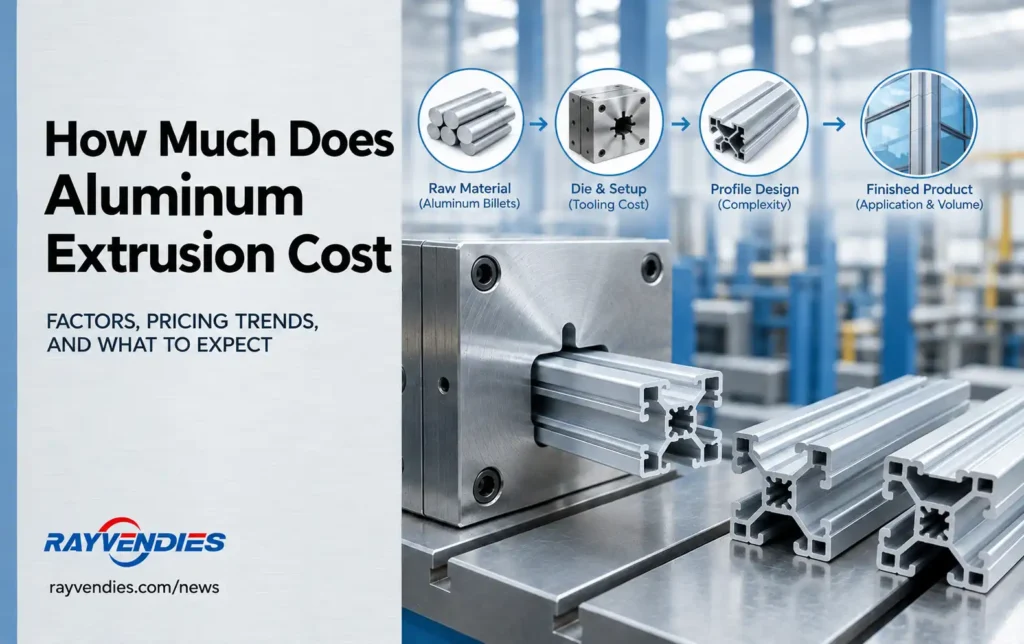
The Extrusion Manufacturing Process
How is a high-precision t-slot aluminum extrusions profile created?
- Billet Heating: Cylindrical aluminum logs are heated to approximately $400^\circ\text{C} – 500^\circ\text{C}$ ($750^\circ\text{F} – 900^\circ\text{F}$) until the metal becomes soft and malleable.
- Pressing: A heavy-duty hydraulic aluminum extrusion press forces the heated billet through a precision steel die containing the desired cross-sectional profile shape.
- Cooling & Stretching: The emerging profile (the extrusion aluminum length) is cooled using air or water quenches and stretched to relieve internal stress.
- Cutting & Aging: Profiles are cut to length and thermally aged in ovens to achieve temper hardness (e.g., T5 or T6).
How Surface Finishing Prevents Corrosion
To answer how to prevent aluminum corrosion, surface finishing is paramount:
- Anodizing: An electrochemical process that increases the thickness of the natural oxide layer. Anodized aluminum extrusions offer extreme scratch resistance, enhanced salt-air corrosion resistance, and beautiful aesthetic options like clear satin or black aluminum extrusion.
- Powder Coating: Applies a protective polymer resin layer baked onto the profile. Perfect for vibrant outdoor equipment and harsh chemical exposures.
- Chemical Conversion Coating (Chromate/Fluoride): Provides a conductive, corrosion-resistant base layer for secondary painting.
Real-World Applications of Modular Extrusion Systems
Because modular t slot aluminum extrusions eliminate the need for welding, they are used across virtually every modern industry:
1. Industrial Automation & Workstations
- Aluminum Extrusion Workbench & Aluminum Extrusion Table: Built using dynamic t slot aluminum framing, these industrial tables allow quick height adjustments, tool mounting, and overhead lighting integration.
- Aluminum Extrusion Frame Kits: Pre-engineered assembly kits for safety guards, machine enclosures, and cleanroom partitions.
2. Electronics & Additive Manufacturing
- Aluminum Extrusion for 3D Printer: High-precision profiles (such as 2020 aluminum extrusion) serve as rigid linear motion guide rails for 3D printers, CNC routers, and laser engravers.
- Aluminum Extrusion Enclosure: Protective housing units for electronics, server racks, and outdoor control boxes.
3. Specialty Hardware & Accessories
Modular framing relies on a complete ecosystem of aluminum extrusion parts and aluminum extrusion hardware:
- T Nuts for Aluminum Extrusion: Drop-in or roll-in threaded nuts that lock securely inside the T-slot.
- Aluminum Extrusion Brackets: Right-angle plates, gussets, and internal corner connectors for sturdy joints.
- Aluminum Extrusion Connectors: Hidden lock fasteners and knuckle joints for clean frame assembly.
- Aluminum Extrusion Slider: Low-friction plastic or linear bearing blocks designed to slide smoothly along extrusion channels.
- Aluminum Extrusion Rail: Precision-ground extrusions used for direct mounting of linear guide blocks.
Rayven: Your Trusted Partner for Premium Aluminum Extrusions
When choosing an aluminum extrusion supplier or searching for an aluminum extrusion company that delivers uncompromised quality, precision engineering, and durable corrosion resistance, Rayven leads the industry.
Why Choose Rayven?
- Unmatched Manufacturing CapabilitiesAs a premier aluminum extrusion manufacturer and global supplier, Rayven operates advanced aluminum extrusion machine technology and high-tonnage extrusion presses. Whether you need standard aluminum extrusions or complex custom aluminum extrusions, Rayven delivers tight tolerances and flawless finishes.
- Comprehensive Alloy & Profile SelectionRayven stocks an extensive catalog of extrusions aluminum products, ranging from architectural aluminum t slot extrusions and heavy-duty structural profiles to specialized architectural aluminum extrusions and high-strength aerospace aluminum extrusions.
- Full Customization & Precision FabricationLooking for reliable custom aluminum extrusion solutions? Rayven provides end-to-end aluminum extrusion services, including precision CNC machining, custom die design, tapping, mitering, and surface treatments. From high-grade clear anodizing to sleek black aluminum extrusion finishes, Rayven products resist corrosion in the toughest environments.
- Global Reach with Local ConvenienceStop searching online for a reliable aluminum extrusion near me, aluminum extrusions near me, 8020 aluminum extrusion near me, or searching endlessly through generic aluminum extrusion suppliers and aluminum extrusion companies. Rayven guarantees fast lead times, dependable delivery, and unmatched customer support directly to your facility.
Frequently Asked Questions (FAQ)
Does aluminum rust or tarnish over time?
Aluminum does not form red rust, but bare aluminum can tarnish or oxidize, turning from a shiny metallic sheen to a dull grey finish. Applying anodization from Rayven keeps your structural frames looking brand new for years.
Does aluminum rust or corrode faster when connected to other metals?
Bare aluminum can experience galvanic corrosion when directly touching dissimilar metals (like carbon steel or copper) in the presence of an electrolyte (like salt water). To prevent this, use stainless steel fasteners or isolating nylon washers with your aluminum extrusion frame.
What is the difference between an aluminum extrusion supplier and a manufacturer of aluminum extrusions?
A distributor or supplier resells stock profiles, whereas a true manufacturer of aluminum extrusions like Rayven controls the entire extrusion press process, alloy chemistry, die creation, custom finishing, and direct quality control.
Does aluminum rust?
No. Aluminum does not produce conventional iron rust. Instead, it rapidly forms a protective aluminum oxide layer when exposed to oxygen.
Does aluminum rust in water?
No. Water does not cause traditional rust on aluminum, although certain water chemistries can cause aluminum corrosion.
Does aluminum rust with salt water?
No, but salt water can accelerate corrosion, especially pitting corrosion caused by chloride ions.
Does aluminum rust in salt air?
No. However, airborne salt and moisture can create conditions that promote localized corrosion.
What does aluminum corrosion look like?
It may appear as white powder, gray discoloration, rough patches, stains, or localized pits rather than reddish-brown flakes.
Does aluminum rust or corrode?
Aluminum does not rust, but it can corrode through chemical or electrochemical reactions with its environment.
Does aluminum rust on cars?
Aluminum automotive components do not rust like steel, but they can oxidize, pit, or experience galvanic corrosion.
Does aluminum rust underground?
No. However, buried aluminum can corrode depending on soil moisture, pH, salts, conductivity, and contact with other materials.
Does aluminum rust in rain?
No. Aluminum generally performs well in normal atmospheric exposure, although pollutants and deposited salts can increase corrosion risk.
Does aluminum rust in a bathroom?
No. High humidity, water, cleaning chemicals, and trapped moisture can nevertheless cause surface corrosion or discoloration.
Does aluminum rust in pool water?
No, but pool chemicals and chloride-containing water can contribute to aluminum corrosion under unfavorable conditions.
Does aluminum rust faster than steel?
No. Aluminum does not rust. Steel can rust when iron reacts with oxygen and moisture, while aluminum develops a protective oxide layer.
Final Takeaway: Aluminum Does Not Rust, But It Can Corrode
So, does aluminum rust? No—not in the technical sense of iron-based rust.
Aluminum’s natural ability to form a thin, adherent, and protective oxide layer gives it excellent resistance to many everyday environments. This makes aluminum extrusion a practical material for industrial framing, machinery, architecture, transportation, electronics, workstations, and outdoor structures.
Nevertheless, aluminum is not corrosion-proof. Salt water, sea salt, chloride-containing environments, harsh chemicals, trapped moisture, and galvanic contact with dissimilar metals can damage the protective oxide layer and produce pitting, crevice corrosion, galvanic corrosion, or other localized degradation.
For this reason, selecting the right aluminum extrusion requires more than asking whether aluminum rusts. The alloy, profile geometry, surface treatment, hardware, drainage, environmental exposure, and maintenance requirements all need to be considered.
For standard profiles, modular T-slot systems, or custom aluminum extrusions, Rayven can help you evaluate the requirements and develop a solution around your actual application.
Elevate Your Next Project with Rayven Aluminum Extrusions
Whether your application demands weather-resistant outdoor framing, ultra-precise motion guide rails, or robust industrial workbenches, understanding how aluminum resists corrosion empowers you to make the smartest material choice. Bare aluminum never develops destructive red rust, and when paired with Rayven’s superior anodized surface treatments, your structures will easily withstand humidity, sea salt, rain, and demanding chemical environments.
Ready to upgrade your framing systems with industry-leading custom aluminum extrusions suppliers?
Click Here to Contact Rayven’s Engineering Team Today to request a custom quote, explore our complete product catalog, or discover how our precision aluminum extrusion solutions can bring your designs to life!