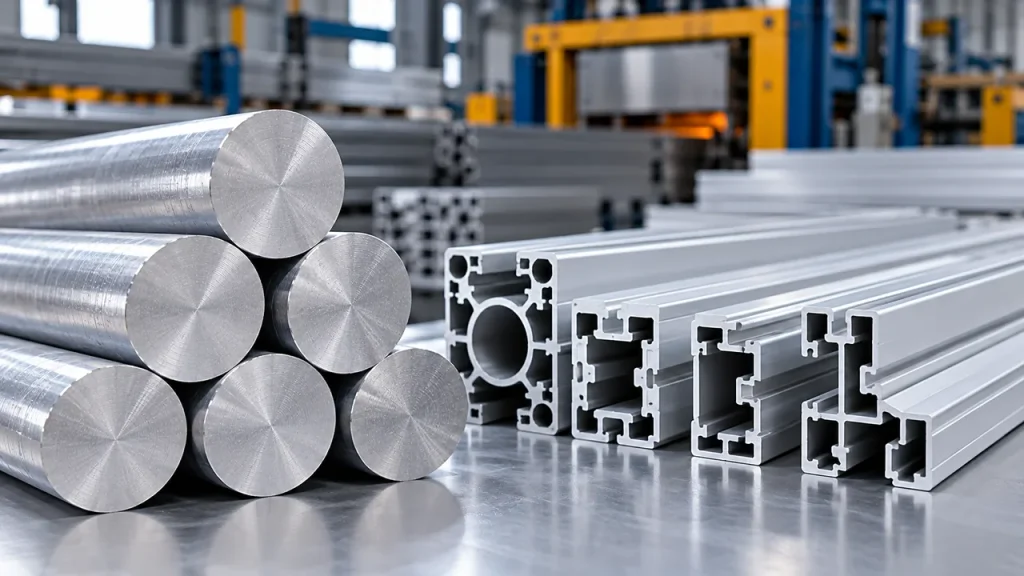
Aluminum extrusions are the shaped profiles that come out of a press when a heated aluminum billet is pushed through a steel die. The range of aluminum extrusion die applications runs from window mullions and solar mounting rails to the battery trays in electric vehicles, and most of the products involved are everyday objects rather than specialist hardware.
Extruded aluminum is used for any part that needs a constant cross section, low weight, and resistance to weather and corrosion: window and door frames, curtain wall mullions, railings, roof and solar mounting rails, vehicle crash structures and battery enclosures, heat sinks, LED lighting channels, machine frames, ladders, furniture trim, and consumer goods from bicycle frames to cookware. Building and construction takes the largest share of global demand, followed by transportation and electrical and electronic applications.
The sections below cover the industries that consume the most extruded profile, what drives the price, where the process runs into limits, and how to choose an alloy and section that will extrude cleanly.
What are aluminum extrusions?
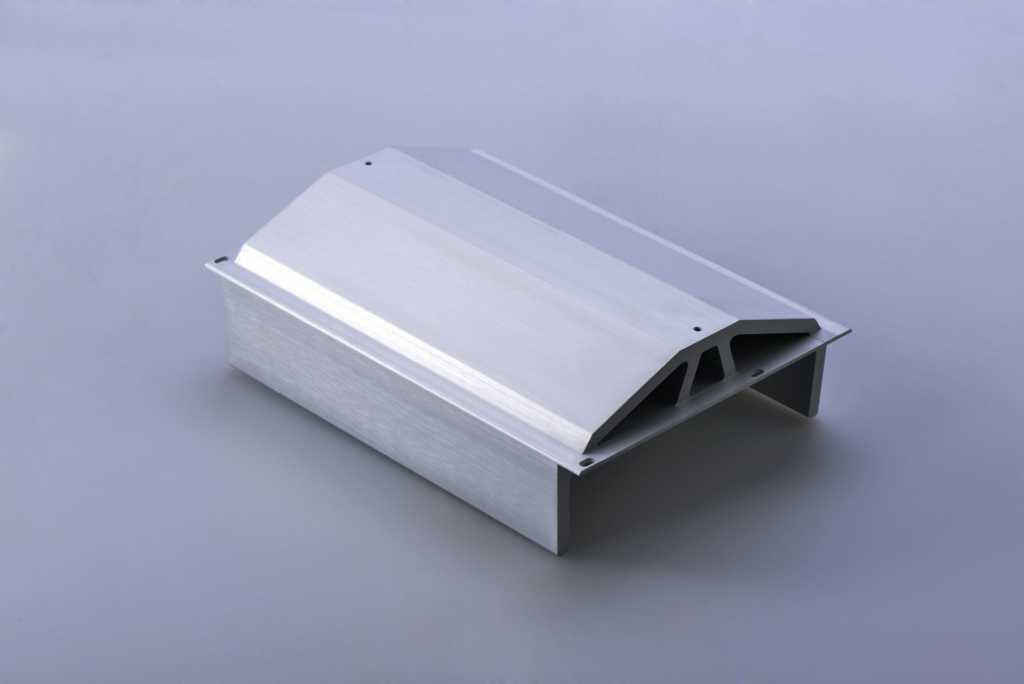
An aluminum extrusion is a length of aluminum with a fixed cross section, formed by forcing a heated billet through a shaped die opening. The profile holds the same shape from the first meter to the last, which makes the process fast and the tooling cheap compared with casting or machining. It is also the limit that decides where the part can be used.
Profiles come in three families. Solid profiles have no enclosed void and cover flat bars, angles, channels, and T-sections. Semi-hollow profiles partly enclose a void. Hollow profiles contain fully enclosed cavities, such as square tube and multi-void window sections, and need a different die construction because the metal must flow around a mandrel and rejoin without leaving a weak seam.
The alloy matters as much as the shape. 6063 is the architectural default because it extrudes easily and takes anodizing well. 6061 adds strength at some cost to surface finish and suits structural frames and transport parts. Temper matters too: 6063-T5 and 6061-T6 differ only by heat treatment, and soft material will not carry structural loads whatever the alloy name suggests.
How are aluminum extrusions made?
Extrusion runs continuously, and most of the sequence is finished within a day.
- The billet is cut to length and preheated, usually to between 450 °C and 500 °C.
- A hydraulic press pushes it through the die, and the profile emerges continuously.
- Air or water quenching sets the metallurgical condition.
- The profile is stretched to straighten it, then cut to the ordered length.
- T5 and T6 tempers come from artificial aging in an oven.
- Finishing follows: anodizing, powder coating, or fabrication such as drilling.
The tooling is the fixed variable. The press supplies force and speed, but the section geometry, the tolerance window, and the practical wall thickness all come from custom aluminum extrusion dies, which is why profile design and die design are usually settled together rather than in sequence.
What are aluminum extrusion profiles?
A profile is the shape of the cross section, and the market splits it into standard and custom. Standard shapes already exist as tooling: square and rectangular tubes, angles, T-slot framing sections, and common channel sizes. Because the die exists, there is no tooling charge, and lead time is short. Custom profiles are designed around one application, whether that is a window sash, a heat sink with a set fin pitch, or a battery enclosure frame.
Which industries use the most aluminum extrusions?
Building and construction is the largest consuming sector, followed by transportation and then electrical and electronic applications. The Aluminum Extruders Council groups demand into transportation, building and construction, infrastructure, consumer, industrial, healthcare, defense and aerospace, and energy (AEC industry overview).
The global aluminum extrusion market was estimated at $93.04 billion in 2025 and $101.12 billion in 2026, with a projected 9.07% compound annual growth rate to 2032 (360iResearch, September 2026).
| Sector | Typical extruded parts | Why the material is chosen |
| Building and construction | Window and door frames, mullions, railings, formwork | Corrosion resistance, finish quality, long service life |
| Transportation | Crash systems, battery enclosures, subframes, roof rails | Weight saving, energy absorption, stiffness per kilogram |
| Electrical and electronics | Heat sinks, enclosures, busbars, LED lighting channels | Thermal and electrical conductivity |
| Infrastructure | Bridges, platform structures, lighting columns | Low maintenance, weather resistance |
| Industrial machinery | Machine frames, guards, conveyor rails, workstations | Modular assembly without welding |
| Consumer and healthcare | Furniture, appliances, rehabilitation equipment | Finish, cleanability, weight |
Building and construction
Window and door systems, curtain wall mullions, sliding tracks, balcony railings, and roof edge trim depend on profiles that hold a tight section over a long span. Aluminum forms a protective oxide layer in air, so an outdoor profile does not need the repainting cycle a steel section does.
Automotive and transportation
Extruded parts appear in crash management systems, door beams, subframes, roof rails, and the frames around battery packs. Extrusion content in North American light vehicles roughly doubled over the decade to 2022, from about 25 lb to nearly 50 lb per vehicle (Aluminum Extruders Council).
Electrical, electronic, and heat sinks
Aluminum conducts heat well and electricity adequately at a fraction of copper’s weight and cost, which makes it the default for heat sinks, inverter housings, busbars, and lighting channels. Fin pitch, fin height, and base thickness are one cross section, so a single press pass replaces a machined or brazed assembly.
Renewable energy and solar
Solar mounting rails, module frames, tracker parts, inverter enclosures, and battery cabinet frames are almost all extruded, and they combine decades of outdoor exposure with predictable performance under wind and snow load.
Machinery, industrial equipment, and automation
T-slot framing, machine guards, conveyor side rails, robot bases, and assembly workstations make up the industrial side of the market. The draw is modularity: a frame built from a standard profile can be assembled, changed, and rebuilt without welding.
Consumer furniture and interior products
Kitchen cabinet trim, wardrobe rails, furniture legs, appliance trim, ladders, and luggage frames all use extruded sections. Finish does most of the work here, with anodising giving a scratch-resistant metallic surface and powder coating allowing colour matching across a furniture range.
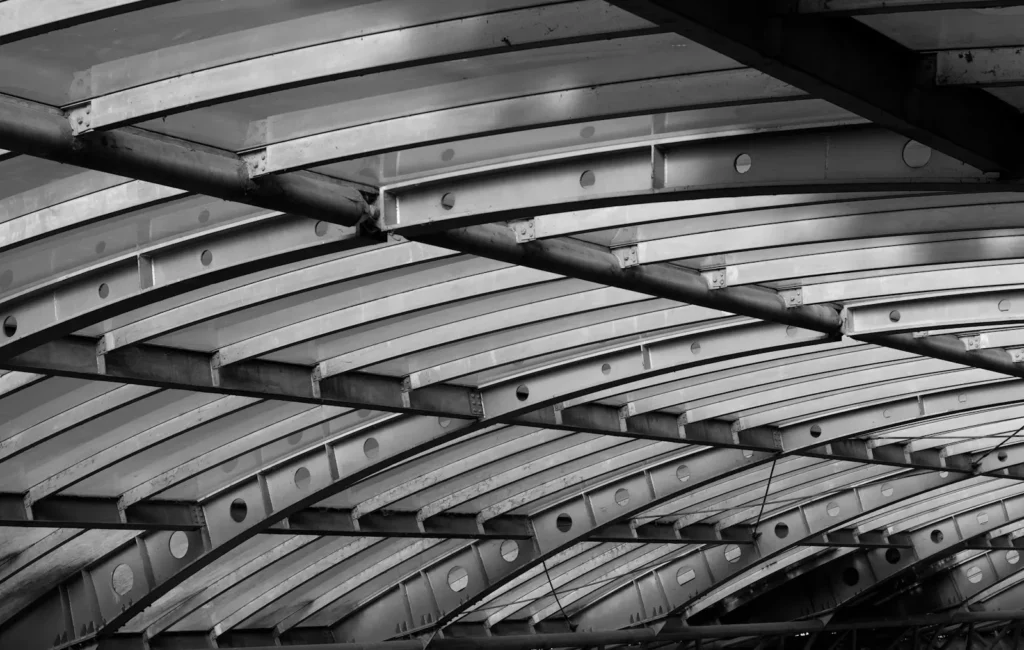
What are some examples of aluminum extrusions around you?
You probably do not have to leave the room to find several.
- At home: window frames, cookware, laptop bodies, and the heat sink inside a desktop computer.
- In a vehicle: roof rails, door sills, seat frames, battery cooling tubes.
- At work: T-slot machine frames, safety guards, conveyor rails, LED light fittings.
- Outdoors: solar panel frames, bus shelters, ladders.
Why manufacturers choose extruded aluminum over steel or plastic
Four properties do most of the work: weight, corrosion behavior, thermal performance, and the way one profile can replace several welded or machined parts.
Strength to weight: is extruded aluminum stronger than steel?
No, not in absolute terms, but common alloys do far better per kilogram, and the strongest ones exceed mild steel on specific strength.
| Material | Density (g/cm³) | Tensile strength (MPa) | Yield strength (MPa) | Elastic modulus (GPa) |
| 6063-T5 | 2.70 | 186 | 145 | 69 |
| 6061-T6 | 2.70 | 310 | 276 | 69 |
| 7075-T6 | 2.81 | 572 | 503 | 72 |
| A36 carbon steel | 7.85 | 400 | 250 | 200 |
Two readings matter. Aluminum is about one-third the density of steel, and every aluminum alloy sits at roughly one-third of steel’s elastic modulus, because stiffness cannot be heat treated. Swapping aluminum for steel in the same section will therefore deflect about three times as much. The fix is geometry: deeper sections, ribs, box shapes, and flanges raise the moment of inertia until the aluminum part matches the steel one at a fraction of the weight.
Corrosion resistance and surface finishes
Aluminum forms a thin, hard oxide layer within minutes of exposure to air, and that layer stops it rusting the way steel does. Anodizing thickens the layer electrochemically without adding a separate coating, which suits architectural and wear-exposed parts. Powder coating applies a polymer film with a wider color range and better UV stability outdoors. Both are chosen before the die is cut.
Conductivity, recycling, and part consolidation
Aluminum conducts heat at roughly half the rate of copper but weighs about a third as much, so it wins per kilogram of dissipated heat. That is why extruded heat sinks dominate electronics cooling.
It also recycles repeatedly without losing its properties, and remelting takes roughly 92% less energy than primary production (Aluminum Extruders Council). The quieter benefit is part count: because the die can carry screw ports, mounting slots, and cable channels in one section, an extrusion often replaces several parts and their fasteners.
What are the disadvantages of aluminum extrusion?
Two things cause most of the problems, and both can be planned for: the die comes before the part, and the section stays the same along the whole length.
| Limitation | What it means in practice | How it is handled |
| The cost and lead time come first. | Tooling is a one-off charge before a single profile exists, and it dominates unit cost on small runs. | Allow for it at the prototype stage, or use an existing die. |
| The cross section stays constant. | Undercuts, cross-drilling, and wall thickness that varies along the length cannot come from the die. | Build the feature into the section, or plan secondary machining. |
| Lower stiffness than steel | An identical section bends about three times as much. | Deepen the section, add ribs, or use a box profile. |
| Strength depends on alloy and temper. | Soft or unaged material will not carry structural loads. | Specify the temperature and ask for mechanical certificates. |
| Wall thickness and hollow complexity | Thin walls and multi-void hollows need a more complex die. | Keep walls uniform and confirm the minimum with the die maker. |
| Press capacity limits section size. | A wide circumscribed circle needs a bigger press than every supplier runs. | Check press tonnage before committing to a wide profile. |
| Exposure to metal price movement | Billet pricing is usually the largest line in a quote | Use an escalation clause on long projects. |
What drives the price of an aluminum extrusion?
There is no single price, because a quotation is a stack of separate costs. Two buyers asking for what looks like the same section can receive very different quotes, and the gap is usually in tooling, volume, or finishing rather than in the metal.
| Cost element | What it covers | Notes |
| Metal input | Billet price plus alloying additions | Tracks the exchange-traded aluminum price |
| Die tooling | The die plus backer and holder | One-off, amortized across the order |
| Extrusion run | Press time, energy, labor, and die wear. | Falls per kilogram as volume rises |
| Surface finish | Anodizing, powder coating, sublimation | Adds unit cost and lead time |
| Secondary operations | Cutting, drilling, machining, bending | Priced per operation, not per kilogram |
| Packaging and freight | Bundling, protection, transport | Driven by profile length rather than weight |
How is the cost amortized?
Tooling is a fixed charge, so its effect on the unit price depends on order size: one-time die cost divided by the total weight of the order. A 500 kg trial run and a 50-tonne production run share the same die, so the production order carries one hundredth of the tooling burden per kilogram. That ratio explains most of the gap between a prototype quote and a production quote.
What pushes the price up?
- Wall thickness that changes in steps, which forces slower press speeds.
- Tolerances tighter than the standard for the alloy.
- Multiple voids or an asymmetric section, which makes the metal flow unevenly and wears the die faster.
How to choose the right aluminum extrusion for your application
Work from the load and the environment toward the material, then the section, and only then the finish. In the other order, projects end up with a profile that cannot be extruded.
- Define the load case and the service environment: temperature, exposure to salt, and expected life.
- Select the alloy family. Extrudability, strength, and finish quality pull in different directions.
- Select the temper and confirm the mechanical values you are specifying.
- Sketch the section with uniform walls, and check the circumscribed circle against available press capacity.
- Set tolerances to a standard you can justify, since extra precision is a cost rather than a default.
- Decide the finish and the secondary operations before the die is cut.
| Typical use | Common alloy | Usual temper | Reason |
| Window, door, and architectural profiles | 6063 | T5 | Smooth surface, easy extrusion, anodizes well |
| Structural frames, brackets, transport parts | 6061 | T6 | Higher strength with good machinability |
| Welded structural assemblies | 6082 | T6 | Strength close to 6061 with better weld behavior |
| High-stress performance parts | 7075 | T6 | Highest strength of the group, with limits on welding |
| Heat sinks and thin-wall hollows | 6063 | T5 | Extrudability plus thermal conductivity |
Frequently asked questions
Can aluminum extrusions be bent, machined, or welded after extrusion?
All three are routine, with conditions. Bending works best in the softer tempers and with a generous radius, since a T6 section will often crack at a tight bend. Welding is reliable on 6061 and 6082 with the right filler alloy, while 7075 is generally treated as unweldable.
What is the difference between mill finish, anodized, and powder-coated profiles?
A mill finish is the raw surface from the press, with visible extrusion lines and no protection beyond the natural oxide layer. Anodizing grows an oxide layer out of the metal itself, giving a hard surface that suits decorative metallic finishes. Powder coating applies a polymer film in almost any color, with the best outdoor color consistency.
How do you tell whether a profile design is extrudable?
Look for a uniform wall thickness, no undercuts that the metal cannot flow around, a circumscribed circle within the available press capacity, and a wall thickness above the minimum for the die type. A hollow section with several cavities also needs balanced mass flow, or the profile will twist as it leaves the die.