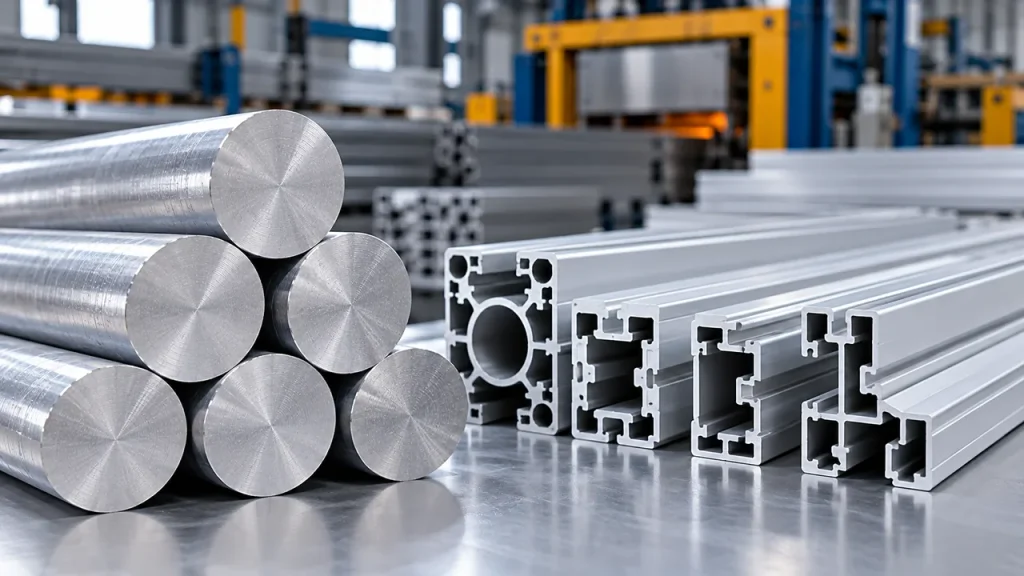
Most extrusion quotes arrive as a single price per kilogram, and that one number hides almost everything that decides whether the project works. A custom profile is not a stock bar cut to length. Its shape exists only because someone designed and cut a steel die first, and the quality of that die decides whether the finished profile comes out straight, within tolerance, and cheap enough to reorder. Buyers who cannot see where the money goes end up comparing suppliers on price alone, which is how a project pays twice for one die. Bringing a custom aluminum extrusion dies manufacturer in before the drawings are frozen is the cheapest way to avoid that.
Custom aluminum extrusions are made by pushing a heated aluminum billet through a shaped steel die. The die opening sets the cross-section, and every step after it exists to hold that cross-section straight, hard, and dimensionally stable until the profile reaches the customer.
The order of operations barely changes between suppliers, but the decisions inside each stage do, and that is where cost and quality are settled.

What makes an extrusion custom
A profile is custom when its cross-section does not exist until a die is made for it. Stock profiles run through dies that already exist and are shared across hundreds of customers. A custom profile gets its own die, cut to one cross-sectional drawing, and that die then runs for that part only.
The mechanics are the same in both cases. A cylindrical aluminum billet sits in a heated container, a hydraulic ram presses it forward, and the metal flows through the die opening at temperatures between roughly 400 °C and 500 °C. It leaves as a continuous profile whose cross-section matches the die. The difference between a commodity bar and a custom part is entirely in where the geometry comes from, which is why the die is the first cost, the first risk, and the first thing to get right.
Solid, hollow, and semi-hollow profiles
Extruders sort profiles by how much void the cross-section encloses, because that classification drives die construction and price.
| Profile type | The construction | Typical use | Relative tooling cost |
| Solid | One-piece die, no mandrel | Bars, angles, channels, trim, heat sink bases | Lowest |
| Semi-hollow | Die with a tongue that forms a partly open void; the tongue ratio has to stay low | Window tracks, handrails, glazing beads | Moderate |
| Hollow | Porthole or bridge die with a mandrel that forms an enclosed void, plus a weld chamber | Tubes, structural frames, sections with sealed internal chambers | Highest |
Hollow dies cost more for a physical reason. The mandrel that creates the internal cavity has to be held in place by legs, and the metal has to rejoin behind those legs before it leaves the die. That rejoining leaves a weld line in the finished profile, which is why die designers move weld lines away from visible faces and highly stressed areas.
How custom aluminum extrusions are made, step by step
The sequence is fixed: design and cut the die, preheat the billet and the die, extrude, cool or quench, stretch and straighten, cut to length, age to temper, finish, and inspect. What varies is how tightly each stage is controlled.
Designing and machining the die
Everything starts with a cross-section drawing. Die designers check wall thickness balance, tongue ratios, and void geometry before any steel is cut, because those features decide whether metal flows evenly or stalls in one part of the profile. The die is machined from hot-work tool steel and heat-treated, and hollow profiles need a matched pair: a mandrel plus a die cap. A profile that breaks the basic flow rules can still be extruded, but it will need longer setups, slower press speeds, or a die that fails early.
Preheating the billet and the die
The billet is cut from a longer log and heated to a plastic but not molten state. The die is heated into the same range so that the first metal through it does not chill on contact and tear. Temperature spread across the billet matters more than the set point on the panel. A cold spot produces harder metal that resists flow and pulls the profile out of shape.
The press stroke
The heated billet goes into the container, and the ram drives it through the die under thousands of tons of force. Metal takes the path of least resistance, which is why die designers spend so much effort balancing flow: thick sections run faster than thin ones, and when the difference is large, the thin walls starve. Press speed, billet temperature, and bearing length are tuned together for each profile, and the settings that worked for one shape rarely transfer cleanly to the next.
Cooling, stretching, and cutting
The profile leaves the die hot and is cooled on a run-out table, either by air fans or by water quenching. Air cooling suits profiles that will be aged to a moderate temper. Water quenching cools faster and supports higher strength tempers at the cost of more distortion. After cooling, the profile is gripped at both ends and stretched to straighten it and relieve internal stress. Then it is sawn to the ordered lengths.
Aging, finishing, and inspection
Aging is a controlled heat treatment that raises hardness to the specified temper, most often T5 or T6 for the 6000-series alloys used in extrusion. Finishing comes after. Mill finish stays bare, while anodizing, powder coating, or painting adds corrosion protection and appearance at extra cost. Inspection closes the loop with dimensional measurement, surface checks, and mechanical testing against the agreed standard.
Direct versus indirect extrusion, and why press tonnage matters
Two press arrangements are in use. In direct extrusion the billet sits in a stationary container, and the ram pushes it forward through a fixed die, so the metal slides against the container wall. In indirect extrusion the die moves toward a stationary billet, the metal flows in the opposite direction, and friction drops sharply.
That friction difference is not academic. Less friction means more even temperature from front to back, which produces smoother surfaces and tighter dimensional consistency, and it is why indirect presses are preferred for demanding work. The catch is that indirect presses are less common and generally built in smaller sizes, so large architectural or transport sections usually run on direct presses regardless.
What press tonnage decides
Tonnage sets the largest cross-section a plant can extrude and how much resistance the metal can overcome.
| Press size | Typical work |
| Under 1,500 tons | Small profiles, thin-wall tubes, heat sinks |
| 1,500 to 4,000 tons | Most commercial shapes: architectural and standard industrial profiles |
| Above 4,000 tons | Oversized and thick-wall profiles, high extrusion ratios |
Tonnage alone does not buy precision. A well-machined die on a smaller press holds tighter tolerances than a poorly balanced die on a larger one, because tolerance depends on die design and press stiffness together.
How to design an aluminum extrusion profile
Design settles most of the cost before any metal moves. The AEC design tips make the point bluntly: minor tweaks to a profile often deliver large gains in extrudability and, in turn, in price.
Wall thickness and balance
Uniform wall thickness is the most important rule. Metal flows at different speeds through thick and thin sections, so a profile with a heavy boss next to a thin web will twist, bow, or drift out of tolerance after cooling. Keep the ratio between the thickest and thinnest walls under roughly 2:1, and where a transition is unavoidable, taper it rather than stepping it. Very thin walls are also expensive, because they extrude slowly and tear more easily.
Symmetry, corners, and hollow sections
Symmetrical profiles extrude faster and straighter because pressure and cooling are even around the section. Where asymmetry is required, ribs and added wall thickness can rebalance the shape. Sharp internal corners concentrate stress in the die and cause surface defects, so internal radii start around 0.4 mm, and larger radii are better. Outside corners should be rounded slightly as well. Minimize hollow sections where a solid or semi-hollow shape will do the same job, and keep tongue ratios low, since a long, thin tongue is the most common cause of die breakage.
What drives the price of a custom extrusion?
A custom quote carries two separate numbers: a one-time tooling charge for the die and a recurring per-kilogram running cost for each order. Buyers get into trouble when they compare quotes without separating the two, because a low running rate paired with an expensive die can cost more over the life of a program than the reverse.
| Cost component | What it covers | Behavior |
| Raw aluminum | Billet at market price | Largest single line; moves with the metal market |
| Extrusion processing | Heating, pressing, cutting | Falls per kilogram as volume rises |
| Tooling | Die design and machining | One-time, amortized across the run |
| Surface treatment | Anodizing, powder coating | Adds cost per unit and per square meter |
| Secondary operations | Drilling, machining, bending | Billed on top of the extrusion |
| Freight and packaging | Packing, shipping, duties | Rises with length and order weight |
Tooling and die cost
Tooling is the one charge that does not recur on a reorder. A simple solid die costs far less than a multi-void hollow die, and the gap widens with each internal chamber added. The cost also spreads across volume: the same die amortized over ten thousand pieces contributes a fraction of what it contributes over a hundred. This is the main reason small orders look expensive per piece even when the running rate is competitive.
Why extruded aluminum gets expensive
Extruded aluminum looks costly for four reasons, and only one of them is the metal itself. Raw aluminum is priced on a global commodity market, and no extruder controls that. Complexity raises die cost and running cost together, because hollows, thin walls, tight tolerances, and large cross-sections all slow the press and increase scrap. Low volume leaves the tooling charge concentrated on too few parts. Finishes and secondary machining add cost on top of the extrusion, and specifying a heavier finish than the application needs inflates the unit price without improving performance. Bringing the extruder in during design, rather than after the drawing is locked, is the most reliable way to control all four.
Where extruded aluminum profiles are used
Extruded profiles appear wherever a section has to be light, stiff, corrosion resistant, and repeatable. The list is long, but it clusters around a few well-known categories.
| Sector | Typical profiles |
| Building and construction | Window and door frames, curtain wall, handrails, louvres |
| Transportation | Chassis and body components, battery enclosures, roof rails |
| Electronics and power | Heat sinks, enclosures, mounting rails |
| Renewable energy | Solar module frames, mounting structures |
| Furniture and interiors | Cabinet frames, handles, trim, shelving |
| Industrial equipment | Machine frames, conveyors, guard rails, workstations |
The appeal is the same in each case. One die produces thousands of identical metres at consistent dimensions, and features such as screw ports, gasket channels, and stiffening ribs come out with the profile instead of being machined in later. For a buyer scoping a new part, the aluminum extrusion applications behind these sectors show how much assembly work can be designed into a single section, which is often the difference between a product that carries its cost and one that does not.
FAQ
How long does it take to make a custom extrusion die?
The design and machining usually run two to four weeks for a straightforward solid profile. Hollow dies take longer because the mandrel and the die cap have to be matched and trialled together. Add a sample approval cycle on top of that, and expect complex profiles to need more than one trial correction before the die is signed off for production.
What is the minimum order quantity for a custom extrusion?
Most extruders set a minimum weight per profile rather than a minimum piece count, and the threshold exists to cover setup time. Swapping a die, an alloy, or a color costs production hours that have to be recovered somewhere in the order. Smaller runs are often accepted, but the per-kilogram price rises to absorb the same setup.
Can a custom extrusion be machined after it is extruded?
Yes, and planning for it early saves money. Features that are difficult to extrude, such as fine internal threads or deep cross-drillings, are usually cut after extrusion by CNC machining, drilling, or tapping. Leaving extra material where those features will go and choosing an alloy and temper that stay machinable keeps the secondary operations simple.