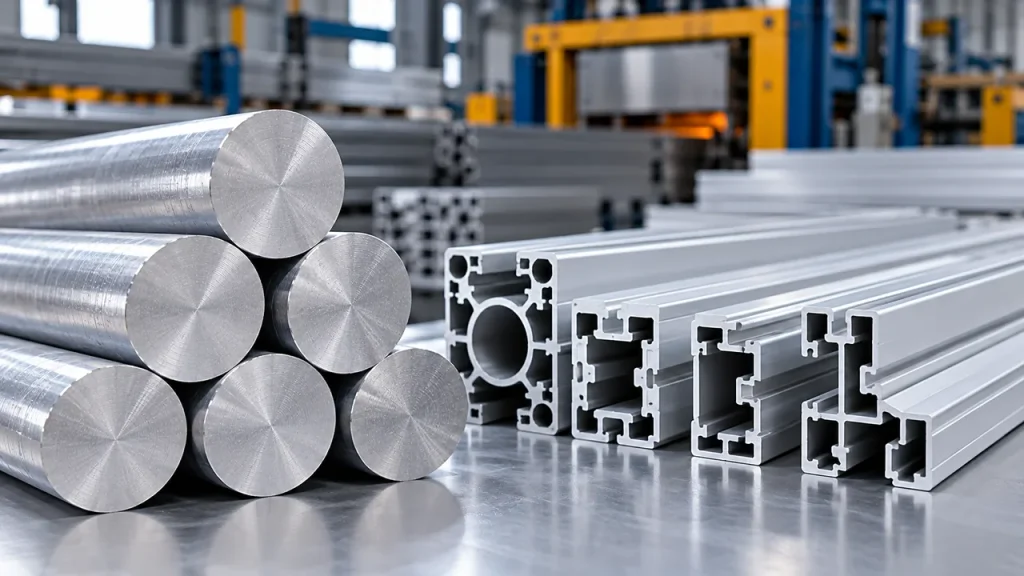
Aluminum extrusion disappears into the product. A heated billet goes through a steel die, comes out as a long profile with the same cross-section along its length, then gets cut, machined and finished. If you are sourcing a profile, the useful question is not whether extrusion works but which sectors already buy it, at what specification, and what that does to price.
Eight sectors account for most industrial demand: building and construction, transportation, renewable energy and electrical equipment, industrial machinery, consumer electronics and appliances, building interiors and furniture, marine, and aerospace and medical equipment. Construction buys the most tonnage, transportation is growing fastest, and aerospace and medical pay the highest price per kilogram. What separates them is not the press but the custom aluminum extrusion dies each sector depends on.
The differences come down to three things: what the profile has to do, which alloy and tolerance the job needs, and what that combination costs.

Where aluminum extrusions show up in industry
Most global extrusion output goes into buildings, vehicles and energy hardware, with machinery, electronics, interiors, marine and medical work taking the rest.
| Sector | What the profile does | Common alloys | Demand character |
|---|---|---|---|
| Building and construction | Window and door frames, curtain wall mullions, shading, formwork | 6063, 6060 | Highest tonnage, price-led |
| Transportation | Battery enclosures, crash systems, body structure, railcar framing | 6005A, 6082, 6061 | Fastest growth, specification-led |
| Renewable energy and electrical | Solar module frames, mounting rails, busbars, heat sinks | 6063, 6101, 1350 | Policy-driven, long runs |
| Industrial machinery | Machine frames, conveyors, guards, workstations | 6063, 6061 | High mix, short runs |
| Consumer electronics and appliances | Heat sinks, enclosures, chassis parts | 6063, 6061 | Tight finish specs |
| Building interiors and furniture | Cabinet systems, LED channels, partitions, retail fittings | 6063 | Decorative finish |
| Marine | Hull framing, railings, masts, gangways | 5083, 6082 | Corrosion first |
| Aerospace and medical | Seat tracks, structural members, bed frames, trolleys | 7075, 2024, 6061 | Low volume, high specification |
That covers most of what aluminum extrusion is used for, but it hides the split between volume and value. Tonnage concentrates. Building and construction takes roughly half of global extrusion consumption and transportation around 18 percent, according to a 2025 market outlook from AL Circle, which also puts Asia Pacific at about 74 percent of demand and China at 66 percent of global use in 2023.
North America reads differently. The Aluminum Association estimated US and Canadian aluminum demand at 26.65 billion pounds in 2025, up 0.8 percent, while demand for extruded products fell 3.1 percent (Aluminum Association, checked 19 October 2026). New orders were still ahead of 2024 through November, so the fall reflects shipments rather than design activity.
Why the extrusion process serves all of them
Extrusion is cheap per metre because the die is paid for once and the cross-section never changes, which is why sectors with different requirements can share one process. What differs is die geometry, alloy, temper and secondary machining.
The aluminum extrusion process runs in five steps:
- A cast billet is preheated, typically above 375°C and in some cases to 500°C.
- The die is preheated to a matching temperature.
- A hydraulic press, from about 100 to 15,000 tonnes, pushes the billet through the die.
- The profile is quenched, stretched to straighten it, and cut to length.
- It is aged to the required temper, then finished or machined.
What a die can and cannot shape
A die can produce a solid profile, a hollow one, or a semi-hollow section with a narrow opening. Hollow profiles come from porthole or bridge dies, where metal splits around a mandrel and rejoins downstream. Multi-port dies let one press stroke produce two identical profiles, spreading die cost across more metres.
A die cannot change section along the length. Undercuts, closed cavities and abrupt wall thickness changes push the design toward machining, and sharp internal corners wear faster than radiused ones. The die also sets the tolerance class: commercial tolerance suits window frames and cable trays, while structural and automotive work moves to tighter classes at a clear price step.
Alloy choice by sector
The 6xxx series does most of the work. Alloy 6063 is the default for architectural and heat sink profiles because it extrudes fast and takes a good anodized finish. Alloy 6061 carries more strength and machines well, which suits brackets and machinery. Alloys 6082 and 6005A appear in automotive structures where crash behaviour matters. The 5xxx series, notably 5083, is chosen for marine work because it resists saltwater. Aerospace parts can move to 7075, and 1350 from the 1xxx series is used for busbars where conductivity matters more than strength.
Building and construction
Construction is the largest extrusion market by a wide margin, and almost all of that volume goes into fenestration and façade systems.
Fenestration and curtain wall
A modern curtain wall is a kit of extrusions. Mullions carry wind load, transoms carry glass, and pressure plates and covers close the system. One die can run for years, and the fabrication shop can cut, punch and assemble without welding in most cases. Thermal movement, drainage and glass bite are designed into the cross-section rather than added later.
Thermal break and finish specifications
Aluminum conducts heat, which is a problem in both cold and hot climates. The fix is a thermal break: the profile is extruded in two pieces and joined with a polyamide strip, rolled in or poured and debridged. Energy codes in Europe and North America require it for most new fenestration.
Finish matters as much as alloy. Anodizing gives a metallic look and abrasion resistance, powder coating gives colour range and a thicker film, and specifications state the type, film thickness and colour standard.
Automotive and transportation
Transportation is the fastest-growing extrusion market, and the growth sits in electric vehicles and crash structures. A DuckerFrontier study for the Aluminum Association’s Aluminum Transportation Group projected light-vehicle aluminum content at 514 pounds by 2026, up 12 percent from 2020, and 570 pounds by 2030.
EV battery enclosures and crash structures
Battery packs need a stiff, sealed box that protects cells in a crash without adding mass. Extruded side rails, cross members and base plates are a common answer, because the section can carry internal ribs and cooling channels in one piece. Crash systems use extruded beams that crush progressively.
Die design usually develops alongside the vehicle structure, since wall thickness, corner radii and alloy interact. Suppliers who make automotive extrusion dies for this sector typically work from a structural target rather than a finished drawing.
Rail, trailer and commercial vehicles
Railcars use extruded profiles for sidewalls, floor planks and roof sections, and trailer builders use them for side posts, flooring and body rails, where weight savings turn into payload. Both want long, straight profiles with consistent wall thickness.
Renewable energy and electrical infrastructure
Solar is the largest extrusion application in the energy sector, and aluminum frames still dominate the module market. Industry cost breakdowns put the frame at roughly 10 to 15 percent of module cost, second only to the cells, and aluminum frames held about 82 percent of photovoltaic frame market value in 2025.
Solar frames and racking
Module frames have to be light, stiff enough for wind and snow load, and corrosion resistant for 25 years outdoors. Extrusion handles all three, and corner keys and mounting grooves are formed into the section. Rooftop racking uses similar profiles for rails and clamps. Utility-scale ground mounts often use galvanized steel instead, so the aluminum share runs higher in rooftop work.
Busbars, heat sinks and power electronics
Electrical work uses extrusion for conductivity and heat. Busbars in the 1xxx series carry current with low resistance. Heat sinks use 6063 because the fins are extruded as part of the body, which removes a bonding step. Inverter housings, charging station frames and data centre containment draw on the same family of profiles.
Industrial machinery and automation
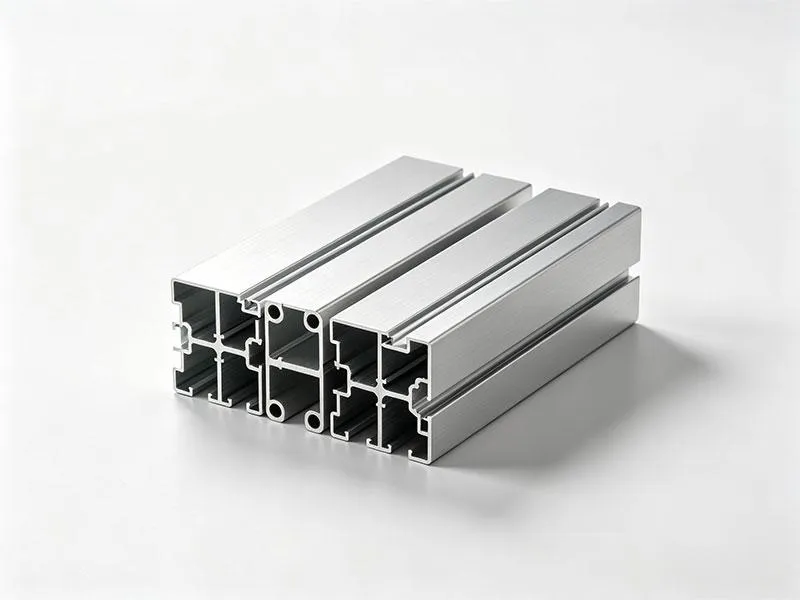
Machine builders use extrusion because it lets them assemble a frame in hours instead of fabricating one in days. T-slot aluminum extrusion profiles, with a groove on each face, accept nuts and brackets anywhere along the length, so a guard or a sensor mount can be added without drilling.
Modular framing versus welded steel
Welded steel wins on stiffness and damping, and still does for heavy cutting machines. Extruded frames win on speed, adjustability and finish. A typical automation cell uses extrusion for the perimeter guard, the control cabinet frame and the fixture, and steel only where the load path demands it.
Consumer electronics, appliances and interiors
Electronics and interiors use extrusion for surface quality as much as structure. A laptop chassis, a television bezel and a kitchen cabinet frame have little in common mechanically, but all three need a clean, repeatable profile.
Thermal management
Extruded heat sinks remain the cheapest way to move heat off a component. The fins are part of the extrusion, so there is no interface resistance between fin and base. At higher power densities it gets machined or replaced with a skived part, but extrusion covers most consumer electronics.
Interiors, furniture and retail fit-out
Cabinet systems, wardrobe frames, LED channels, partition profiles and retail fittings are almost all extruded. The finish carries the design intent: anodized for a metallic look, powder coated for colour, increasingly wood-effect for furniture. Tolerances are moderate, but surface defects are not, because the profile stays visible.
Marine, aerospace and medical work
These three sectors buy small volumes at high prices, and the specification follows from the consequences of failure rather than cost per metre. Each one narrows the acceptable alloy, temper and inspection regime.
Marine
Saltwater attacks aluminum differently from fresh water, and 5083 is the usual choice for hulls, decks and superstructures because it resists corrosion and stress cracking in welded joints. Anodizing and paint add barrier protection, and profiles appear in railings, masts, gangways and window frames, where weight above the waterline matters.
Aerospace and medical
Aerospace uses 7075 and 2024 where strength-to-weight decides the design, with traceability requirements that add cost at every step. Medical equipment sits between aerospace and general industry: bed frames, trolleys and wheelchair components need strength, low weight and surfaces that tolerate repeated disinfection. The finish, not the alloy, is usually the harder specification to meet.
What drives aluminum extrusion price in each sector
There is no standard extrusion price, because a quote combines metal, conversion, tooling and finishing, and each moves differently by sector. Two buyers with similar profiles can see very different numbers depending on volume, tolerance and who owns the die.
| Cost driver | How it moves the quote | Where it bites hardest |
|---|---|---|
| Billet price and regional premium | Passed through, usually with a lag | Construction, where margins are thin |
| Press size needed | Larger presses cost more per hour | Wide profiles, large battery enclosures |
| Die cost and amortisation | Fixed cost spread over order volume | Low-volume machinery and marine work |
| Alloy | Higher-strength grades extrude slower | Aerospace, automotive structures |
| Tolerance class | Tighter limits mean slower runs and more inspection | Medical, aerospace, precision machinery |
| Surface finish | Anodizing and powder coating add handling and yield loss | Interiors, consumer electronics |
| Secondary operations | Cutting, machining, bending, welding | Automotive, machinery |
Billet is the largest line and tracks the metal market. Conversion is where suppliers compete. The cost is the item buyers most often misread: a die has a finite life, and whether it is charged separately, amortized into the piece price or owned by the customer changes the comparison.
To compare quotes, send a drawing with alloy, temper, tolerance class, finish, annual volume and service life, and ask for die and piece price separately.
FAQ
Can the same profile be used in more than one industry?
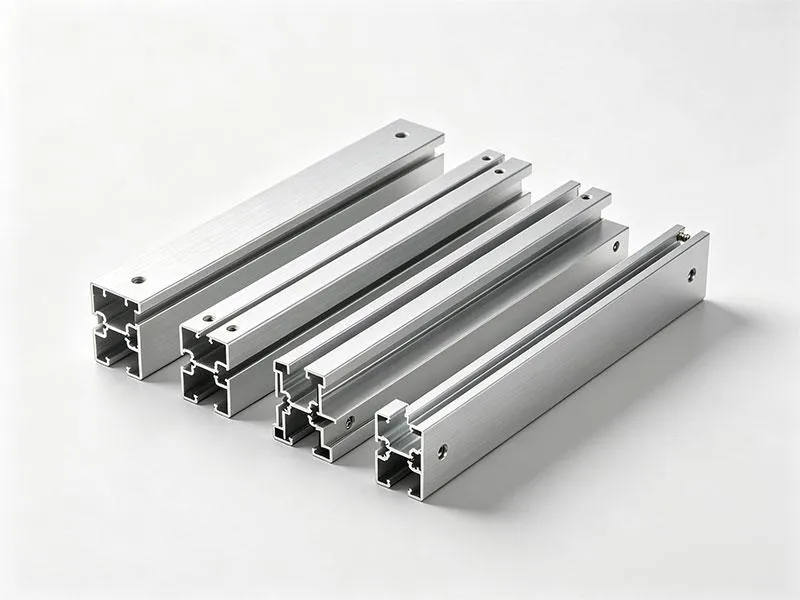
yes. A standard T-slot section sold to machine builders also works for retail fixtures and solar mounting. What changes is the alloy, the temper and the finish, not the geometry. The constraint is certification: a profile accepted for a machine frame will not pass automotive or medical documentation without a different inspection regime.
Is extruded aluminum strong enough for structural use?
It can be, but strength is only half the calculation. Deflection usually governs, because aluminum’s modulus is about a third of steel’s. A 6082-T6 or 6005A-T6 section carries a serious load in compression and bending. The question is whether the section is deep enough to limit deflection.
How does extrusion compare with casting or machining for the same part?
Extrusion wins when the part has a constant cross-section and needs to be long. Casting wins when the shape changes along its length. Machining wins at low volume or when tolerances are tighter than extrusion can hold, and it often follows extrusion to add features. The crossover depends on volume and tooling cost.